
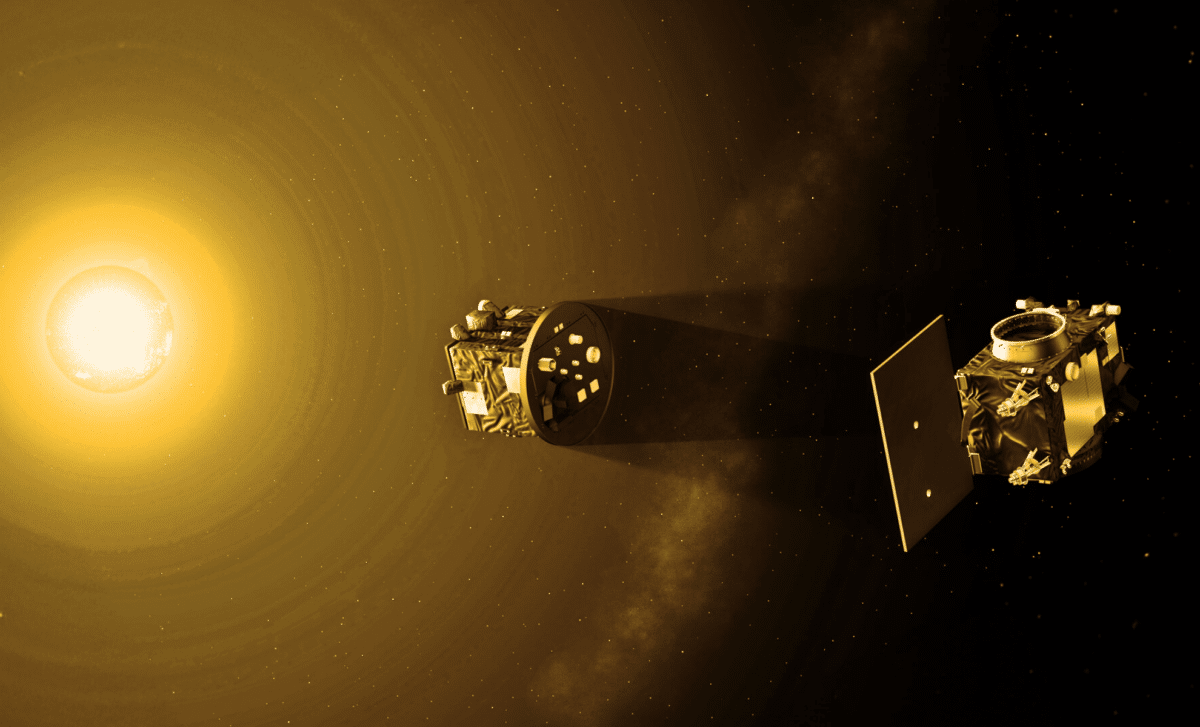
ESA’s Proba-3 mission has delivered a breathtaking new perspective on the Sun’s inner corona, capturing rare solar prominence eruptions with unprecedented clarity. Using two spacecraft flying in perfect formation, scientists have managed to simulate artificial eclipses in orbit, unlocking a region of the Sun that has long remained shrouded in mystery.
A Breakthrough In Solar Observation
The European Space Agency (ESA) has pushed the boundaries of solar research with its latest technological achievement: Proba-3, a dual-satellite mission designed to explore the most elusive part of the Sun’s atmosphere. This groundbreaking setup uses one spacecraft to block the Sun’s bright disc, allowing the second to observe the faint glow of the corona, a feat previously only possible during total solar eclipses on Earth.
 [Image description: This is a gif animation made up of false-colour images taken by ESA’s Proba-3 mission and NASA’s Solar Dynamics Observatory. Against a dark background, the Sun’s disc is shown in dark orange, as captured by NASA’s Solar Dynamics Observatory. A thin halo of yellow light surrounds the Sun, giving it a luminous outline against the dark background of space. This yellow outline shows the Sun’s inner corona, as captured by Proba-3. Also in yellow, three solar prominence eruptions are visible, resembling bright yellow wave-like outburst extending outwards from the Sun. First, we can see a smaller one in the top right corner, followed by a larger one in the top left and a third one in the bottom right. The whole animation lasts about 4 seconds and plays in a loop.]Credit: ESA
By synchronizing their positions with extreme precision, the two satellites created a sustained eclipse effect in orbit, allowing the ASPIICS coronagraph to observe the corona continuously and in detail. The result is a spectacular animation revealing the Sun’s dynamic atmosphere in shades of deep orange and soft yellow, captured in collaboration with NASA’s Solar Dynamics Observatory (SDO).
These images not only show the Sun’s surface but also unveil the inner corona, a region crucial to understanding solar activity, space weather, and how energetic particles travel through the solar system. The ESA mission represents a monumental step forward for heliophysics, enabling scientists to capture data that bridges the gap between previous missions like SOHO and Parker Solar Probe.
The Fiery Heart Of The Corona
“The corona is extremely hot, about two hundred times hotter than the Sun’s surface,” explains Andrei Zhukov from the Royal Observatory of Belgium, Principal Investigator for ASPIICS. The corona’s temperature can soar to millions of degrees, even though the surface beneath remains relatively cooler, a paradox that continues to challenge scientists.
Zhukov and his team observed the Sun during a highly active period on September 21, 2025, when three distinct prominence eruptions occurred within just five hours. “Sometimes, structures made of relatively cold plasma (charged gas) are observed near the Sun – although these are still around 10 000 degrees, they are much colder than the surrounding million-degree hot corona – creating what we call ‘a prominence’,” he notes. These prominences appear as looping, flame-like structures that can expand outward and sometimes erupt, ejecting plasma into space.
The Proba-3 mission’s ability to capture three such eruptions in such a short window is nothing short of remarkable. “Seeing so many prominence eruptions in such a short timeframe is rare, so I’m very happy we managed to capture them so clearly during our observation window,” adds Zhukov. These observations help scientists better understand the Sun’s magnetic fields and the processes driving solar storms, events that can affect satellites, power grids, and communication systems on Earth.
A New Era Of Solar Science
The animation produced by Proba-3’s ASPIICS coronagraph offers a unique combination of data from different instruments. It merges the inner solar corona observed in yellow light with data from NASA’s Atmospheric Imaging Assembly (AIA), which captures the solar disc in dark orange. This blending of spectral lines, including those emitted by helium atoms, produces an image similar to what the human eye would perceive during a total solar eclipse.
Beyond its stunning beauty, this dataset is scientifically invaluable. The faint yellow glow surrounding the Sun is the result of visible light scattering from the Sun’s surface onto coronal electrons, a phenomenon that helps scientists trace the movement of solar material and energy. With these insights, researchers can refine their models of solar activity and improve predictions of geomagnetic storms that affect Earth’s technological systems.
ESA’s Proba-3 mission, licensed under CC BY-SA 3.0 IGO, exemplifies international collaboration and innovation. It bridges the observational gap between the Sun’s surface and its outer atmosphere, allowing researchers to piece together a more complete picture of our star’s complex dynamics.