
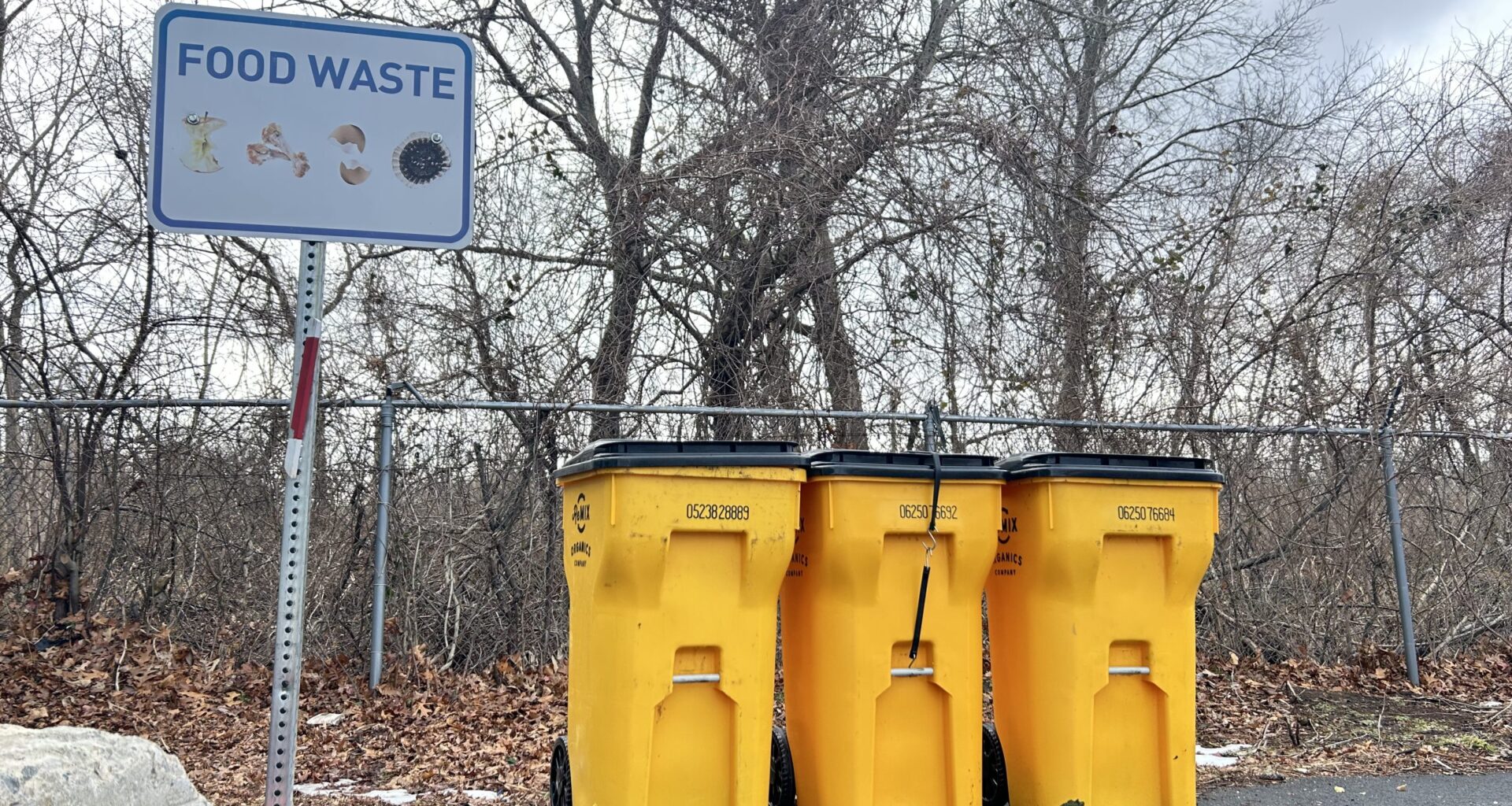
Multiple days a week at the New Bedford Waste and Recycling Center on Shawmut Avenue, New Bedford recycling coordinator Jessica Caban staffs the three banana-yellow bins labeled “Food Waste.”
In a few days’ time, the bins will be filled to the brim with vegetable peels, apple cores, onion skins, chicken bones and the like before being carted off to the nearest composting facility or anaerobic digester, Caban said. A resident pulls up to the station with his own bucket of scraps and hands Caban his license.
“You don’t have to show me your ID,” Caban assured him. “I’ve seen you around before.”
In November, the city launched a partnership with Providence-based ReMix Organics to allow residents to drop off their food scraps in bins during recycling center hours. The program is currently a gentle push to reduce and repurpose food waste that would otherwise go to a landfill or incinerator — but it could soon turn into a shove.
By 2030, the Massachusetts Department of Environmental Protection is expected to ban all food scraps in municipal trash. New Bedford officials say the city — and most communities in the state — aren’t ready.
“I don’t think it’s realistic,” Caban said. “Personally, I think they’re going to have to push it back because the infrastructure isn’t there yet.”
Nearly a quarter of Massachusetts household trash is food waste. In a state that is already increasingly exporting its trash as landfill space tightens, 160 communities have already adopted some form of food waste collection program to increase landfill capacity and lower hauling fees.
Fourteen communities, including Boston, Cambridge, and Medford, have rolled out municipal curbside compost programs to help make composting as easy as taking out the trash. Other communities like Newton and Dartmouth have launched partnerships with private companies offering curbside service to encourage residents to adopt the practice.
Lower-income cities like New Bedford, however, have struggled to set up either taxpayer-funded or private curbside composting programs — leaving money and scraps on the table. According to Caban, the city can’t afford to fund a program, residents can’t or won’t pay for a private service, and communities in similar positions must all compete for the same limited pot of grant money.
“We’re stuck between a rock and a hard place,” Caban said.
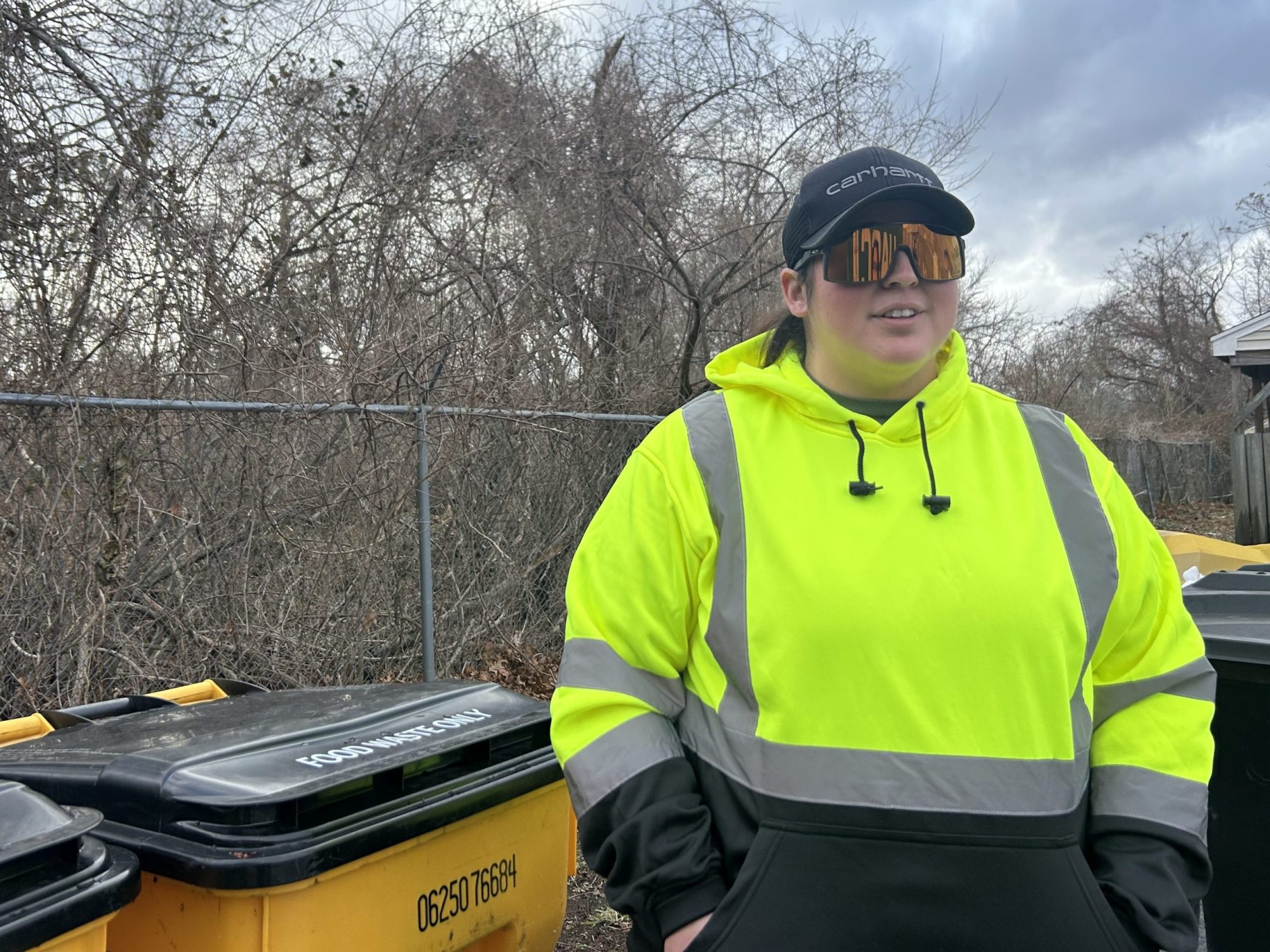 When she’s not manning the recycling center, Jessica Caban is in frequent talks with city leaders about the future of New Bedford’s waste. Credit: Brooke Kushwaha / The New Bedford Light
The future is food waste
In 2023, Massachusetts communities reportedly diverted over 20,000 tons of food scraps from landfills or incinerators through food waste collection programs, not counting households with their own backyard compost. By 2030, MassDEP aims to divert 780,000 tons of household food waste from the regular waste stream annually.
The ambitious goal comes as more and more Massachusetts cities have to export their waste out of state as landfill space tightens, driving up hauling costs. The Crapo Hill Landfill, which serves both Dartmouth and New Bedford, has an estimated life span of just 13 more years, after which point the region will have to pay more to export its trash elsewhere.
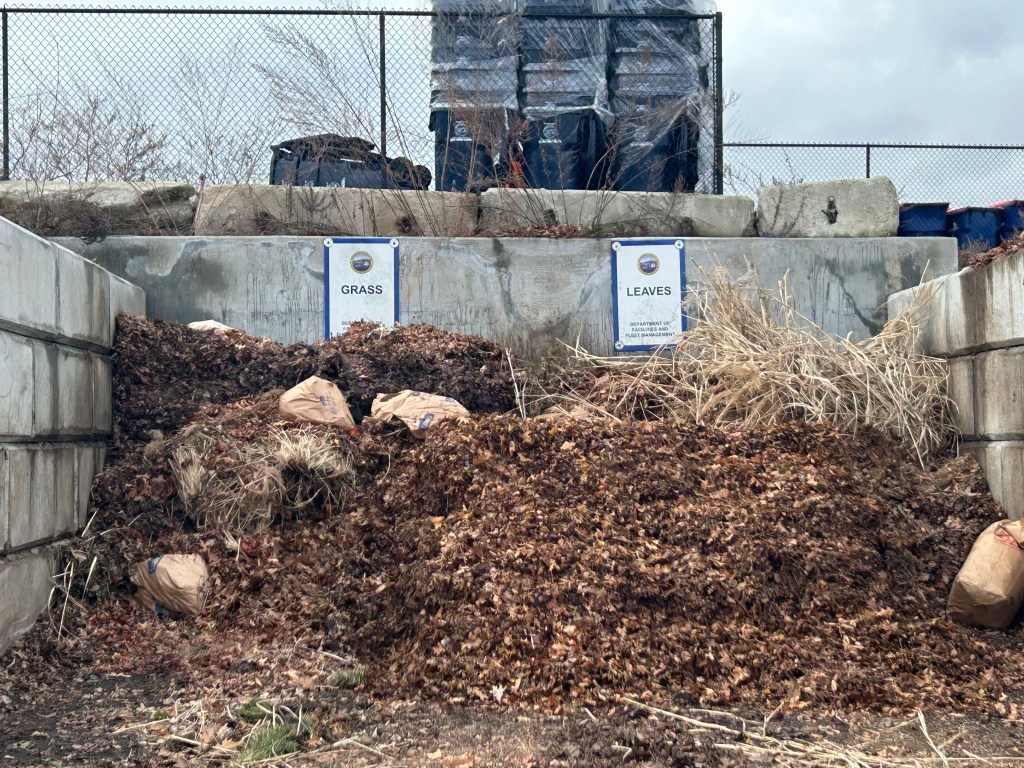 The Crapo Hill Landfill currently only has the capacity to compost leaf and yard waste. Credit: Brooke Kushwaha / The New Bedford Light
Kirstie Pecci, the CEO and president of Just Zero, an environmental advocacy group that promotes zero-waste policies, said the new regulation is decades in the making. Since 2014, MassDEP has regulated the amount of food waste commercial operators can throw in the trash, although this would be the first limit on residential food waste.
“The best way to solve a landfill problem is to put as little in the landfill as possible,” Pecci said. “And right now, in every state in the country, somewhere between 25 to 33% of what goes into the landfill by weight is food and yard waste.”
New Bedford has offered a food waste drop-off program at the recycling center on Shawmut Avenue since 2022. In that time, the amount of food waste the center receives has roughly doubled—from 50 to over 100 gallons collected per week, Caban said. In 2025, the recycling center collected 20,616 pounds of food scraps and sold 116 backyard compost bins to residents.
New Bedford Public Schools has also composted its food waste since 2021, diverting 67 tons of scraps in 2025.
But even with more robust participation, Massachusetts communities will need to do much more to comply with MassDEP’s upcoming regulations. Anthony Novelli, the executive director of the Greater New Bedford Regional Refuse Management District, which operates the Crapo Hill Landfill, said the district is exploring the landfill’s long-term operations, including a possible on-site composting facility, although nothing is certain yet.
“If they were to ban all municipal food waste across the state, I don’t think there’s enough composting or facilities in the state to handle that much food waste at this point,” Novelli said.

Learn more
New Bedford Food Waste Drop-off Program
Where: New Bedford Recycling Center, 1103 Shawmut Ave.
When: Monday, Wednesday, Friday: 11 a.m. to 4 p.m. and Saturday: 7:30 a.m. to 3 p.m.
For that reason, Novelli said much of the district’s outreach efforts revolve around reducing food waste in the first place by encouraging reuse and responsible shopping. On a broader scale, organizations like Just Zero and the Marion Institute, a local nonprofit, also work to prevent food waste through practices like gleaning (combing local farms for spare crops) and coordinating food donations from farms and restaurants.
But one day soon composting will have to become trash day de rigueur, Pecci said, and it’s up to each community to help residents get there.
“Change takes time, it’s habits, it’s all those pieces,” Pecci said. “Eventually, it’ll become second nature to people that ‘Of course, you don’t put your food in the trash. Who would do that? That’s crazy.’”
Thinking outside the bin
Of the 160 Massachusetts communities with a food waste collection program, 82 have a drop-off program like New Bedford’s. A select few have started to collect food scraps curbside with their regular trash pickup.
In 2018, the City of Cambridge launched its citywide municipal composting program with roughly half of the city’s eligible households. Since then, the program has grown from 25,000 to nearly 40,000 households served — roughly 80% participation.
Mike Orr, the recycling director at the Cambridge Department of Public Works, said the program — one of the first of its kind on the East Coast — was the product of a dedicated group of activists who helped usher the program from a fledgling drop-off program to the one known today.
A MassDEP grant helped Cambridge launch the program, which was made cheaper because Cambridge already hauled its own waste instead of using an outside trash service. In just a few years, the city has already reaped some financial benefits, Orr said. While the cost of trash disposal has nearly doubled in the past 10 years, the cost of compost continues to decrease.
“They’re moving in different directions, so every time that we can separate food out of the trash is a cost savings to the city,” Orr said.
One unforeseen benefit, Orr added, is the program’s effectiveness in rodent mitigation. In 2022, the City of Cambridge audited its trash bins to find that 45% had holes from rodents. The city then switched out the bins, swapping half with lidded food waste barrels. Two years later, just 1.5% of food waste barrels had holes due to rodents, compared to 10% of trash bins.
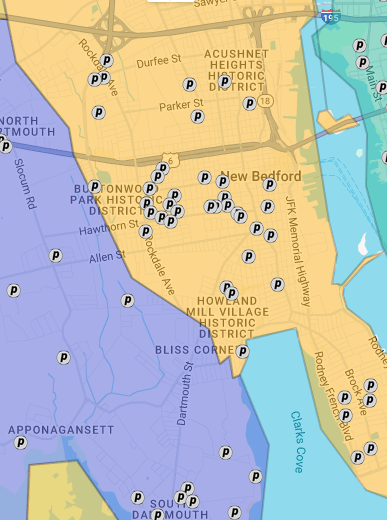
A majority of the households who preregistered for Black Earth Compost service lie in the city’s South End. Credit: Black Earth Compost
“If you have a mouse infestation in your home, the first thing the exterminator says is to put your bags of rice and your grains in a sealed container so that they can’t access it,” Orr said. “It’s the same thing for your food waste outside. If you put your food in a sealed container, the mice and the rats are not going to get to them.”
Boston started up its own free curbside program in 2022, although it initially limited enrollment to just 10,000 households and has yet to expand to a majority of the city. Part of that slow-roll is because Boston contracts with Waste Management, which does not have its own compost facility.
Recovering from sticker shock, some communities have opted for partnerships with private composting companies like Black Earth Compost to bring curbside service to residents. Using state grant funding, Newton has offered one such service to residents since 2019, growing from 500 to about 3,200 households.
Waneta Trabert, the director of Newton’s Sustainable Materials Management Division, said the program has allowed the city to offer discounted compost service to residents without breaking the bank.
“I think it’s fair to say that [Cambridge] is pretty committed to sustainability goals, and they have the means to be able to put a lot of investment there,” Trabert said. “I would say many communities, including Newton, do not have that degree of flexibility with the general fund.”
Getting over the ‘yuck factor’
Not everyone has the stomach for compost. These programs are expensive, Trabert said, even though they may reap savings in the long term.
Even as city-run compost programs in Cambridge and Boston take off, the number of residents participating in these programs remains relatively low. Despite delivering free compost buckets to every doorstep, the City of Cambridge is still missing roughly 20 percent of eligible households. Boston’s program currently serves just 27,000 of the city’s 295,000 households, and is closed to residents in buildings with seven or more units.
In Newton, the city’s partnership with Black Earth Compost showed early promise, but for the past two years has seen membership plateau.
“There is kind of this point at which most of all the people who are into it and are really enthusiastic about it have already adopted it, and then it becomes a much harder request of people who are on the fence or are curious about it, but have some apprehension,” Trabert said.
In Cambridge, Orr said outreach can be difficult with a young adult population constantly moving around, and even with consistent outreach, some people will always be late adopters. Compost bags and bucket liners can also be pricey, which is why the city is looking into ways to reduce those ongoing costs for residents already participating in the program.
States like California have eliminated holdovers by charging more for trash service than compost service, but this approach may have limited success in Massachusetts. In November, Medford announced the city’s new pay-as-you-throw program, which would charge residents based on the amount of trash they produce. Among the changes effective July 2027, the city would also decrease trash service to biweekly while making curbside compost service weekly.
Although these changes had been years in the making and years from taking effect, the backlash from residents received national attention.
Years earlier, Fall River reversed its pay-as-you-throw program due to political unpopularity.
Caban sees the situation in Medford as a cautionary tale, and a lesson in fostering community buy-in before introducing major changes.
“That’s why we do everything that we’re doing — because we don’t want that to happen here,” Caban said.
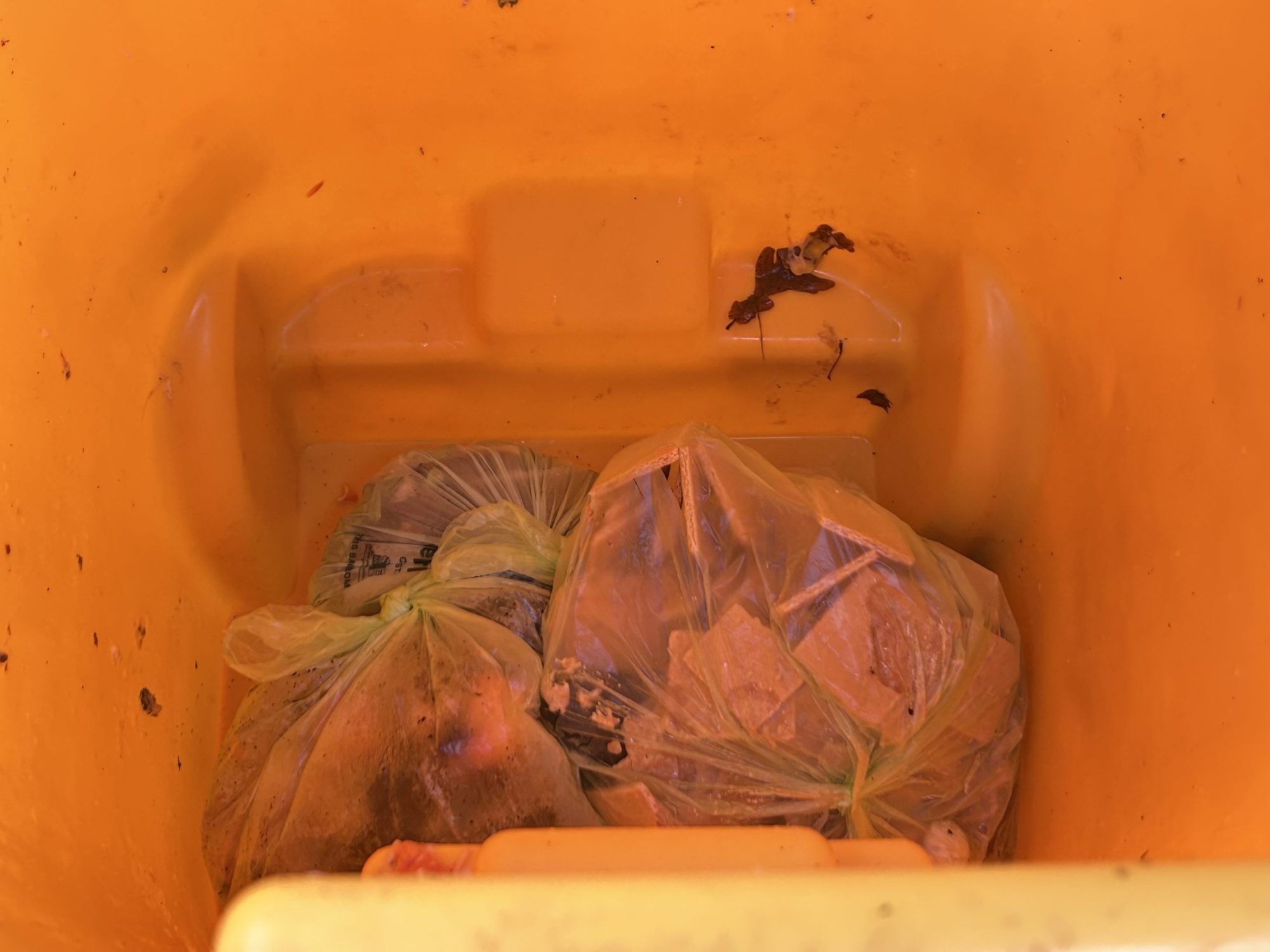 New Bedford residents can bring compostable bags full of food scraps to the recycling center during regular hours. Credit: Brooke Kushwaha / The New Bedford Light
Leaving it all on the table
Curbside compost could soon become a reality for New Bedford residents — but only for those willing to pay for it.
Black Earth Compost is a private composting service offering weekly or biweekly curbside food waste pickup to Massachusetts residents, provided that enough households sign up for the service within a certain square mile radius. Although Black Earth currently serves residents in both Dartmouth and Fairhaven, the company has struggled to gain enough interest in New Bedford, municipal coordinator Jon Laurie said. Just 65 out of 38,000 eligible households so far have preregistered for compost service, most of them in the city’s South End.
Initially, the company offered to begin service in New Bedford once it received 100 sign-ups, but it now has decided to try to move forward with compost service in the South End.
Last week, Black Earth sent out a survey to its pre-registered households in New Bedford to make sure they would still like to sign up, Laurie said. If just 25 households respond “yes,” the company will begin service as soon as next month.
Laurie still hopes to hit that 100-household benchmark before any buckets hit the curb. The more households that participate, he added, the cheaper Black Earth’s service becomes.
“Getting a program started is sometimes the best advertising we can do,” Laurie said. “Once the neighborhood is full of bins, people start getting curious on what that is, and if they can participate.”
Residents can still drop off their food scraps at the recycling center free of charge, but Caban said one of the largest barriers to composting besides cost is just asking residents to change their habits.
“It takes time and it takes a mindset shift, but it’s not too hard to stop by the recycling center when you go out to get your groceries,” Caban said.
After seeing the number of residents who turned out to oppose a waste transfer station last summer, Pecci is hopeful that local activists will turn their attention to the next big shift in New Bedford trash.
“Sometimes people are drawn to the fight against something and they don’t know what to fight for,” Pecci said. “I would say, most definitely, locally, New Bedford residents should fight for a good composting program.”
Email Brooke Kushwaha at bkushwaha@newbedfordlight.org.
January 20, 2026January 20, 2026

January 18, 2026January 18, 2026

January 15, 2026January 15, 2026

Keep The Light shining with your donation.
As an independent, nonprofit news outlet, we rely on reader support to help fund the kind of in-depth journalism that keeps the public informed and holds the powerful accountable. Thank you for your support.