
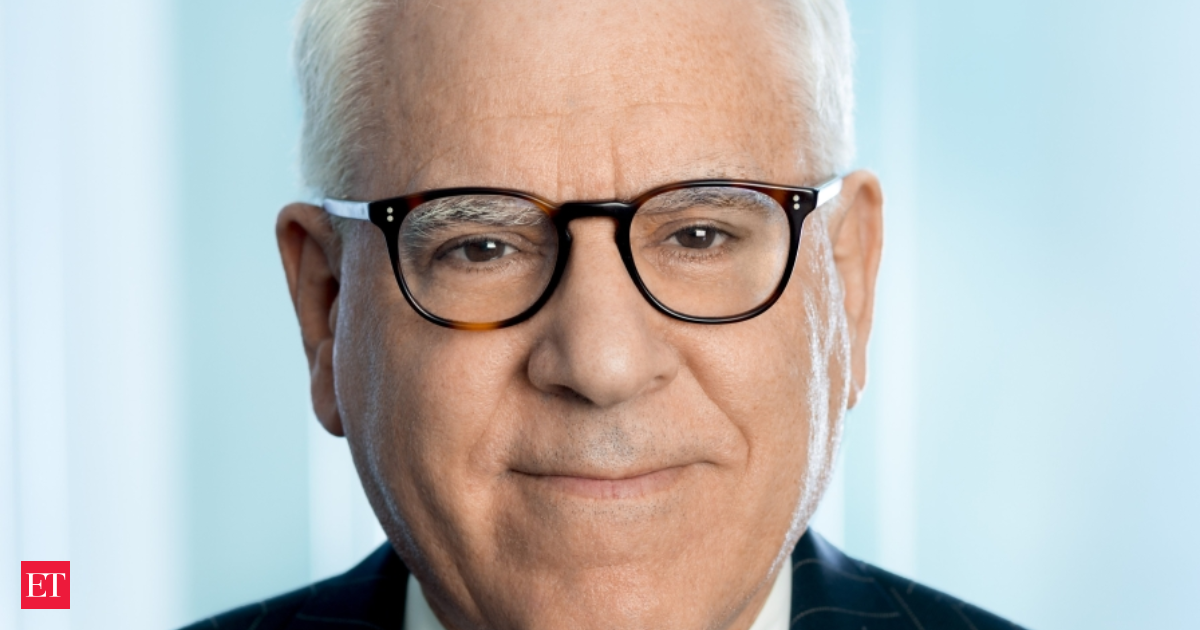
President Donald Trump’s tariff barrage had been expected to spark a recession and high inflation—that hasn’t come to pass, David Rubenstein, co-founder and co-chairman of the Carlyle Group, told ET in an exclusive interview at the World Economic Forum in Davos. The private equity veteran spoke at length in the interview on his insights into Trump, the US economy, China and, of course, India, which he tips as gaining in economic stature over the next few decades. Edited excerpts:
Carlyle is the only firm of its scale to be headquartered in Washington DC. How has President Trump been for corporate America, the investment landscape and fund managers overall?
I think generally, President Trump has a very pro-business outlook on things. He’s a businessman. And therefore, I would say, as a general rule of thumb, the business community is pretty pleased with him. There’s always some exceptions, and nobody agrees with him 100% on everything. But generally, I think the business community is happier and the stock market reflects that.
But tariffs should hit business as well as US households?
When tariffs were first announced, it was expected that it would produce a recession and very high inflation. Neither have come to pass. So the predictions about tariffs are obviously not always accurate. At this point, all the tariffs have not been put in place, and they have been changed a fair bit, and all of the costs of tariffs have not been passed along. So it’s too early to say how the tariffs will impact the overall economy. But at the moment, as you’ll notice, the US economy is in pretty good shape. We’re growing at a reasonable clip. I’d say about 3% or so. Unemployment is tolerable at 4.4% and the inflation rate is under 3%.
 Live Events
The US economy is doing well, banks are well capitalised, the stock market is robust. But is there a schism between Trump’s supporters, who’re feeling the pinch of grocery prices, and the rich? Inflation was a key election plank for Trump.
That’s the issue that the President has been trying to deal with. And he’s trying to now address that in ways that, you know, some people like and some people don’t. His issue of lowering interest rates on credit cards is obviously an affordability issue that he’s trying to address. There’s been a spate of them such as stopping companies from buying residential real estate. He’s opposed buybacks and dividends for defence companies. Some of these measures hit at the very core of the business models on which several of these successful corporations are built.
Well, announcing a policy and having it being implemented are two different things. The President does say a lot of things that may happen, may not happen. And you know, the business community recognises that getting a pronouncement from the President and then getting legislation and regulations actually implemented are two different things. At the moment, I don’t think the business community is unduly concerned about where the President is going. But obviously nobody is 100% supportive of everything he does. That’s just unrealistic.
So far most CEOs have kept mum. But some voices seem to be emerging, such as Jamie Dimon of JPMorgan after the credit card news. Is this the beginning of a cooling between boardrooms and the White House?
I wouldn’t say that. I did interview Jamie Dimon myself recently and I would say no president, a Republican president or Democratic president, gets the business community to agree with them on 100% of their things. So at the moment, I wouldn’t say that the business community is ready to disagree with Trump on the bulk of his policies. What the business community basically likes is less regulation, low interest rates, little federal regulation in terms of legislating new initiatives. They just prefer to have the market kind of operate itself. To some extent, President Trump has been able to do that, but he hasn’t agreed with the business community on everything and nobody in the business community finds any president that they like perfectly.
So you’re not losing sleep over all these announcements, and as we get closer to the November 3 mid-term elections?
Remember, announcing a policy and making a speech are two different things from implementing a policy and having administrative regulation. The business community is pretty good at adjusting to what the policies are and maybe amending or modifying whatever the regulation might be. Generally, I would say the President is not somebody that the business community is that worried about. But obviously I can’t speak for the entire business community.
With respect to India, the President has had a close relationship with Prime Minister Narendra Modi over a number of years. And I think PM Modi has generally been supportive, though they have some disagreements on some issues from time to time. But I would say the President has generally been quite positive on the US relations with India. He sent over a very close ally of his to be ambassador. And generally, I think of all the things the President is worried about, and American people are worried about, our relations with India are not one of them at the moment.
How should global CEOs and boards navigate Trumponomics? And how should fund managers prepare to allocate capital in all this flux?
Well, I think you have to recognise that what somebody says at the White House or even the President, doesn’t always mean the policy is going to be implemented that way. So I think you have to be very careful in making sure you know what the details are, and you recognise that presidents and all elected officials will say some things that will have popular appeal, but the policy behind that might not get implemented in quite the same way that the public speech might be.
The President’s strident China stand has been well known, and the rhetoric is therefore not surprising. But despite tariff hostility, China is at a record trade surplus. Has the China strategy misfired?
Well, the China strategy was not designed to hurt China. It was designed to reduce our deficit with China. What China did, when recognising that some challenges exist with the US, is that they began selling products in other markets. So they have an over $1 trillion annual surplus, and that’s in part because they increased their sales elsewhere. President Trump, while I don’t pretend to speak for him, I think feels he has a good relationship with President Xi Jinping, and they will be meeting at least twice this year. The President is going to China, and I believe that President Xi will come to the US. My guess is that they’ll probably work out some arrangement. President Trump likes to meet with heads of state in person, because he thinks he’s a good negotiator, and he thinks he generally can work something out. So I would say right now, China is not his main problem. And I think President Xi’s main problem is not the US.
What is Trump’s main problem then?
Well, I think he’s trying to address Russia, Ukraine. He’s trying to address the economy in the US. He’s trying to address the problem that the midterm elections are coming up this year. And then he also wants to celebrate the 250th anniversary of our country in an appropriate way. He’s working on ways to do that
Will the US ever emerge from this protectionist, antagonistic mindset against China even if there’s a Democrat in the White House.
It’s hard to use the word ever and know exactly what will happen. I would say under President Biden, the tariffs that President Trump put in place in his first term were continued. So it’s not as if there’s a Democrat coming in who all of a sudden may say, I’m going to get rid of every tariff. We have to recognise that we’re in a bipolar economic world now. Basically China and the US are the two dominant economic powers in the world. Though, I think in our lifetime, or your lifetime, maybe more than mine, India might be the biggest economy in the world.
Really?
Well, I would say probably within 20 to 30 years it could happen. And India has an advantage of having a younger population. In China, because of its one-child policy, it has an ageing population, and it has a shrinking population. India’s population is growing, and a very large percentage of people are young. And while our population in the US is growing – it is ageing. So I think India could be 20 years from now a dominant economy in the entire world.
The past three years of public-market strength have put the PE industry under scrutiny. Returns from a small group of mega-cap stocks have driven public indexes sharply higher, giving investors both stronger short-term performance and full liquidity. But it has also widened the gap with private markets. Exits are few and far between… Isn’t this an existential crisis after raising so much capital in the last few years?
David Rubenstein: Over the last 30 years, 20 years, 10 years, private markets have outperformed public markets on average. And top quartile private funds have done extremely well. I don’t think the people that are putting money in private funds – private funds being private equity, venture capital, growth capital, real estate, private credit and so forth –are abandoning that asset class. I would say right now the private equity market is more complex than it was maybe a couple of years ago. But the private equity market is still thriving in my view. It’s thriving in India.
Do you also see more consolidation in the industry itself? We’ve seen some because of the exit problem and so much capital being raised.
Some of the smaller firms may get bought by medium-sized firms, but I don’t think the giants in the industry are likely to do something that is going to revolutionise private investment. We have a large number of private equity and private credit firms that are so well capitalised that I don’t think they need any mergers.
Is that why secondaries are now the most sought-after strategy–Carlyle too has raised $20 billion to acquire ageing private equity stakes at a discount from pension funds and other investors through Carlyle AlpInvest.
Secondaries allow people who invest in private investments to sell before they otherwise would be able to. It’s been a very healthy and robust market for the last 5-10-15 years, and right now, it’s booming. May not boom at quite this level in the future, but it’s doing quite well now, and it gives people a chance for liquidity and pretty good rates of return. So, I don’t think it’s going to go away.
Ray Dalio recently shared his investment advice with you on The David Rubenstein Show. [LL1] In January 2026, let me ask you for some advice. Where should I put money–in gold, silver, euro, dollar, inflation-indexed bonds?
I would say I do think that anybody that’s a serious investor should allocate their money in various places, not all in one place. I think some public equities are probably a pretty good thing, some public credit, but I think private investments – which I mean, buyouts, venture capital, growth capital, private credit – are still a good place to put one’s money. And I would say most endowments in the US that are well run, probably have 20 to 30% of their money in private investments. And I think generally they’re pretty happy with that.
Will you follow a different strategy for emerging markets like India, the Middle East?
First of all, the phrase emerging markets is not being used as much anymore. Now we have the wonderful new phrase Global South. But in the Global South or emerging markets, I think generally, the rates of return are theoretically supposed to be higher because there’s less competition, prices are lower and so forth. But over the last 10-15-20 years or so, the returns in emerging markets have not outperformed, let’s say, developed market returns, and the risk is somewhat higher. So I think people are allocating a little bit less to emerging markets than I would have thought they would have at this point.
You said you travelled to India many times. How have you seen the private equity industry evolve in India?
When I set up our operation in India 25 years ago, I didn’t see a lot of my peers there. We had the investment environment largely to ourselves, and there were some Indian-based companies. Now, everybody who’s a major player in private equity and private credit is in India. I wish I could have it to myself, but that’s not likely to happen anytime soon. India has a big population of 1.4 billion people and a big economy. You have a young population and a government that I think is willing to allow capitalism to be pursued, much more than it was under previous regimes, for example. So I’m pretty bullish on India.
What would you suggest or what is your advice to Indian policy makers overall, from a reforms agenda perspective.
Indian policy makers should not see global private credit, private equity, private investments as a Western-type investment. As India enables the private equity market and private credit market to thrive, well-capitalised Indian entrepreneurs will get into this business as well. Right now, many of the most talented Indian professionals–educated in India –come to the US. And as you know, a third of all the Silicon Valley companies are probably run by someone with Indian origin. So why not have policies that encourage many of these people to stay in India or get their education in the US and go back, or build a business in the US and go back. I’ve invested with a lot of Indian entrepreneurs over the years, and many of them, would rather live in the US. I think Indian policy makers would be well advised to consider doing things that would get many of these Indian business leaders to come back and contribute to the country.
New Delhi is disappointed with Washington DC. Why are we at this crossroads?
I would say Washington DC doesn’t speak with one voice. The President is one person. Then you’ve got Congress and you’ve got regulatory agencies and so forth. I think most people in Washington DC, that’s where I live, are very bullish on India as a place to invest and as a partner and ally of the US. So I think President Trump regards India as an ally and as a friend. I am not sure why some people are concerned, but generally, I would say no two countries can always agree on every single thing. But generally, India and the US have a good relationship, and I think we’ll get stronger.
India has 1.4 billion people. Many are young and the biggest challenge for policymakers is jobs for those entering the workforce. The biggest worry is AI will take away blue-collar jobs or outsourcing roles that have been the bedrock of India’s booming IT services export story.
When the industrial revolution started in the 1870s in Europe and then came to the US, people said, people are not going to work anymore, because these machines are going to take over all the human jobs. Same thing was said when the internet appeared. All of a sudden, they’re not going to be any jobs now. The internet created a lot of jobs, and Amazon, Uber or companies like that. There’s always worry that something new is going to hurt the status quo. But generally, humans are pretty ingenious, and they’re willing to work. And I do think that artificial intelligence will create new jobs and it will eliminate some existing jobs. So you’ve got to be nimble, but I don’t think the world’s going to fall apart because of AI.
Will the world of investing also change because of AI?
Everything will change because of AI. And I can’t predict exactly how it will happen. AI is a phenomenon, not unlike the internet when it came along, but remember, AI is still probably in inning one, and it’s a long way to go. We can’t predict how it’s going to happen in time, but right now, it’s obviously causing concern. But I think this concern is a little bit misplaced.
Billions of dollars are getting funnelled toward building AI infrastructure. Your economist argues all these investments are crowding out investments in other critical infrastructure. How big a concern is it?
Obviously, right now, a lot of people are putting money into AI, maybe more than might be appropriate right now. As you know, everybody wants to invest in AI and nobody wants to invest in more traditional businesses, but that creates opportunities. And so right now, I think whenever something new comes along, you do see people rushing into it. Everybody’s afraid they’re going to miss something. And I think people should also look at other things that are not AI-oriented. Recognise there’s a lot of value in underpriced companies as well in other industries.
Is that the Carlyle strategy as well–to invest in the downstream or would you say it’s better to pause since valuations have significantly run up?
We are investing in AI. We are heavily involved in AI, but we do invest in other areas. We have 2,500 people and a lot of investment professionals among them, and they’re investing across the board. So we’re not putting all our eggs in the AI basket, but we’re not ignoring AI either.
Many would argue PE is a young man’s industry, but with really old founders. How does the industry evolve? How do all of you handle succession?
I would say younger people are always going to be more creative and willing to take bigger risks than older people. By definition, that’s the way the world always operates. So the older generation probably is not going to be as conversant with or adopting AI as quickly as maybe the younger people will. Younger people are where you often get fresh ideas, because they’re not burdened by the things of the past. I think a good firm should have some older people, some people with some wisdom, but also needs to have a lot of young people.
How do you as a firm, and overall as corporate America, prepare for a potential China takeover of Taiwan?
I don’t expect that will happen anytime soon. I can’t speak for the Chinese leadership, but obviously, what happened with Russia and Ukraine showed that it’s not that easy to take over a country that doesn’t want to be taken over. And remember, China hasn’t fought a war for 70 years or so. I think China is observing what happened in Ukraine, and is recognising that if they want to do something with respect to Taiwan, maybe doing it peacefully might be more beneficial.
You just celebrated your 25th anniversary in India. Where do you see the franchise for the next 25 years? Venture capital, credit or infrastructure?
I expect we will probably want to expand what we have there, because India is a growing economy. It will be in my lifetime, or certainly in your lifetime, the biggest economy in the world, and it is the biggest population in the world. So how can you not want to be there? So I expect we’ll be very actively involved there.
Do you see more opportunities in credit, real estate, some of the other sectors that Carlyle will get into?
I wouldn’t preclude us from doing anything there, and we’ll probably do things there that we do elsewhere. We have expertise in all those areas.