
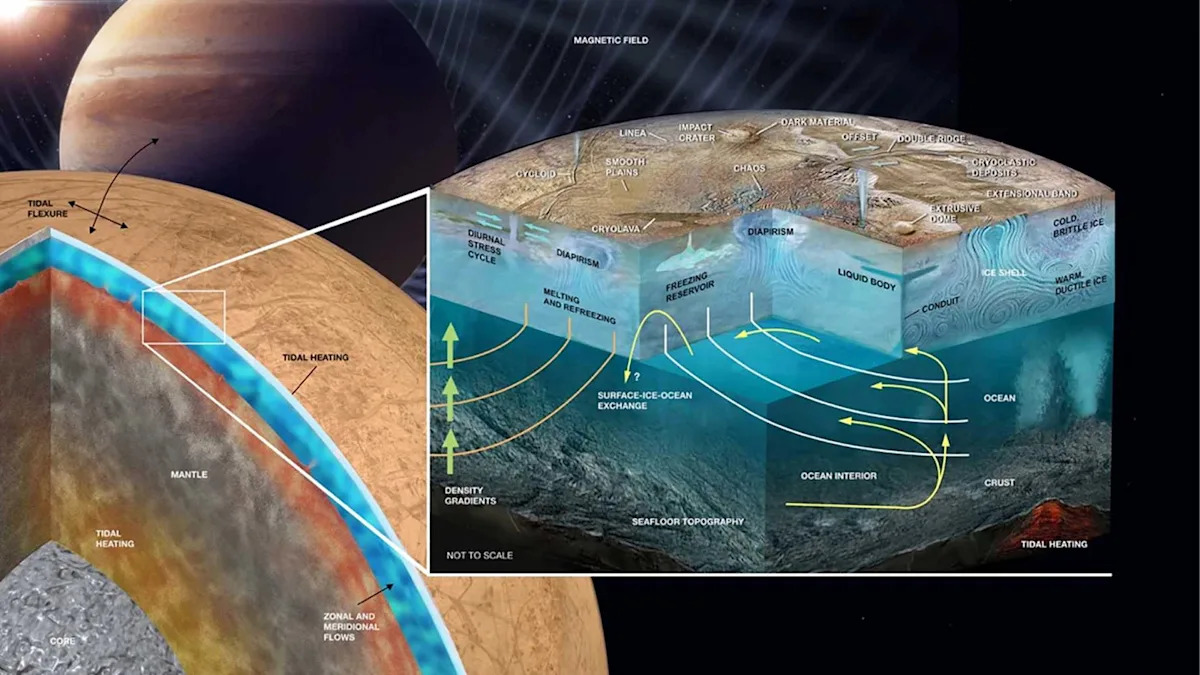
A new study from Washington State University looks at the interaction between salt-enriched ice and pure water ice, highlighting one way in which Europa’s deepest ocean might gain access to the nutrients it needs to support life. It’s thought that, under the right conditions, ice enriched with life-sustaining nutrients from salts and Jupiter radiation could drive deeper into the ice shelf and into the ocean below, delivering nutrients and minerals that could sustain an ocean full of alien life.
The oceans of Jupiter’s moon Europa have long been considered a potential source of alien life. One problem with this theory, though, is how the nutrients and minerals necessary for life to form and evolve would reach the oceans themselves. They lie under thick shells of ice that block sunlight, so any life under Europa’s oceans is unlikely to rely on the sun for energy. Where, then, could they get it from?
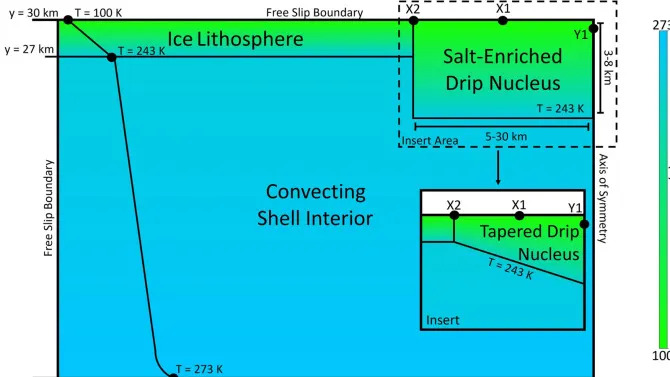
Europa Ice sinking diagram.
Credit: The Planetary Science Journal
Through this study, geophysicists proposed a novel mechanism by which the necessary nutrients could reach deep into the oceans: crustal delamination. This is the process by which a crust is tectonically squeezed and made denser until it grows so dense (compared to its surroundings) that it sinks. This is typically observed in Earth’s rocky crust, but the paper’s authors, Catherine Cooper and Austin Green, suggest it could occur on Europa, too.
The idea is that the combination of Jupiter’s radiation and salts on Europa’s icy surface could create useful nutrients in the top layers of the moon’s ice. As Jupiter’s extreme gravitational pull has a tectonic effect on Europa’s ice, it would move, creating stresses that compress certain portions of the surface and weaken others. Denser salt-enriched ice would be more likely to be compacted by these movements, eventually reaching a density at which it would sink through the outer layers of the icy shell and into the oceans beneath.
Using computer modelling, the study suggests that any salt content, however small, would be enough to cause the denser ice to sink beneath the surface of the shell and potentially reach the global oceans below.
This is something that the Europa Clipper spacecraft may be able to prove more conclusively, although it isn’t slated to arrive at Europa until 2030.