
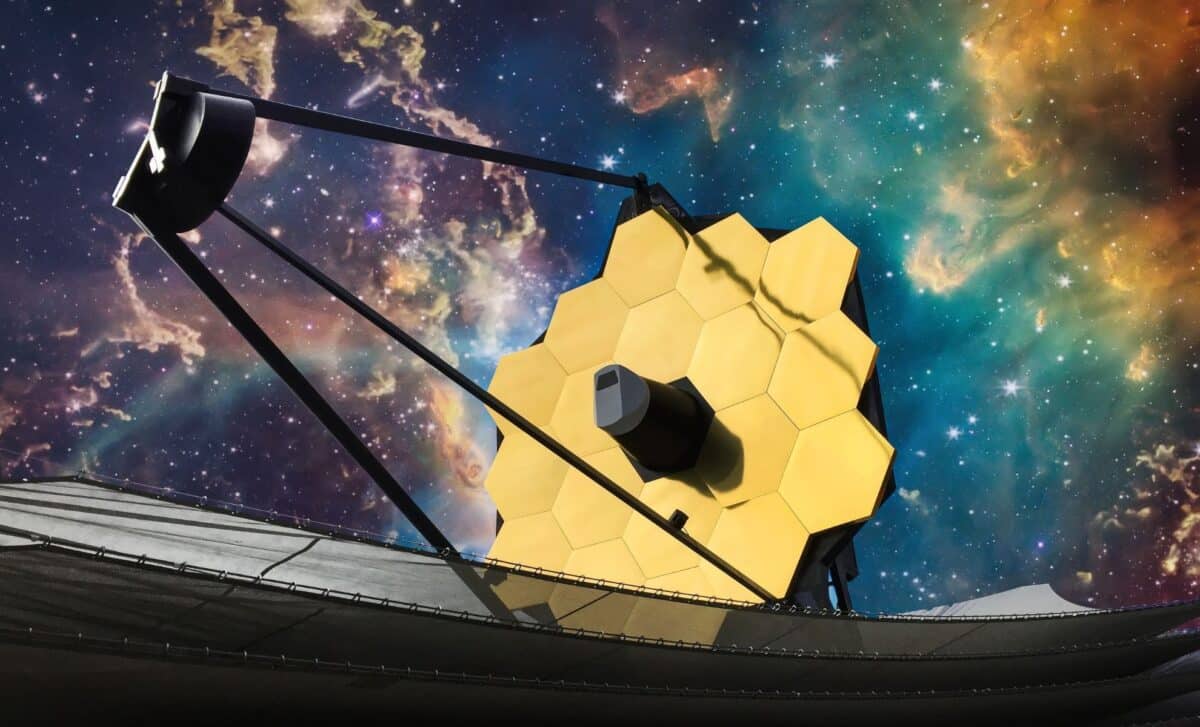
A team of astronomers using the James Webb Space Telescope (JWST) has detected a remarkably distant Type II supernova that erupted just 1 billion years after the Big Bang. The cosmic event, named SN Eos after the Greek goddess of dawn, was made visible through a rare gravitational lensing effect that amplified its faint light across space and time.
This unprecedented discovery, captured on September 1 and October 8, 2025, marks one of the earliest known stellar explosions ever observed. Gravitational lensing not only made SN Eos visible, but also split its light into two images, letting astronomers study the supernova in two separate locations within the same frame.
A Lens Through Space And Time
The supernova was observed in the galaxy cluster MACS J1931.8-2635, where the cluster’s immense gravity distorts and magnifies light from objects lying far behind it, allowing JWST to capture its image from over 13 billion light-years away. That lensing effect produced two images of the same explosion, labeled 101.1 and 101.2, allowing researchers to confirm SN Eos’s identity and study its properties with unprecedented detail.
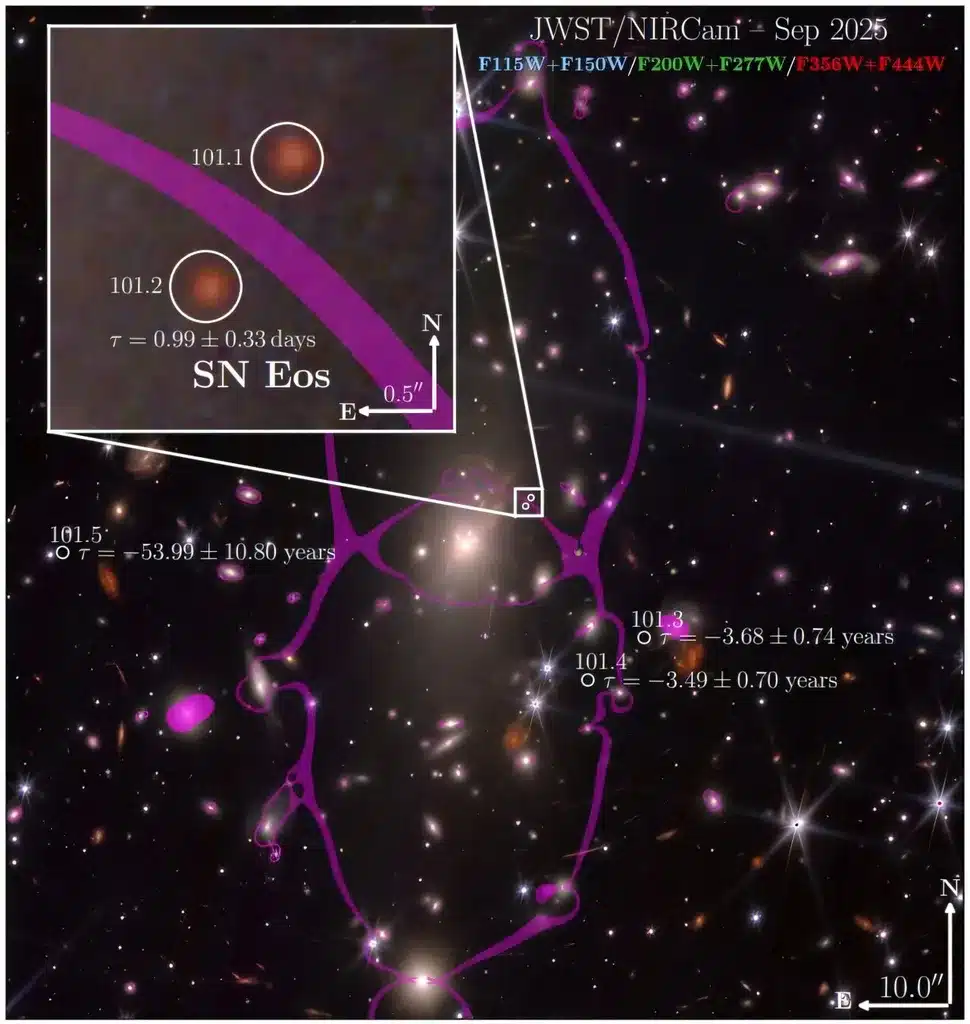 SN Eos appears twice (101.1, 101.2) due to lensing by MACS J1931.8–2635; magenta outlines the boost region. Credit: Coulter & al. / JWST
The detection of SN Eos was made possible through a cosmic magnifying glass.The research, made public on January 7 through the arXiv preprint server, underscores the telescope’s role in tracing back the universe’s formative epochs. Gravitational lensing occurs when the light from a distant object travels through a warped region of spacetime, often caused by the gravity of a massive foreground object.
In this case, the effect was strong enough to both brighten and split the light into two visible occurrences, enabling astronomers to examine the explosion more clearly than would otherwise be possible. This technique is increasingly being used in tandem with JWST’s infrared capabilities to observe faint, distant events in the early universe.
A Hydrogen-rich Explosion In A Metal-poor Universe
The light from SN Eos revealed it to be a Type II-P supernova, a specific variety known for maintaining a nearly constant brightness for a time before dimming. According to the research team’s analysis of ultraviolet light, the star that exploded was rich in hydrogen and lived in an environment with a notably low concentration of heavy elements, often referred to as metals in astronomical terms.
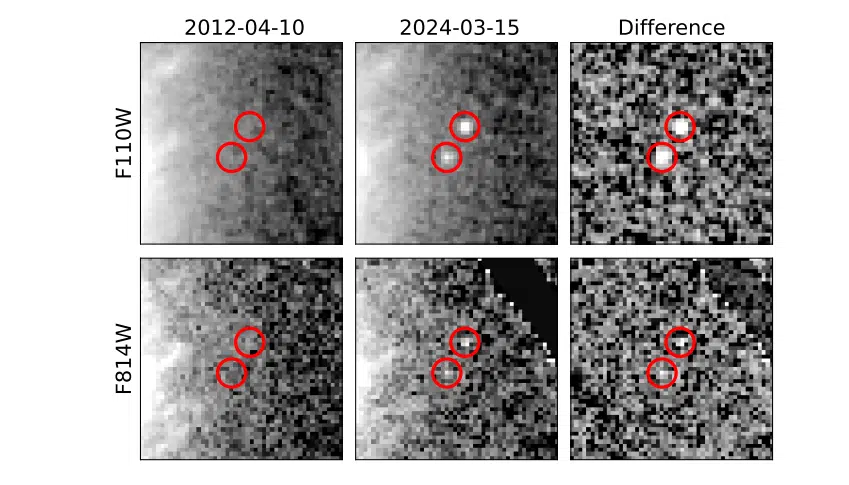 Comparison of JWST images from 2012 and 2024 showing the lensed supernova SN Eos in two infrared filters (F110W and F814W). Credit: arXiv
In fact, the progenitor star is estimated to have had less than 10% of the metal content of the sun, indicating it was formed in a very early, chemically unprocessed region of the cosmos. This low metallicity is one of the clearest indicators of the star’s ancient origin. It supports theories that the earliest stars formed from mostly hydrogen and helium, the two lightest and most abundant elements after the Big Bang.
Aligning With JWST’s Mission To Trace Cosmic Origins
This discovery supports one of JWST’s primary scientific goals: understanding how the first stars lived and died, and how their deaths shaped the development of galaxies. According to the researchers quoted in Live Science, this event contributes directly to the telescope’s mission of probing the origins of elements and documenting the evolution of young galaxies.
While only a single data point, SN Eos serves as a vital reference for what early massive stellar explosions may have looked like. Further observations of similar events will help confirm whether Eos is representative of early supernovae or a more unusual case.