

Two bright, short-lived flares from accreting white dwarfs have been detected near the Milky Way’s core by the South Pole Telescope (SPT), marking a first for millimeter-wavelength observations. The flares were captured not through targeted observation, but during repeated scans of the Galactic Plane, highlighting the power of blind surveys in uncovering brief cosmic events.
According to the findings were published in The Astrophysical Journal and are already shifting how researchers view millimeter-wave astronomy and its role in time-domain astrophysics.
Two Unexpected Flares Caught Over Two Years
Originally built to measure the cosmic microwave background, the SPT was repurposed for Galactic Plane surveys using its SPT-3G camera. These scans aim to monitor variability across a broad area of sky. As reported by the study, two flares from known white dwarf binary systems were recorded over two years, an unexpected result that immediately drew attention.
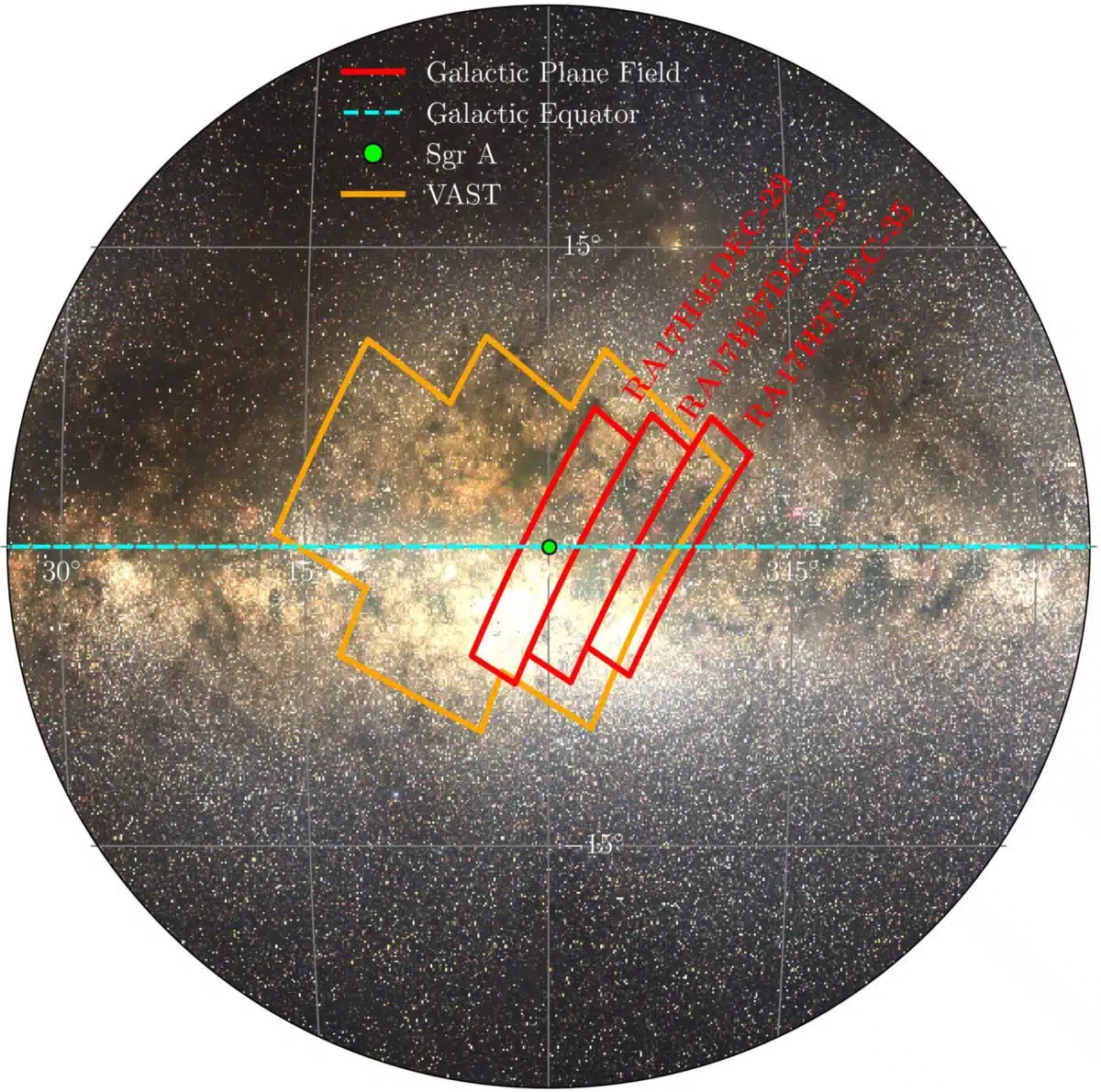 The Galactic Plane field appears over Mellinger’s full-sky Milky Way image, with the Galactic equator shown as a dashed aqua line. Credit: The Astrophysical Journal
As stated by Tom Maccarone, a physicist at Texas Tech University who collaborated on the study:
this kind of detection shows “a great example of the adage among astronomers that opening new windows on the universe produces new, unexpected, exciting results.”
Flares Lasted One Day, Seen Only In Millimeter Wavelengths
Each flare lasted about 24 hours and came from known binary systems where a white dwarf is drawing matter from a companion star, forming an accretion disk. The disk, made of hot, swirling gas, can suddenly release energy in bursts.
The research team noted that the events likely came from magnetic reconnection, a process also seen in solar flares. Here, it occurs in a far more extreme setting, with dense material and higher energies. These are some of the first such events observed in millimeter light, where transient discoveries are still rare. Before now, most flare-type variability had been seen in optical or X-ray bands, not in this quieter portion of the spectrum.
The researchers had not been specifically watching these stars when the flares occurred. Instead, they used wide-area, repeated scans, making the find serendipitous. As Maccarone explained, this approach may reveal many more such events in the future, since “we’ve only scratched the surface of what can be done” with this method.
Disk-Driven High-Energy Flares
These findings add to the growing interest in how accretion disks behave in compact binary systems. When gas is pulled from one star to another, it forms a disk that can heat up, destabilize, and erupt. This may be what triggered the observed flares.
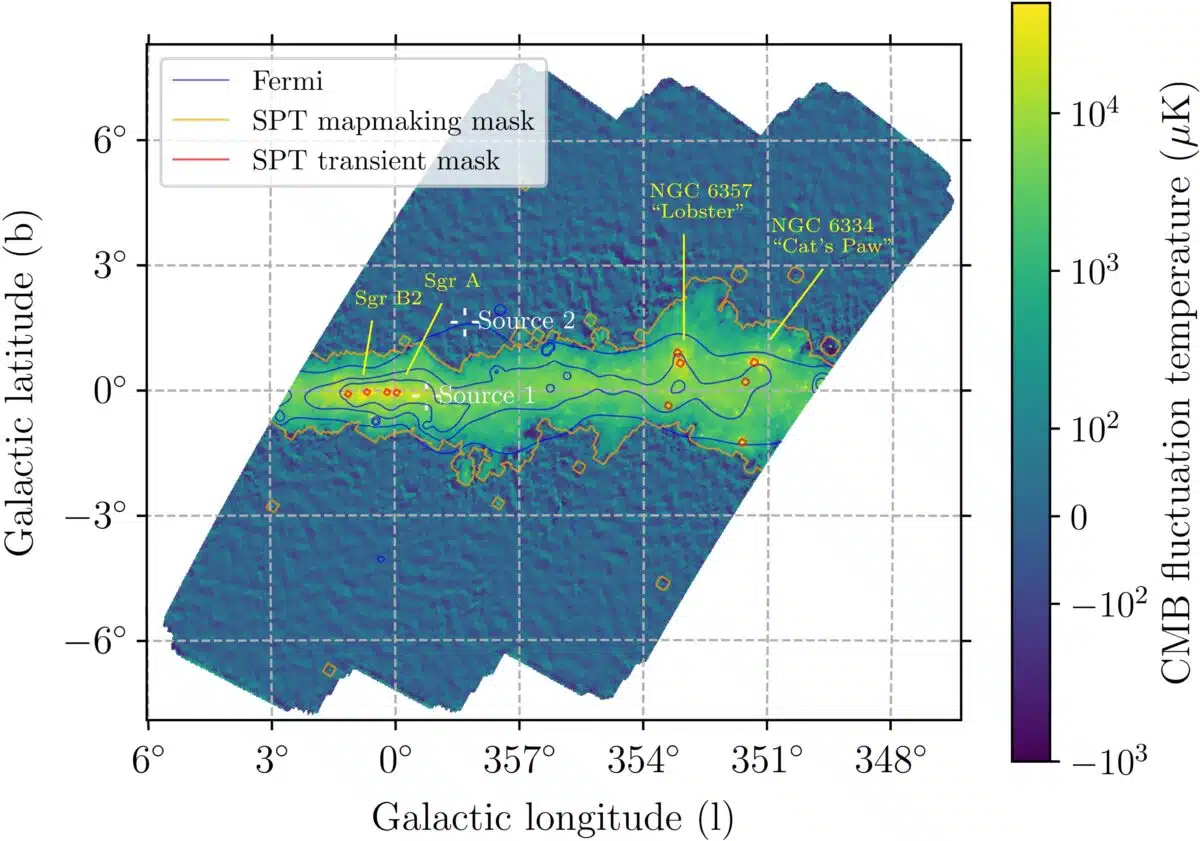 Two-year SPT-3G average at 150 GHz in Galactic view. Credit: The Astrophysical Journal
In both detected systems, the flares were likely driven by sudden changes in the disk’s magnetic structure, releasing energy quickly and radiating across several bands. Although each event was brief, it places strong limits on the size and structure of the emitting region. The flares’ durations and intensities suggest a high-energy process unfolding on compact scales.
Galactic Plane Survey Enters A New Phase
The SPT-3G Galactic Plane Survey continues to collect data roughly one month per year, adding to a growing timeline of activity near the galactic center. These millimeter-wave records are now showing that this part of the sky is not as static as once thought.
Led by graduate student Yujie Wan of the University of Illinois Urbana-Champaign, the team developed specific tools to identify these sudden flares, called transient, which appear and fade in a matter of hours or days. As reported by the group, the survey’s growing time-domain data will allow researchers to better understand the fast physics playing out in real time near the center of the Milky Way.