

A potential merger between three parties opposed to Prime Minister Benjamin Netanyahu in this year’s election would yield the biggest Knesset party, far surpassing the ruling right-wing Likud, according to polls published Thursday.
But the megaparty wouldn’t significantly boost the overall anti-Netanyahu bloc or deliver it a majority when compared to a scenario in which they ran separately, according to a new survey conducted this week for Zman Yisrael, The Times of Israel’s Hebrew-language sister site.
A poll by Channel 12 reported similar results, showing that the combined party would lead polls but that neither camp would achieve a majority.
Channel 12 news reported this week that former IDF chief Gadi Eisenkot, head of the new Yashar! party, has proposed a merger between three factions: His party, Opposition Leader Yair Lapid’s Yesh Atid, and the new party founded by former prime minister Naftali Bennett.
Right now, polls regularly show Bennett’s party regularly garnering more than 20 seats in the 120-member Knesset, close on Likud’s heels. Yesh Atid and Yashar generally score in the high single digits or low double digits.
Get The Times of Israel’s Daily Edition
by email and never miss our top stories
By signing up, you agree to the terms
The merger aims to present a unified slate that will become the Knesset’s biggest faction. That could give it an air of dominance and make President Isaac Herzog more likely to tap the party to form the next government.
If that scenario comes to pass, it will mark a symbolic change. Aside from a blip during the four successive elections between 2019 and 2021, Likud has been the leading party for more than a decade.
The Zman survey shows the merged party achieving primacy in numbers. While the three parties get a combined 33 seats if they run separately — a relatively low 18 for Bennett’s party, 8 for Yesh Atid and 7 for Yashar — the figure grows to 36 if they merge. Likud stands at 25 seats in both scenarios.
But this doesn’t translate into a game-changer regarding which bloc of parties is likely to form the next government. In line with most polls over the past two years, both scenarios indicate a potential deadlock between the pro- and anti-Netanyahu parties.
The Channel 12 poll also reports a deadlock, even as the merged party wins 38 seats. In that poll, the three parties collectively perform one seat better if they run separately.

Prime Minister Benjamin Netanyahu seen with ministers and MKs in the Knesset in Jerusalem, on January 5, 2026. (Yonatan Sindel/Flash90)
If the merger doesn’t go ahead, the parties in Netanyahu’s current 64-strong coalition get 53 seats in the Zman poll — far short of a 61-seat majority. If the parties do merge, the pro-Netanyahu parties get 52 seats.
The non-Netanyahu-aligned parties get 67 seats without a merger, and 68 if the parties combine.
But that number doesn’t actually constitute a majority. In both cases, it includes Arab parties that collectively receive 11 seats — as well as centrist and right-wing parties that have vowed not to join a coalition with them. Moves are also underway for the Arab parties to entertain their own merger.
Channel 12 reports that the opposition, sans Arab parties, can get closer to a majority, with 59 seats.
The Zman survey finds that both Benny Gantz’s centrist Blue and White and Bezalel Smotrich’s far-right Religious Zionism would squeak past the 3.25 percent electoral threshold with 4 seats each, unlike many recent polls that have predicted political demise for both. Channel 12 reports that neither would win seats.
In the event Eisenkot, Gantz and Bennett run separately, the Zman poll predicts 25 seats for Likud, 18 for Bennett’s party, 10 each for Yisrael Beytenu and Shas, 9 for the Democrats, 8 each for Yesh Atid and United Torah Judaism, 7 for Eisenkot’s Yashar, 6 each for Otzma Yehudit and Ra’am, 5 for Hadash-Ta’al, and 4 each for Blue and White and Religious Zionism.
The pro-Netanyahu bloc gets 53 seats, the anti-Netanyahu Zionist bloc gets 52 seats, while the Arab parties get 11. The non-aligned Blue and White stands at 4, delivering a majority to neither side.
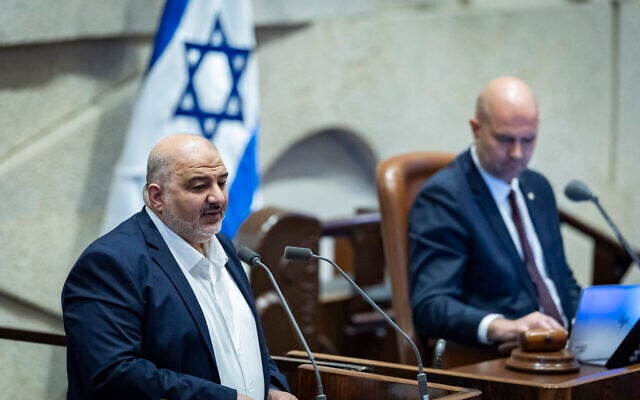
Ra’am MK Mansour Abbas speaks during a 40-signature debate at the Knesset in Jerusalem, January 19, 2026. (Chaim Goldberg/Flash90)
If the merger materializes, Zman predicts 36 seats for the merged party, 25 for Likud, 9 each for Yisrael Beytenu and Shas, 8 each for the Democrats and United Torah Judaism, 6 each for Otzma Yehudit and Ra’am, 5 for Hadash-Ta’al, and 4 each for Blue and White and Religious Zionism.
The pro-Netanyahu bloc gets 52 seats and the anti-Netanyahu Zionist bloc gets 53 seats. The Arab parties stay at 11, while Blue and White stays at 4.
The survey was conducted on January 21-22 by Tatika Research and Media in collaboration with the Adgenda panel, and included 500 Jewish and Arab respondents, controlled for age, religion, gender and place of residence. The margin of error is 4.4%.
Is accurate Israel coverage important to you?
If so, we have a request.
Every day during the past two years of war and rising global anti-Zionism and antisemitism, our journalists kept you abreast of the most important developments that merit your attention. Millions of people rely on ToI for fact-based coverage of Israel and the Jewish world.
We care about Israel – and we know you do too. So we have an ask for this new year of 2026: express your values by joining The Times of Israel Community, an exclusive group for readers like you who appreciate and financially support our work.
Already a member? Sign in to stop seeing this
You appreciate our journalism

You clearly find our careful reporting valuable, in a time when facts are often distorted and news coverage often lacks context.
Your support is essential to continue our work. We want to continue delivering the professional journalism you value, even as the demands on our newsroom have grown dramatically since October 7.
So today, please consider joining our reader support group, The Times of Israel Community. For as little as $6 a month you’ll become our partners while enjoying The Times of Israel AD-FREE, as well as accessing exclusive content available only to Times of Israel Community members.
Thank you,
David Horovitz, Founding Editor of The Times of Israel