
Unlock the White House Watch newsletter for free
Your guide to what Trump’s second term means for Washington, business and the world
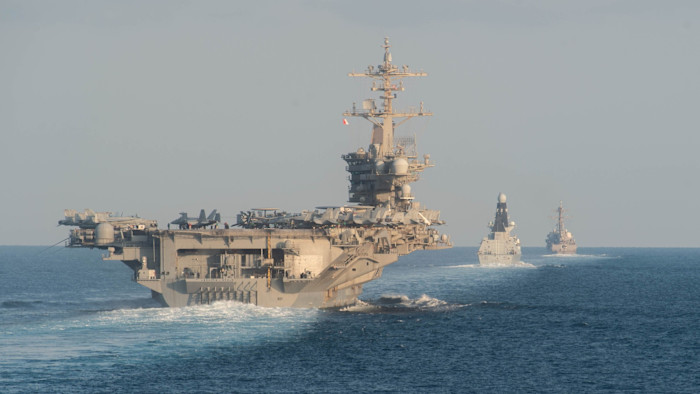
Donald Trump said on Thursday that he had sent an “armada” of US naval forces towards Iran, “just in case” he had to take action against Tehran, in his latest warning to the Islamic republic.
Speaking to reporters on Air Force One, the US president reiterated previous warnings to Iran not to restart its nuclear programme, or execute people arrested during recent mass protests against the regime.
“We have a lot of ships going that direction, just in case . . . I’d rather not see anything happen, but we’re watching them very closely,” Trump said, as he returned to the US from the Davos conference in Switzerland.
Tensions soared across the Middle East earlier this month after Trump hinted that he was about to intervene in Iran, writing on social media that “HELP IS ON ITS WAY” as Iranian authorities launched a brutal crackdown to crush the biggest wave of protests against the regime in years.
But they eased after Trump dialled down his rhetoric following intense lobbying from both Arab and Israeli officials.
Several Arab states sought to convince Trump to hold off on striking Iran, worried that it could trigger a wider regional conflict, while some also cautioned that an attack could cause Iranians to rally around the flag.
Israeli officials expressed concerns that their country could also be targeted in Iranian retaliation for a US strike, according to two people briefed on the discussions.
However, even as Trump’s rhetoric has eased, the US has continued to deploy military assets to the region, with the USS Abraham Lincoln strike group leaving the South China Sea and moving into the Indian Ocean.
The influx of US naval forces to the region means the US would be better placed both to strike Iran and to help defend Israel and its bases in the region from Iranian retaliation, as it did during the 12-day war between Israel and Iran last year.
Iran’s foreign minister Abbas Araghchi has said that Tehran is willing to negotiate with Trump over its nuclear programme, but insists that negotiations have to be “fair and just”, signalling that Iran will not agree to preconditions such as giving up its right to enrich uranium.
He has also warned that Iran is prepared for war if the US or Israel attack.
Araghchi has said that a communication channel between him and US envoy Steve Witkoff has remained opened throughout the recent protests.
Recommended

The two officials have been in contact since Iran and the US held indirect talks over Tehran’s nuclear programme last year. Those negotiations ended after the 12-day war last June — which the US briefly joined — on the eve of a round of discussions.
On Thursday Trump, who has said Iran’s nuclear programme was “obliterated” by the US’s bombing in June, said Tehran wanted to negotiate and “we’ll talk”.
Tehran, which has blamed “terrorists” and the US and Israel for stoking the violence, has said more than 3,000 people, including hundreds of security forces, were killed in the protests. Human rights groups estimate the toll is higher.
Oil prices rose in response to Trump’s latest comments, with Brent crude futures for March climbing 0.7 per cent early on Friday on fears that a renewed round of fighting could disrupt supplies from Iran, which is one of the world’s biggest oil producers.