
Why the January 2026 uprising marks a decisive break with reform, compromise, and all forms of authoritarian rule in Iran.
Iran stands at one of the most critical—and at the same time most hopeful—moments in its contemporary history. Just as the Iranian people once overthrew the Pahlavi dictatorship, the theocratic system of Velayat-e Faqih now finds itself facing an accumulated popular fury and an iron determination that point unmistakably toward its downfall.
The nationwide uprising that began in January 2026 is no longer a temporary wave of protest. It is a radical, organized, and irreversible movement whose declared objective is the complete end of dictatorship in Iran—without substitution, cosmetic reform, or recycled authoritarianism.
Some observers focus on the role of foreign actors; others speculate anxiously about regional consequences. But the central and undeniable fact is the resolve of the Iranian people themselves. Society has crossed a historic threshold—from what can be described as a phase of endurance into a phase of victory. At this stage, no force appears capable of pushing the movement back into silence.
Dictatorships Do Not Fall Quietly
History shows that no dictatorship relinquishes power voluntarily. In its final stages, authoritarian rule typically resorts to fear-mongering, disinformation, internal division, and the deliberate muddying of political waters. Often, it attempts to redirect popular energy toward a new form of control—this time packaged as moderation, reform, or managed democracy.
The essential question today is whether this familiar scenario will succeed once again. Will the Iranian uprising be derailed, suppressed, or diverted? Or will it achieve its final objective?
The answer is already visible in the streets, in the chants of young protesters, in nationwide strikes, and in the blood of those killed by state violence. History does not move backward. After decades of lived experience under religious dictatorship, Iranian society is no longer willing to compromise with any form of authoritarian rule.
A Generation with Nothing Left to Lose
What distinguishes the current uprising from previous protest movements is its complete radicalization. The era of hope in internal reform, gradual change, dialogue with power, or purely civil resistance has long passed.
The dominant slogan heard today in streets and universities is stark and unambiguous: “Freedom or death.” Iranian youth—those who have paid the highest price—state openly that they have nothing left to lose. The ruling system has taken from them their future, security, dignity, livelihood, and even the basic right to life.
This reality has transformed fear into defiance.
From Protest to Revolutionary Confrontation
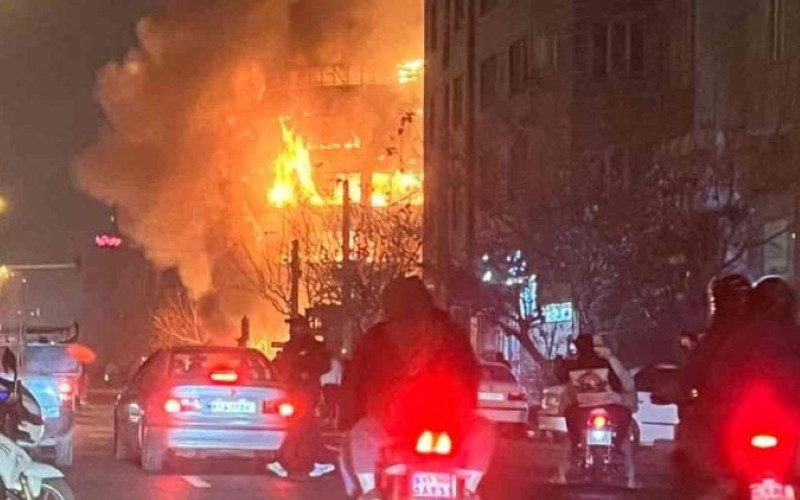
The scale of the uprising underscores this transformation. Protests have spread to more than 190 cities. Continuous clashes have erupted across hundreds of locations. Unarmed civilians confront heavily equipped security forces. Widespread strikes have paralyzed key sectors in at least 12 provinces, from Kurdistan to West Azerbaijan.
Repression has lost its deterrent effect. Instead, it has become the primary accelerator of a full-scale revolutionary situation.
Every execution, every night raid, every report of a killed protester deepens public anger and strengthens collective resolve—particularly among the youth. This reversal of repression is not accidental; it is a defining feature of the final stages of major revolutions. The regime no longer controls escalation. Each act of violence expands both the scope and depth of resistance.
Strikes as a Strategic Weapon
Recent strikes go far beyond traditional labor demands. They have become an integral component of a radicalized revolutionary strategy. When truck drivers, teachers, industrial workers, students, and even traditionally conservative sectors halt work simultaneously, the economic legitimacy of the regime collapses.
Combined with continuous street resistance, strikes cease to be a pressure tactic. They become a direct strike against the regime’s economic and political backbone.
This is precisely how authoritarian systems unravel.
The Lesson of 1979—and Its Warning
The 1979 revolution succeeded only after it moved beyond limited demands and entered a phase of full radicalization. Had that uprising remained confined to reformist or sectoral protests, the monarchy might well have survived.
The same historical rule applies today: dictatorship yields only to a united, organized, and radical popular force.
Iranian society has learned this lesson—at great cost.
A Clear Vision Beyond Dictatorship
The Iranian people are not rising merely against repression; they are rising for a defined future. Their fundamental demand is the establishment of a democratic republic based on freedom, social justice, separation of religion and state, and genuine popular sovereignty.
Any force or faction seeking to reproduce authoritarianism after the fall of the current system—under any label—will face strategic defeat. The political consciousness of society has advanced too far for regression.
Iran’s future is no longer an abstract aspiration. It is a tangible horizon shaped by sacrifice, unity, and irreversible momentum.
An Irreversible Path Forward
The Iranian uprising continues. This time, it has reached a level of revolutionary radicalism from which there is no return.
Freedom is no longer a distant dream. It is approaching reality.
And this path—marked by resistance, solidarity, and determination—is the path to the Iranian people’s final victory.