
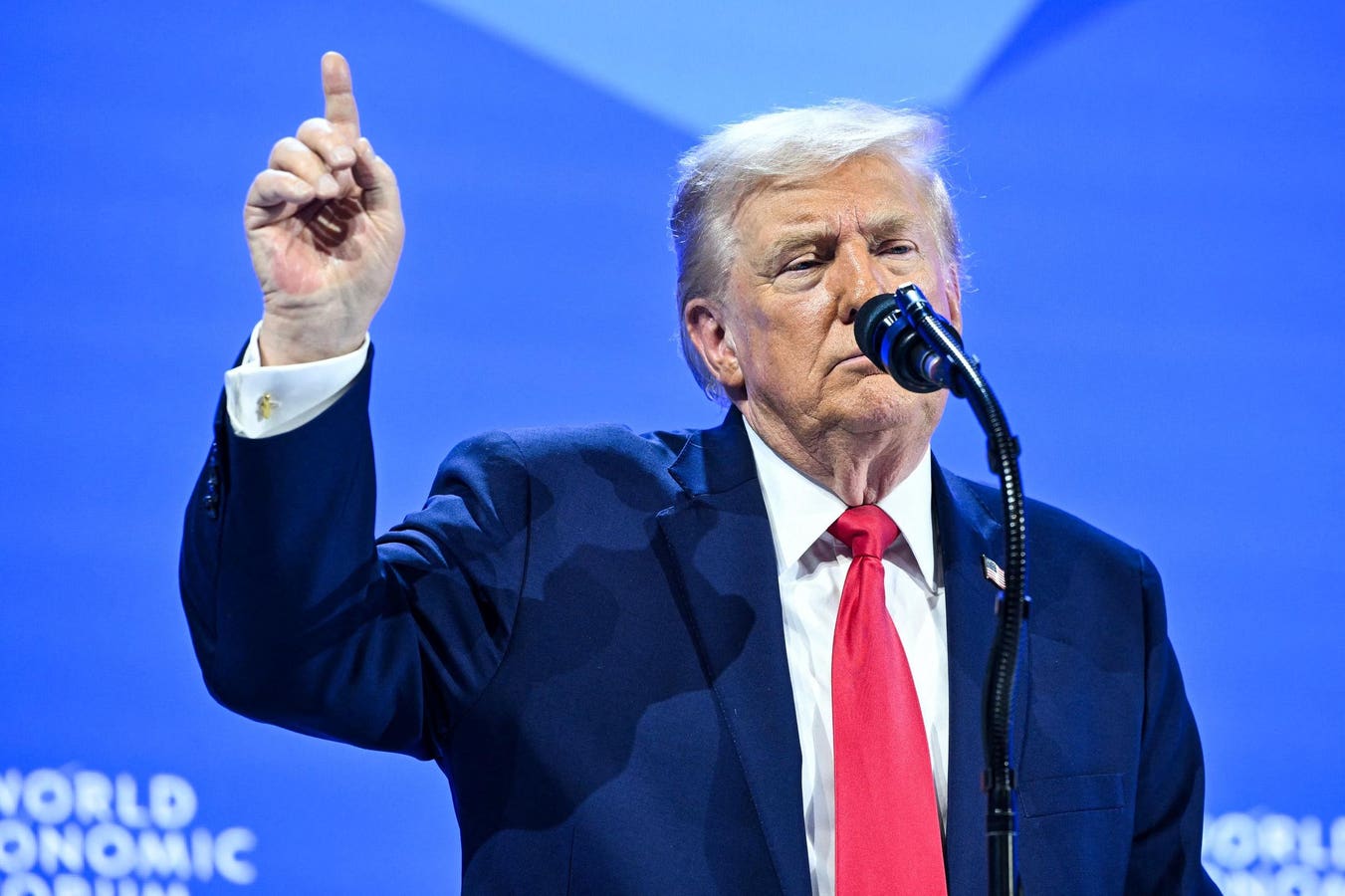
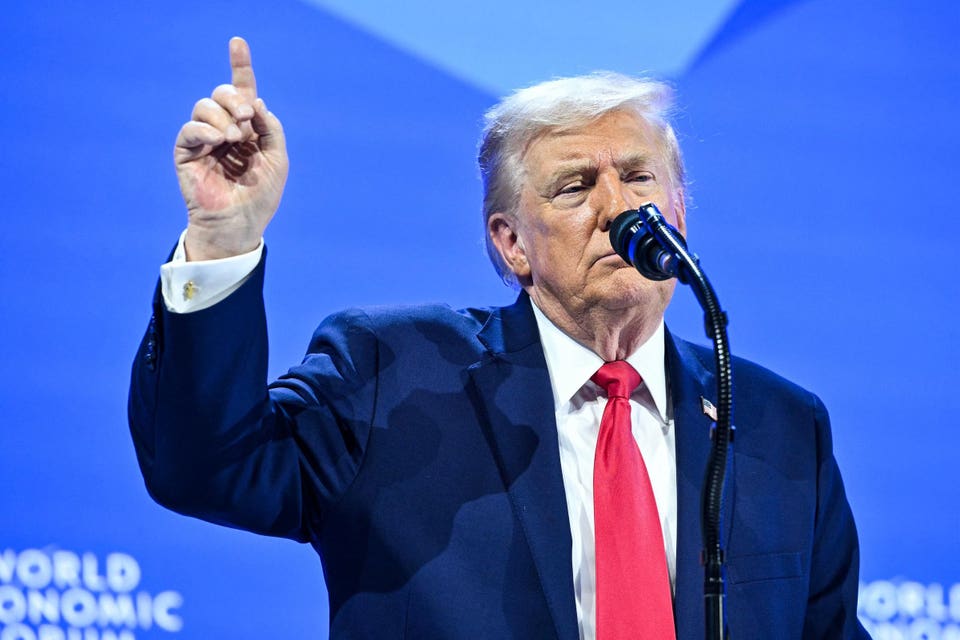
US President Donald Trump’s speech during the World Economic Forum (WEF) annual meeting in Davos on January 21, 2026. (Photo by Mandel NGAN / AFP via Getty Images)
AFP via Getty Images
It’s been a chilly week in geopolitics. President Donald J. Trump threatened to take Greenland from an ally by force, if necessary. He then retracted the threat of violence if not the desire for the Danish territory in a longwinded speech at the World Economic Forum in snowy Davos, Switzerland.
After the stunning deposition of Venezuelan President Nicolás Maduro in a raid by United States (U.S.) forces, world leaders must take an emboldened Trump’s words both seriously and literally. The resulting chilling effect on U.S. enemies and allies alike will long outlast the annual gathering of world leaders.
Some commentary has suggested that Trump’s lust for Greenland came out of nowhere, but it’s not even the first time the U.S. has tried to buy it — it’s at least the fourth since 1867 and it is the exact kind of sparsely populated, large land mass that the U.S. has successfully purchased in its history. The growing importance of the Arctic region is not a new story at all. You’ll need to borrow French President Emmanuel Macron’s sunglasses to block out that blinding reality in a warming world.
France’s President Emmanuel Macron gestures during the World Economic Forum (WEF) annual meeting in Davos (Photo by Fabrice COFFRINI / AFP via Getty Images)
AFP via Getty Images
So, here are a few reasons why this is not the last we are going to hear about Greenland.
Economic Importance
Increased global temperatures will lead to increased seasonal thawing in the Arctic. In practice, ice-free summers will open up additional shipping lanes as decreasing ice leads to increasing activity. The steady technological improvement of ice-breaking ships will also expand the season.
The Northern Sea Route could increase from 20–30 days of navigability per year to about 90–100 days by later this century according to the U.S. Climate Resilience Toolkit. For ships traveling from the North Pacific to northern Europe, that route is 40 percent shorter than the more widely used Suez Canal Route and would increase efficiency and trade volumes between Europe and China. Paired with the strained transatlantic relationship, such new options could inspire the European Union (E.U.) to fall further into China’s seductive economic embrace.
The E.U. as a block and the U.S. have the largest bilateral trade and investment relationship and the most integrated economic relationship in the world, representing almost 30% of global trade in goods and services and 43% of global Gross Domestic Product (GDP) according to the European Council. While China continues to be the U.S.’ third largest trading partner, the 2025 tariff war has already led China to seek other export markets beyond the U.S. They have found eager buyers for cheap stuff and lower prices in European consumers even if that makes European businesses and policymakers wary.
It would not bode well for U.S. businesses or consumers if the E.U. and China pulled away from it and closer to each other in trade while also selling off U.S. assets. A shorter Arctic trade route could accelerate this process.
Untapped Resources
The Arctic region contains abundant untapped resources that have thus far been impractical to exploit. As sea ice thaws, the prospect of resource extraction will be appealing in an energy-hungry world where climate pragmatism is the new guideline.
Oil and gas exploration is an obvious temptation. Just look at nearby Alaska where energy production is the main driver of the state economy, accounting for thousands of jobs and 80 percent of its revenue according to the National Oceanic and Atmospheric Administration (NOAA).
Greenland also contains significant mineral wealth according to the Center for Strategic and International Studies. Greenland is rich in iron ore, graphite, tungsten, palladium, vanadium, zinc, gold, uranium, and copper, as well as the rare earth elements (REEs) referenced by Trump in his speech. These REEs are vital to the industrial and defense supply chains of the future, especially batteries, and the current supply is dominated by China. China made this clear during the 2025 trade tension when it retaliated against U.S.-imposed tariffs by enforcing export controls on REEs, crippling the U.S. automotive sector almost immediately and leading the Trump Administration to reduce the declared tariffs. That’s not a comfortable position for the U.S. to find itself in and it is looking for alternative supplies even if that is a long-term goal.
Greenland ranks eighth in the world for REEs reserves. Together with its other untapped resources, this presents yet another attractive trait to any suitor in pursuit of technological and industrial preeminence. The U.S. won’t be the only one to make a play.
The Northern Front
That brings us to the ratcheting regional security concerns. A navigable Arctic is not just a potential economic advantage. It also becomes strategically important from the perspective of national security as shown on this map carving up the Arctic by controlling states. Greenland will suddenly find itself on a wide-open border between the United State and Russia that is no longer defended by glaciers and icebergs.
ANKARA, TURKIYE – JANUARY 5: The Importance of Greenland. (Photo by Mehmet Yaren Bozgun/Anadolu via Getty Images)
Anadolu via Getty Images
China, noting this increasing importance to global trade and defense, declared itself a “near-Arctic power” in 2018 when it announced its Polar Silk Road even though it technically lacks a geographic Arctic presence. With all these forces at work, increasing military traffic in the region is inevitable and potentially incendiary.
That said, Greenland is, and has been, under the control of a longstanding and amenable ally. It’s not clear why ownership is essential here when U.S. exploitation of all the above-mentioned resources was already being welcomed. The emphasis on ownership does seem to be in large part motivated by the man himself and his background in real estate, his place in history according to the Donroe Doctrine, and acknowledged anger about not having been awarded the Nobel Peace Prize. But as has been discussed, there is a lot more to the issue underneath the noise. That’s why you can expect increasing activity and attention in Greenland and the greater Arctic region beyond this news cycle.
Great power competition in this new theater is already underway and will accelerate on a heating planet. 2025 was third warmest year on record according to the World Meteorological Organization (WMO). Adaptation in this region is both necessary and already in process. I suspect that United Airlines will be adding more nonstop flights connecting Newark to Nuuk in the years to come and that Greenland will continue to make headlines beyond Davos.
NUUK, GREENLAND – JANUARY 17: People hold Greenlandic flags and placards(Photo by Sean Gallup/Getty Images)
Getty Images