
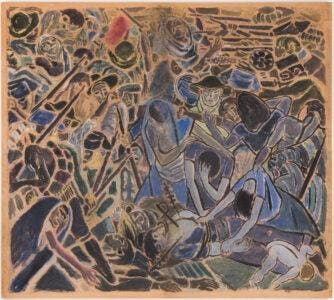
Wifredo Lam, ‘La Guerra Civil (The Spanish Civil War),’ 1937. Gouache on paper mounted on canvas, 6’11 ¼” x 7’9 ¼” (211.5 x 236.9 cm). Capriles Cannizzaro Family Collection © Succession Wifredo Lam, ADAGP, Paris / ARS, New York 2025
©2025 Silvia Ros Images
Wifredo Lam went to Spain from Cuba in 1923 at the tender age of 21 as a classically trained portrait painter.
These aren’t portraits. Or classical.
Not after 1937.
By then, Lam (1902–1982) had been radicalized.
Radicalized by fascists and the outbreak of the Spanish Civil War in 1936. Along with his brushes, he picked up a rifle and fought in Madrid beside the Republicans–the good guys in that case. Suffering from chemical poisoning as the result of working in a munitions factory, Lam went to recuperate in Barcelona.
There, in 1937, he produced his first overtly political and monumental work on paper, La Guerra Civil (The Spanish Civil War). The painting can be seen in the U.S. for the first time during the Museum of Modern Art in New York’s stupendous “Wifredo Lam: When I Don’t Sleep, I Dream” exhibition, the most extensive retrospective devoted to the artist in this country.
Dead bodies litter the street. One is stuck through with swords. Civilians grieve over them. A sea of faces–the righteous and the evil. A flag. A naked baby.
Bullfight imagery references the Badajoz Massacre, where Franco-aligned soldiers penned up roughly 4,000 opposition fighters as prisoners in the local bullring before murdering them all.
Notice the sickle mid-painting–the Communists were the good guys in the Spanish Civil War (don’t tell American history); they fought the fascists, a conflict that would shortly spread across Europe. The Communists and socialists and trade unionists and “radicals” in Germany and France and Italy and Russia fighting fascism across the continent same as their brothers in Spain.
Fascists outfitted by American corporations and industrialists. Ford. Texaco. J.P. Morgan. American business interests then and now hold warm feelings toward authoritarian regimes, so much easier to do business with than messy democracies and all their transparency and constantly rotating civil servants.
La Guerra Civil brings to mind Francisco Goya’s The Third of May 1808 (1814) that Lam saw in Madrid’s Prado Museum as well as Pablo Picasso’s famous Guernica, also produced in 1937, also in response to the Spanish Civil War, also highlighting fascist barbarism. Nazi planes bombed the city of Guernica in support of Spanish fascist Francisco Franco. Picasso depicts what he imagined the scene to look like after having read newspaper accounts.
In an ironic art historical sidenote, Picasso asked the Museum of Modern Art to hold Guernica for safe keeping, not to return the painting to Spain until Franco died. Finally, in 1981, after 42 years, the masterpiece was sent to Madrid.
MoMA won’t hold La Guerra Civil for that long, only through the end of the Lam exhibition, April 11, and it will ironically have to leave America for Spain to escape fascism, not the other way around.
La Guerra Civil hangs in the presentation’s opening gallery, a presentation bookended by Grande Composition (Large Composition) (1949), an image of liberation and empowerment. The massive painting, Lam’s largest, nearly 14 feet across, has not been shown in more than 60 years, never in the US.
Wifredo Lam (Cuban, 1902–1982), ‘Mother and Child,’ 1939. Gouache on paper 41 x 29 (104.1 x 73.7 cm). The Museum of Modern Art, New York. Purchase
Chadd Scott
War wasn’t the only hardship the artist experienced in Spain. In 1931, Lam’s first wife and son died from tuberculosis. TB at that time was no longer a death sentence for those with access to competent medical care. The Lam’s lacked that access. Heath care as a human right and demands for universal access to basic medical treatments are not a 21st century invention.
Lam’s Madre y niño (Mother and Child) (1939) suggests the tragedy. MoMA’s famed founding director Alfred H. Barr Jr. acquired the painting directly from the artist’s Paris gallery that year, the first of his paintings to join a museum collection.
MoMA and Wifredo Lam go way back.
Lam later married the director of a tuberculosis laboratory.
Citizen Of The World
Spanning the six decades of Lam’s prolific career, the exhibition includes more than 130 artworks from the 1920s to the 1970s including paintings, large-scale works on paper, collaborative drawings, illustrated books, prints, ceramics, and archival material, with key loans from the Estate of Wifredo Lam, Paris. La jungla (The Jungle) (1942–43), arguably his best-known work, is a highlight. The vibrant and evocative painting foregrounding the Caribbean landscape, its inhabitants, and its histories of slavery and indenture, has been in MoMA’s collection since 1945.
The artwork holds a special place in MoMA history.
“Some days, when I lived in Harlem, I would visit MoMA just for a moment to see Wifredo Lam’s 1943 painting The Jungle, which hung off the lobby near the coat check,” eminent contemporary artist Kerry James Marshall is quoted as saying in the exhibition catalogue.
The Jungle’s placement in the entry lobby meant it could be admired without paying museum admission. The location, both prominent yet excluded, reveals how MoMA staff recognized the painting as a masterpiece beloved by the public, but uncategorizable among its strictly siloed galleries.
Modern art didn’t have a tidy category in which to place Lam in the 20th century.
Wifredo Lam, ‘La jungla (The Jungle),’ 1942-43. Oil and charcoal on paper mounted on canvas, 7’10 ¼” × 7’6 ½” (239.4 × 229.9 cm). The Museum of Modern Art, New York © Succession Wifredo Lam, ADAGP, Paris / ARS, New York 2025
The Museum of Modern Art, New York
“When I Sleep I Dream” reveals how Lam—an artist born in Cuba to a Chinese father and mother with mixed Congolese and Spanish ancestry who spent most of his life in Spain, France, and Italy—came to embody the figure of the transnational artist commonplace today. Transnational by choice and desperation. Same as today.
He chose to study in Spain. War forced him to Paris in 1938.
“To leave Spain defeated was and is for me such a deep pain that I have never stopped carrying it inside me,” Lam said later in life. “In the beloved Spanish land I left Eva and my son dead. I also left many brothers in struggle.”
In Paris, he met Picasso. While Picasso’s interest in African masks, apparent in another of MoMA’s gems, another of art history’s greatest paintings, Les Demoiselles d’Avignon (1907), passed, the imagery stuck with Lam throughout his career.
“(Lam’s) commitment to making his painting an ‘act of decolonization,’ as he put it, forever changed modern art,” Christophe Cherix, The David Rockefeller Director at the Museum of Modern Art and exhibition co-organizer, said in a press release announcing the show.
“Africa has not only been dispossessed of many of its people, but also of its historical consciousness… I have tried to relocate Black cultural objects in terms of their own landscape and in relation to their own world,” Lam is quoted in exhibition wall text.
Lam also met Surrealist André Breton in Paris before the war again forced him to flee–Picasso safeguarding his paintings–this time to Marseille. There, he collaborated with Surrealists who were also awaiting safe passage out of Europe. They fled to America and Mexico, and in Lam’s case, back to Cuba via Martinique in 1941; neither the U.S. nor Mexico would accept him.
Lam’s return to Cuba led to a complete reinvention of his work and the creation of some of his most important paintings, including The Jungle.
“The trees, the fruit, the light… dazzled me; it was there that encountered… the sources of ancestral cultures that lived in my unconscious mind,” Lam is further quoted in the exhibition.
The quality of light he had forgotten about in Cuba from his time there as a boy shocked him, as did the poverty.
Lam traveled widely–Haiti, back to Europe after the war, the United States–absorbing what he saw, his art constantly evolving and expanding.
“He insisted on placing diasporic culture at the heart of modernism—not as a peripheral influence, but as central, a generative force,” Cherix added.
Political unrest would again force Lam to move.
Fulgencio Batitsta’s military coup in 1952 pushed the artist out of his birth country for good. Back to Paris, by choice, then finally to Albissola Marina, Italy in 1962 where he’d live out the remainder of his life making art, deeply engaged with the other artmaking taking place around the world.
The Caribbean, Africa, Asia, Europe–Lam prefigured contemporary artists inspired by, descended from, traveling, and living globally. Global influence from study and personal experience. An archetype for what is now expected.
Moxy Lower East Side
NEW YORK, NEW YORK – FEBRUARY 25: People attend the annual Lunar New Year parade in Chinatown on February 25, 2024 in New York City. People gathered to enjoy and celebrate the 26th annual Lunar New Year parade, commemorating the end of the 15 days honoring the first new moon on the lunar calendar. 2024 is the “Year of the Dragon.” (Photo by Michael M. Santiago/Getty Images)
Getty Images
If visiting New York, consider staying at the Moxy Lower East side less than .5 miles from the New Museum (reopening March 22) and the Tenement Museum. Marvel at remaining tenement buildings from the hotel’s fabulous rooftop bar with unobstructed views west to the Hudson River, north to the Empire State Building, and south to One World Trade Center.
The property borders Chinatown and Little Italy along historic Bowery street. Destination pizza places Lombardi’s and Williamsburg Pizza are three blocks away.
The hotel was built new in 2023, but hints to the Bowery’s history of performance–live music and circus–through décor and artwork. Pay close attention to wallpaper details. Cheeky, stylish, hip.
Moxy hotels are known for their reasonable rates, lively public spaces, and compact rooms, perfect for solo travelers and couples looking to get out and explore, not hole up with room service. The brand’s Lower East Side location leans into that ethic.
Enjoy an old-school, sit down, tabletop Ms. Pac-Man arcade game in the lobby. Thursdays through Saturdays, local DJs welcome guests by spinning near the entrance. The beats continue long past midnight at Loosie’s subterranean nightclub. Wednesdays through Saturdays, live music in the restaurant adjacent to check-in has “MTV Unplugged” vibes with previous acts including Sublime and Train. The on-site modern Japanese restaurant Sake No Hana employs sake sommeliers.
More From ForbesForbesWifredo Lam’s ‘Mental Decolonization’ On View At Gary Nader Art Centre In MiamiBy Chadd ScottForbesContemporary Native American Artwork On View Across New York This WinterBy Chadd ScottForbesNoah Davis Paintings At Philadelphia Art MuseumBy Chadd Scott