


January 19, 2026 — 7:00pm
Save
You have reached your maximum number of saved items.
Remove items from your saved list to add more.
Save this article for later
Add articles to your saved list and come back to them anytime.
Got it
AAA
Singapore: In China’s sprawling megacities, where millions of people live solitary lives in towering apartment complexes, will anyone notice if they disappear for a few days? What if they get sick or have an accident – who will know and call for help?
These are the questions many young Chinese people are asking themselves as isolation-driven anxieties have fuelled the rise of a once little-known app called Are You Dead? to the top of the country’s download charts last week.
The app, which was called Sileme in Chinese and pitched as a “a lightweight safety tool for solo dwellers”, requires users to check in each day by tapping a button. If they fail to do so for two consecutive days it alerts a nominated emergency contact.
 The app Are You Dead?, pictured on a smartphone in Beijing, surged in popularity among young people in China in recent weeks before developers announced a rebrand to a less controversial name. AP
First launched in June as a free app, its soaring popularity prompted the crack team of developers to introduce an eight yuan ($1.72) fee and to announce a rebranding to a less confronting name – Demumu – for its new global version to be released soon.
In announcing the new Demumu name – a combination of death and Labubu, the plush Chinese toys that have taken the world by storm – the developers urged more awareness of social isolation.
“We would like to call on more people to pay attention to those living alone and to give them more care and understanding. They have dreams and strive to live well; they deserve to be seen, respected, and protected,” the statement said.
For many, the app’s sardonic branding is a core part of its appeal, tapping into a dark humour among China’s Millennial and Z generations and spurring widespread discussions about social isolation and death in a country where more than 125 million people live alone.
“I sometimes fear, what if I’m not noticed by others when I fall down because I faint or from sickness? Or in an extreme case I die, but it goes unnoticed? So this app actually alleviates such fear from loneliness to some degree,” Yu Maohuan, 29, a geologist in Beijing, says in an interview.
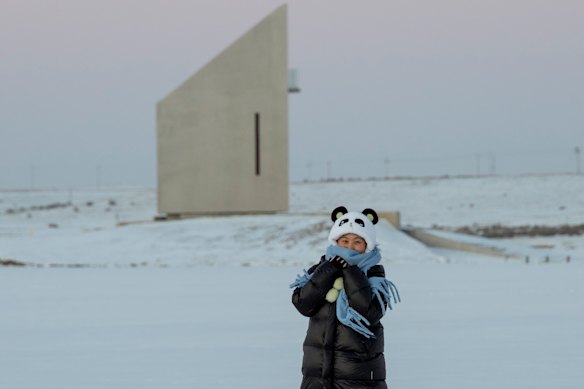 Yu Maohuan, a 28-year-old geologist who lives in Beijing, in front of the Lonely Church at Laolihai Lake in Ulanqab City, in China’s Inner Mongolia region. Sanghee Liu
Yu currently lives in dormitory-style accommodation and says she doesn’t feel the need to download the app just yet, but can see its appeal in the future.
 A man cuts a solitary figure at the Canal Business District in east Beijing’s Tongzhou district.Sanghee Liu
“When my parents become old and my friends get married, but my choice is not to get married and I don’t have a stable partner, I may feel such panic and anxiety at that time,” she says.
With China’s domestic economy in the doldrums, many young people have flocked to big cities like Beijing, Shanghai and Shenzhen to chase better paying jobs, only to struggle to get ahead, leaving them more likely to shun the idea of having children, experts say.
At the same time, the number of China’s single-person households is growing, with Chinese firm Beike Research Institute, estimating the number of young people aged 20-39 living alone is expected to increase from 18 million in 2010 to 40-70 million in 2030.
Another factor is China’s one-child policy. Though officially abandoned in 2016, its legacy for some Chinese people has been a transition from only child to lonely adult.
Related Article
“People are reluctant to socialise, reluctant to marry and have children,” said Dr Fuxian Yi, a demographer at University of Wisconsin-Madison and critic of the one-child policy.
It comes as the country faces a demographic crunch of an ageing population combined with declining marriages and births. In figures released on Monday by the National Bureau of Statistics, China’s population shrank for the fourth consecutive year in 2025, declining by 3.39 million to hit 1.405 billion, while its birthrate fell to its lowest level since the founding of the People’s Republic in 1949.
On Douban, a Chinese social media site similar to Reddit, discussions about loneliness and death has flourished as Are You Dead? has gone viral.
“I often even worry that in my current situation, where I have no partner and my relationship with friends is not very close, if my parents get old, once they get sick, there may not even be anyone to accompany me to the hospital,” wrote one user, who identified herself as a 32-year-old woman and an only child living in Beijing.
Related Article
Another user wrote: “Some people also say that ‘Are You Dead?’ sounds inappropriate and should be changed to ‘Are You Alive?’ It just goes to show that avoiding mentioning death is still a major theme in our society.”
The surging popularity of the app has taken even the developers surprise.
In a statement released on January 11 on social networking site Weibo, they described themselves as a “small, unknown team, founded and independently operated by three people born in the ’90s”.
Get a note directly from our foreign correspondents on what’s making headlines around the world. Sign up for our weekly What in the World newsletter.
Save
You have reached your maximum number of saved items.
Remove items from your saved list to add more.
 Lisa Visentin is the North Asia correspondent for The Sydney Morning Herald and The Age. She was previously a federal political reporter based in Canberra.Connect via Twitter or email.From our partners