
 Close
Close
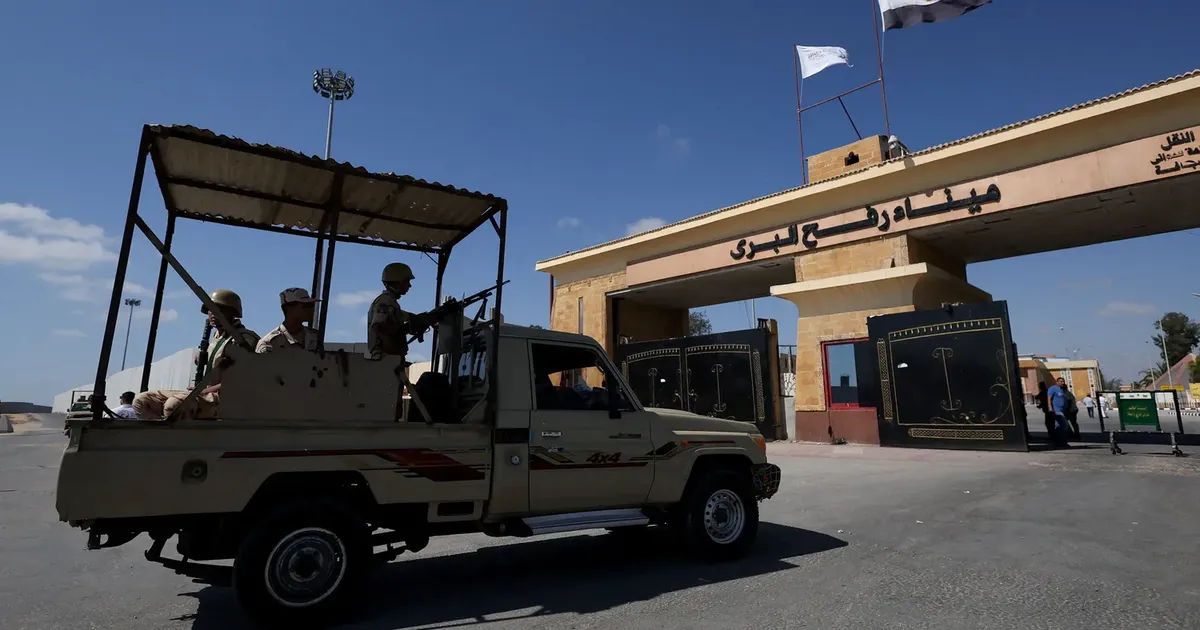
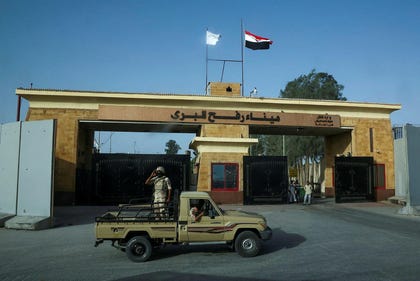
Egyptian soldiers stand guard near the Rafah Crossing at the Egypt-Gaza border, in Rafah, Egypt, 2024. Credit: Amr Alfiky/Reuters
Egyptian soldiers stand guard near the Rafah Crossing at the Egypt-Gaza border, in Rafah, Egypt, 2024. Credit: Amr Alfiky/Reuters
Israel has agreed to open the Rafah crossing connecting the Gaza Strip and Egypt, the Prime Minister’s Office said overnight on Monday, adding that the border would be opened once searches for the last remaining deceased hostage, Ran Gvili, are concluded.
According to the statement, the opening would be limited to the passage of people only and subject to Israeli supervision. It said the move was conditioned on Hamas making a “100% effort” to locate Gvili’s body, but not on the body being found.
The crossing would open after Israel concludes an operation to “fully exhaust all intelligence obtained as part of the effort to locate and recover the body of hostage Ran Gvili,” the Prime Minister’s Office statement concluded.
The statement followed a security cabinet meeting on the anticipated opening of the crossing, after Ali Shaath, head of a U.S.-backed transitional Palestinian committee tasked with temporarily running Gaza, announced last week that the Rafah border crossing would open this week.
Shortly before the cabinet convened, the Prime Minister’s Office announced a “large-scale operation” launched over the weekend to find Gvili’s body centered on a cemetery in the Tuffah neighborhood in Gaza City, following new intelligence on its location.
The Gaza side of the crossing has been under Israeli military control since 2024, and has remained a key unfulfilled element of the cease-fire, brokered by Trump in October last year.
Three sources briefed on the matter said Israel wants to restrict the number of Palestinians entering Gaza through the border crossing with Egypt to ensure that more are allowed out than in. Speaking on condition of anonymity due to the sensitivity of the issue, it remains unclear how Israel planned to enforce limits on the number of Palestinians entering Gaza from Egypt, or what ratio of exits to entries it aimed to achieve.
The three sources said that Israel also wants to establish a military checkpoint inside Gaza near the border, through which all Palestinians entering or leaving would be required to pass and be subjected to Israeli security checks. Two other sources, which also confirmed plans for an IDF checkpoint in Gaza, said that it was not clear how individuals would be dealt with if Israel’s military blocked them from passing through its checkpoint, particularly those entering from Egypt.
An Israeli official told Reuters the government would determine when the border would open and that Palestinians would not be able to leave or enter Gaza without approval from Israel.