
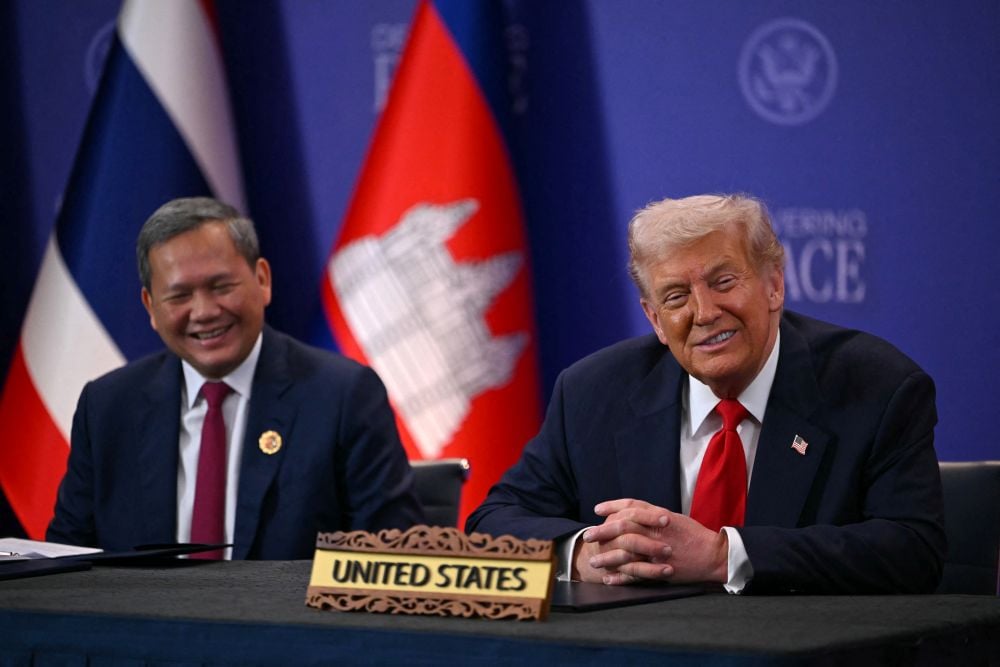
US President Donald Trump (R) smiles next Cambodia’s Prime Minister Hun Manet (L) ahead of a ceremonial signing of a ceasefire agreement between Cambodia and Thailand on the sidelines of the 47th Association of Southeast Asian Nations (ASEAN) Summit in Kuala Lumpur on October 26, 2025. (Photo by ANDREW CABALLERO-REYNOLDS / AFP)
PHNOM PENH – As US President Donald Trump invites Cambodia to become a founding member of a new initiative known as the Board of Peace, the decision on whether to accept presents both challenges and opportunities for the Hun Manet government as it seeks to balance relations with major powers.
Trump sent a letter to Prime Minister Hun Manet on January 16, inviting Cambodia to join as a Founding Member State and become a party to the charter of the Board of Peace, though the invitation was only made public several days later.
In the letter, Trump said he was honored to invite Cambodia to join what he described as a historic initiative to “solidify peace in the Middle East and, at the same time, embark on a bold new approach to resolving global conflict.”
Ro Vannak, an international relations professor, said Washington’s invitation to Phnom Penh was significant given that Cambodia is a small state rather than a major actor in international politics.
“It reflects Cambodia’s image as a country advocating peace within ASEAN and beyond,” Vannak said, adding that the move also demonstrates US efforts to expand diplomatic influence in Southeast Asia, where China has emerged as its most formidable competitor.
“The invitation also reinforces Trump’s narrative that the proposed Board of Peace is an inclusive peace initiative that deserves greater recognition than what he portrays as an exclusive Western elite club,” he said.
Invitation Presents Opportunities
Trump signed the charter of the Board of Peace along with a small group of world leaders on January 22 on the margins of the World Economic Forum in Davos, Switzerland.
However, uncertainty continues to surround the nature and role of the proposed body, and the initiative has attracted skepticism from some US allies. Critics have raised concerns that it could serve as a rival to multilateral institutions such as the United Nations.
Vannak said that for Cambodia, the invitation offers potential benefits and serious challenges.
While joining could be seen as prestigious, elevating Cambodia’s diplomatic profile and opening doors to political and economic gains through expanded engagement with Washington, he said it also serves as test for the country’s ability to balance relations with major powers.
“This is particularly between the United States and China, while Cambodia seeks to maintain strategic autonomy and an ASEAN consensus-based approach,” he said.
From a cost-benefit perspective, participation could enhance Cambodia’s security credibility and international standing, something the country has historically lacked, he added.
Closer ties with the US could also help boost economic growth, attract investment, and deepen cooperation on security issues, while reducing Cambodia’s heavy economic dependence on China and diversifying its external partnerships.
Not Free of Risks
Despite the opportunities, analysts warn that the risks and costs are substantial, as participation could entail expenses of up to $1 billion, which emerges as a challenging task for Cambodia as a small economy.
Ear Sophal, an associate professor at the Thunderbird School of Global Management at Arizona State University, said the invitation must be assessed in light of the Board of Peace’s draft charter, which effectively creates a two-tier system.
Countries may join for three years, but only those contributing $1 billion can secure a permanent seat. While framed as an honor, Sophal said the offer tests a country’s willingness to buy influence in an institution with a lifelong chairman.
“The optics of joining something already criticized as a pay-to-play forum would be challenging for any country, but especially for one seeking to avoid perceptions of alignment with a single major power,” he said.
Sophal added that if Cambodia joins without paying the billion-dollar fee, it would be limited to a three-year term, renewable only at the chairman’s discretion.
“Paying the fee is fiscally impossible. Either path risks signaling a tilt toward a body widely described by diplomats as a Trump-centric alternative to the UN,” he said.
“Cambodia has historically valued multilateral legitimacy because it protects small states. Aligning with a mechanism that appears to weaken established multilateralism runs counter to that long-standing strategy.”
Vannak agreed that many observers may view the Board of Peace as a geopolitical tool rather than a genuine multilateral mechanism, and as a potential rival to institutions such as the UN.
“That would complicate Cambodia’s neutral foreign policy and draw criticism from ASEAN partners and China,” he said.
He added that participation in a US-led initiative could also expose Cambodia to increased pressure from major powers such as China and Russia, both critical partners in its development.
How Can Cambodia Lower Risks?
Asked whether Cambodia should accept the invitation, Vannak said the response should depend on membership conditions rather than immediate acceptance.
“Phnom Penh could signal its willingness to participate as a founding member while setting clear conditions to ensure that its foreign policy independence is not compromised,” he said.
For Sophal, nonparticipation should be seriously considered given the uncertainties surrounding the initiative.
“This would avoid entanglement in an untested institution whose governance is concentrated in a single individual with unchecked authority,” Sophal said.
If Cambodia decides not to join, Sophal suggested it could reduce diplomatic fallout by taking a principled multilateral stance rather than a geopolitical one.
“Cambodia can welcome reconstruction efforts in Gaza and express support for humanitarian objectives while deferring membership until the board’s governance stabilizes and its financing model aligns with global norms,” he said.
Such an approach would neither reject the United States nor commit Cambodia to a structure viewed skeptically by many partners, preserving diplomatic space with Europe, ASEAN, and the UN while signaling respect for US priorities.
For small states like Cambodia, Sophal said it is crucial to avoid binary choices by anchoring decisions in transparent, inclusive processes with institutional safeguards.
“Cambodia can simply state that it cannot commit until the charter reflects these standards,” he said.