
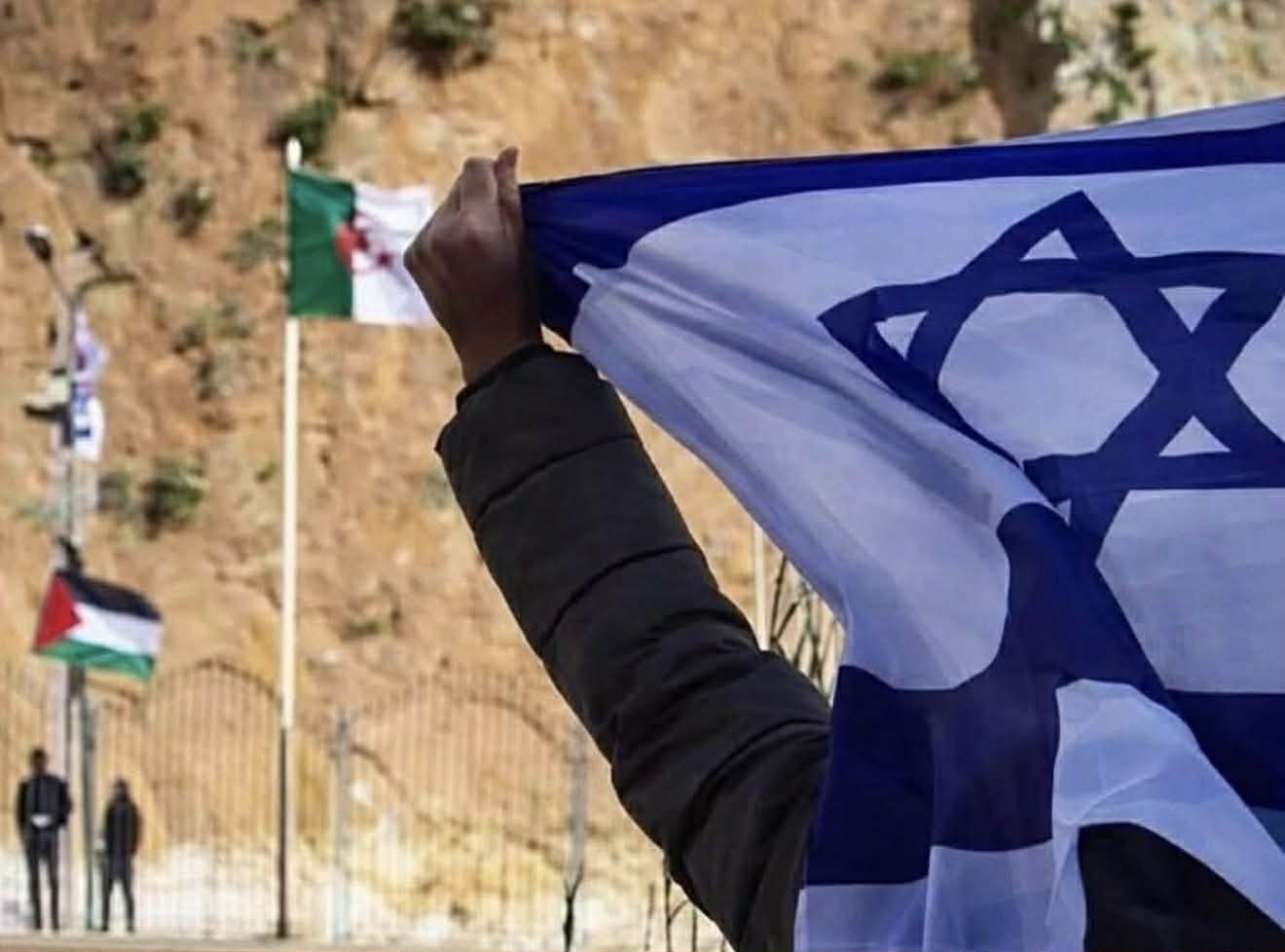
The brief video that surfaced last week from the outskirts of Saïdia – showing an Israeli tourist momentarily waving a flag near the Moroccan-Algerian border, followed by the raising of a Palestinian flag from the opposite side – would, in a calmer regional climate, have remained what it objectively was: an unplanned, individual gesture devoid of institutional meaning. No confrontation followed, no violence erupted, and no authority intervened. That was the entirety of the event.
Yet it took only a few seconds of footage to ignite a storm that says far more about the region’s unresolved tensions than about the act itself. Within hours, the image was stripped of context and repackaged online as evidence of provocation, betrayal, or moral collapse – depending less on what occurred on the ground than on the ideological reflexes, historical grievances, and prior convictions that audiences were already primed to project onto it.
Morocco, however, has never been a country that governs itself through emotional reflex. By design and by practice, the North African kingdom is not a state that criminalizes symbols simply because they provoke disagreement. Its public sphere has long accommodated expressions that clash, coexist, and contradict one another – ranging from fervent displays of solidarity with Palestine to forms of cultural and religious plurality that would be unthinkable elsewhere in the region.
Moroccan streets routinely host Palestinian flags, protest chants, and demonstrations that reflect genuine popular sentiment. The presence of an Israeli flag, waved briefly by an individual tourist, does not rupture that tradition. It simply exists within it.
The act captured in the video was legal, fleeting, and non-representative – no different in principle from the countless demonstrations that take place daily across Moroccan cities without ever claiming to speak for the nation as a whole. Morocco is not a land where flags – however controversial – are policed by mobs or militias.
The law allows such expressions. The state tolerates them. And society, more often than not, absorbs them without hysteria. The actions of a single tourist do not speak for a people, just as those who wave Palestinian flags in Moroccan streets do not speak for all Moroccans. States are not crowds, and nations are not hashtags.
What gave the incident its disproportionate resonance was not its substance, but its exploitation. What transformed a fleeting, inconsequential act into a political spectacle was not Moroccan reaction, but Algerian fixation. From across the border came a torrent of condemnation, indignation, and moral posturing – couched in the language of ethical outrage – that would be more persuasive if it were not so familiar.
For decades, Algeria has spoken the vocabulary of justice while practicing the politics of obstruction, particularly where Morocco is concerned. A state whose official doctrine has long rested on hostility toward Rabat suddenly discovered moral fervor. The same regime that openly celebrates Moroccan sporting defeats and has never mobilized its population in sustained, genuine solidarity with the Palestinian people now claims ethical superiority over a flag waved by a tourist. This is not solidarity. It is instrumentalization.
The sudden rediscovery of moral guardianship feels less like principle than like a continuation of a long-standing strategy: seizing every symbolic moment to reaffirm hostility toward Morocco. That posture collapses under even modest historical scrutiny. Geopolitics, after all, and unlike social media, is not adjudicated by sentiment, but by record.
When Morocco’s modern history is examined with intellectual honesty, a pattern emerges that complicates the simplistic binaries so often imposed upon it. Israel did not engineer the Western Sahara conflict. It did not found or arm the Polisario Front, proclaim a phantom republic on Moroccan territory in 1976, or sustain an armed separatist movement for half a century. It did not train militants, finance insurgency, or lobby relentlessly to fracture Morocco’s sovereignty. It did not participate in attacks that killed Moroccan civilians or soldiers, nor did it orchestrate episodes such as Gdeim Izik or underwrite campaigns designed to sever Morocco from its African depth.
Algeria did all of that – and has never meaningfully denied it. Algeria hosted, armed, financed, and politically shielded separatist militias whose operations cost Moroccan lives across decades. It recognized and sustained a self-proclaimed entity erected on Moroccan soil and spent vast resources – measured not in rhetoric but in budgets – attempting to fracture Morocco’s territorial integrity. Israel did not wage that campaign. Algeria did.
History, after all, is not a matter of sentiment. It is a matter of archives. It is not a matter of interpretation. It is a matter of record. Algeria’s role has been continuous, calculated, and devastating, draining not just public funds but the very prospects of regional integration it claims to defend. The Maghreb remains one of the least integrated regions in the world, not because of fate or colonial inheritance, but because one state chose rivalry over reconciliation and fixation over development.
Morocco’s relationship with Israel deserves to be discussed with seriousness rather than slogans. It did not begin in 2020, nor was it born of opportunism or transactional diplomacy. Long before normalization agreements entered diplomatic headlines, there existed a web of historical memory and pragmatic cooperation that shaped mutual perceptions.
During the Second World War, when Vichy authorities sought to impose antisemitic statutes and deport Moroccan Jews, the Moroccan monarchy refused to comply – not to impress foreign capitals, but to affirm a principle that continues to resonate: Moroccan Jews were Moroccans, not bargaining chips, and their fate was not a matter for negotiation. Moroccan citizenship was not expendable. That decision – taken when resistance carried real risk – has never been forgotten. That moment forged a bond rooted less in ideology than in trust, anchoring a relationship sustained by memory and reciprocity rather than momentary alignment.
In subsequent decades, particularly during periods of internal instability and regional war – moments of acute vulnerability for the Moroccan state – cooperation with Israel took on a discreet yet consequential form. Nor should it be ignored that during the most perilous chapters of modern Moroccan history – attempted coups, regional wars, intelligence threats – it was Israel that provided quiet but decisive support.
Intelligence cooperation helped neutralize threats to the monarchy and contributed to foiling destabilization efforts against King Hassan II. Strategic assistance strengthened Morocco’s defensive posture in the Sahara at a time when several Arab states – not Israel – were aligned against Rabat, hostile to its position, or complicit in its isolation. These actions were not accompanied by grandstanding, moral lectures, or performative rhetoric. They were practical, quiet, and effective – undertaken when they mattered most.
Morocco has never conducted foreign policy as a moral performance. It has conducted it as an exercise in survival, sovereignty, and continuity, shaped by a clear hierarchy of national interests rather than ideological absolutism. States that endure do so by distinguishing between rhetoric and reliability, by refusing to confuse chants with loyalty. They judge partners by conduct, particularly under pressure, not by volume.
By that standard, Israel has been a notably predictable partner on Morocco’s core national concern: territorial integrity. Diplomatic backing, defense cooperation, technology transfer, and local industrial investment have followed a clear logic – one that prioritizes capacity-building over dependency. Support has been expressed in international arenas, advanced cooperation has come with training and integration, manufacturing and investment have had local footprints, and Moroccan engineers and workers have been brought into value chains that extend beyond symbolism.
The contrast with Algeria’s approach is difficult to ignore. Where Morocco has diversified alliances and embedded itself in global networks, Algeria has doubled down on grievance and pathology. Where Morocco has treated sovereignty as a foundation for cooperation, Algeria has treated Morocco’s sovereignty as a problem to be managed, resisted, and undermined – investing immense resources not in regional integration or Maghrebi unity, but in the long project of weakening a neighbor.
The result is a region stalled by choice, not circumstance – a Maghreb of nearly one hundred million people divided less by fate than by deliberate policy. The tragedy is not merely political. It is civilizational.
None of this requires Moroccans to abandon empathy for Palestinians or to silence criticism of Israeli policy. Morocco does not demand that others love Israel, and it has never required ideological conformity from its citizens. What it does demand – quietly but firmly – is honesty: honesty about who has worked to divide this country, who has invested in its destabilization, and who, over time, has stood with it when the stakes were real. Do not rewrite history. Do not pretend neutrality while funding separatism. Do not invoke religion to legitimize the undermining of a neighbor’s sovereignty. Faith does not sanctify betrayal.
Flags waved by tourists fade quickly. The historical ledger endures. And when history is read without theatrics, Morocco’s strategic choices appear less provocative than inevitable. The true enemy of Morocco has never been hidden. It does not wave flags for tourists; it drafts militias, finances division, and weaponizes grievance.
No display of moral pageantry can alter that fact. In geopolitics, friendship is not declared through slogans – it is proven through behavior sustained over time. And over time, Israel has proven itself a reliable partner to Morocco. That, more than any viral video, is the truth that stands.