
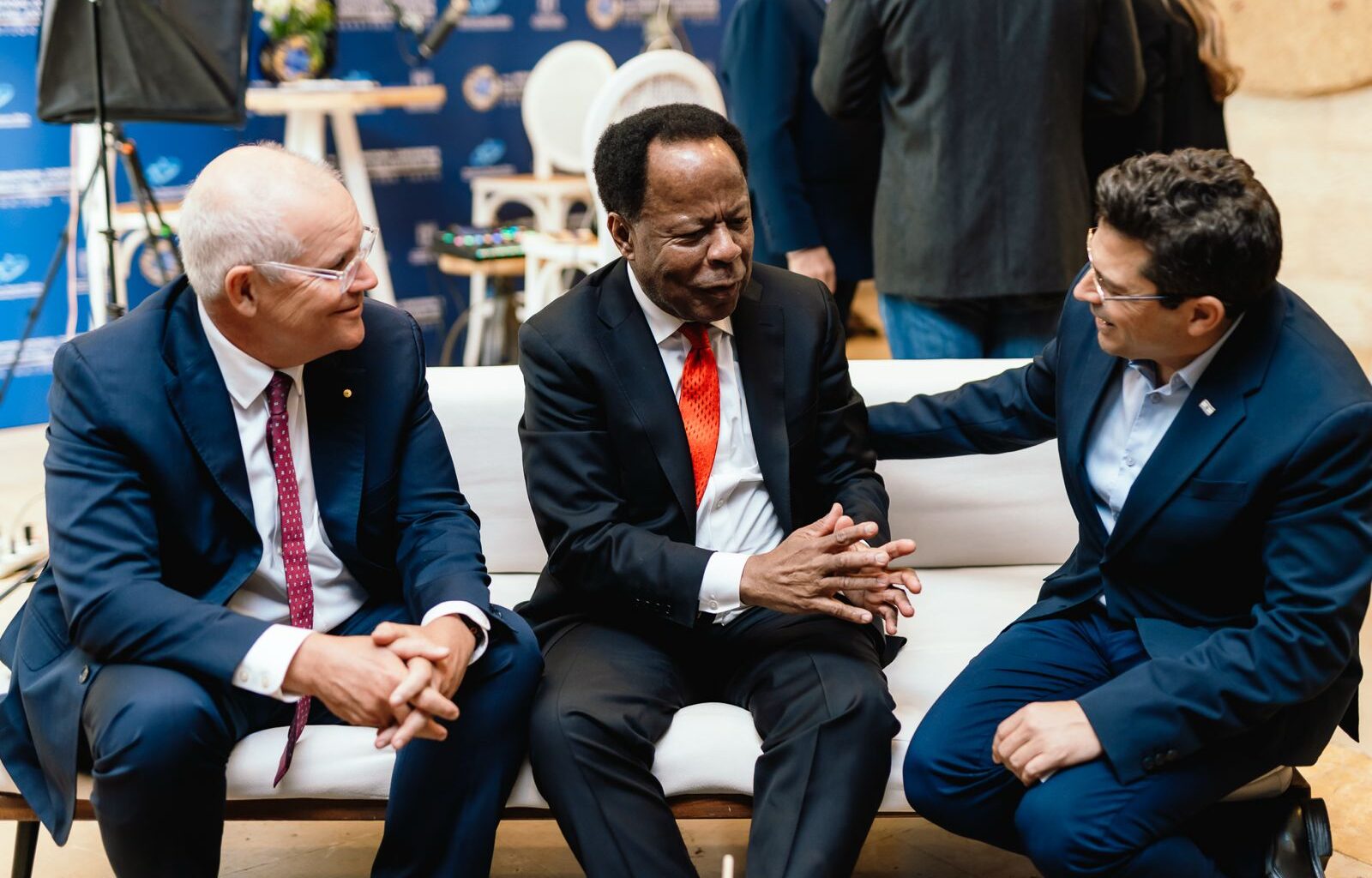
After last year’s government-sponsored International Conference on Combating Antisemitism sparked controversy for including far-right politicians, this year’s version was a more muted affair.
Right-wing politics were still on full display at the conference on Tuesday, with a colorful lineup of influencers, Israel advocates, and foreign politicians including some from the far right, and intellectuals associated with conservative movements from within Israel and around the world.
However, appearances by Israeli President Isaac Herzog, Jewish Federations of North America President and CEO Eric Fingerhut, and other mainstream voices helped temper the mood at Jerusalem’s International Convention Center.
Ahead of last year’s event, several high-profile Jewish leaders backed out due to the inclusion of far-right European politicians. But this year, Diaspora Affairs Minister Amichai Chikli made a point of working closely with Diaspora community leaders to avoid a repeat of the whirlwind of contention, sources told The Times of Israel.
Discussions still focused heavily on the threat posed by jihadist movements abroad, an emphasis of Europe’s far right, as well as the dangers posed by social media and right-wing and left-wing movements.
Get The Times of Israel’s Daily Edition
by email and never miss our top stories
By signing up, you agree to the terms
“This conference seeks to banish political correctness, call the child [antisemitism] by its true name, and mobilize all forces in the ideological and physical struggle against the heirs of the modern Nazis,” Chikli said in his welcome address. “This is not just the struggle of the Jewish people. This is the struggle of the free world against the imperialism and tyranny of radical Islam.”
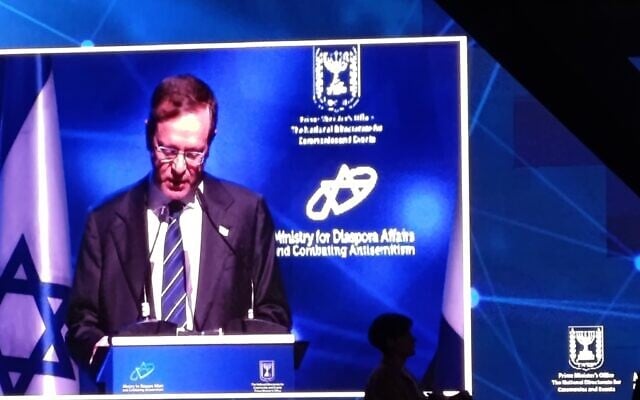
A video screen shows President Isaac Herzog speaking at the International Conference on Combating Antisemitism in Jerusalem, January 27, 2026 (Zev Stub/Times of Israel)
Herzog opened the event, held on International Holocaust Remembrance Day, with a warning that antisemitism remains a potent and deadly force 81 years after six million Jews were killed in the Shoah.
“The Holocaust was the single greatest catastrophe in the history of humanity and in the history of our people,” Herzog said. “The same ancient poison — hatred of Jews — has always carried the same name: antisemitism. Let us call it what it is.”
Chikli, whose ministry organized the conference, has said that one of the conference’s main purposes was to help Israel cultivate ties with the political parties already challenging radical Islam abroad, and invited several members of far-right parties in Europe, which have been historically associated with antisemitic elements.
Politicians associated with the far right who were present at the event included Sweden Democrats leader Jimmie Åkesson, Brazilian senator Flávio Bolsonaro, Belgian lawmaker Sam van Rooy and Dutch lawmaker Geert Wilders.
The conference also included current and former leaders such as Albanian Prime Minister Edi Rama; former Austrian chancellor Sebastian Kurz and former Australian prime minister Scott Morrison, whose country experienced a terror shooting at a Hanukkah event last month that killed 15 Jews.
Argentine Justice Minister Mariano Cúneo Libarona, Hungarian EU Affairs Minister János Bóka and US Ambassador to Israel Mike Huckabee were also present.
Influencers and thought leaders on stage included conservative author and filmmaker Dinesh D’Souza, UK legal advocate Natasha Hausdorf, Seth Dillon, who heads the US conservative satire site the Babylon Bee, and Noa Cochva, a former Miss Israel who now engages in public advocacy for the Jewish state.
On the first day of the conference on Monday, delegates met for a plenary session in Knesset and a nighttime gala event attended by Prime Minister Benjamin Netanyahu. Chikli presented an award of honor to Leo Terrell, who heads the US Department of Justice Task Force to Combat Antisemitism. He also honored slain US conservative activist Charlie Kirk with an award presented to Kirk’s pastor, Rob McCoy.
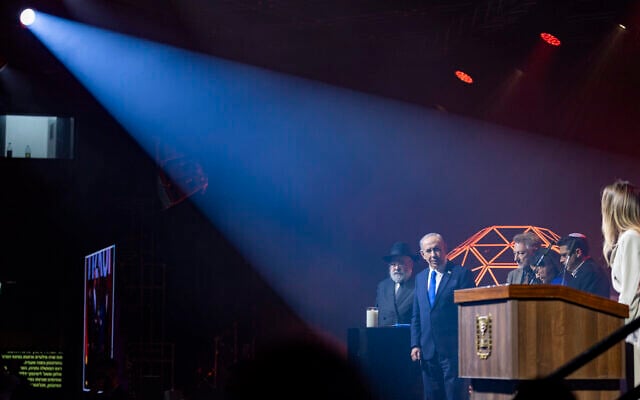
Prime Minister Benjamin Netanyahu and others at a gala event ahead of the International Conference on Combating Antisemitism in Jerusalem, January 26, 2026 (Chaim Goldberg/Flash90)
Addressing the conference on Tuesday, Morrison, a conservative, focused on the impact of rising antisemitism in Australia, describing fear and trauma within the Jewish community and warning that democratic societies must confront uncomfortable truths to preserve pluralism.
Referring to the December terror attack at Sydney’s Bondi Beach, Morrison argued that failures of leadership and education, along with a lack of moral clarity, have allowed extremism to fester in the country.
“Antisemitism flourishes when responsibility is replaced by grievance,” Morrison said. “Societies depend on individual moral agency, and when failure is moralized as systemic injustice, liberal norms collapse.”
Morrison spoke after Rabbi Yehoram Ulman, the co-founder of Chabad of Bondi and father-in-law of Rabbi Eli Schlanger, one of the victims of the attack.
Ulman urged Jews not to retreat in the face of hostility, arguing that the response to hatred must be “more Jewish life, more Jewish pride, more Jewish visibility — not less.”
He called for stronger moral education, including a daily moment of silence in schools to encourage reflection and responsibility, a longtime Chabad priority.
“Antisemitism is not a theory. It is not a policy debate. It is not a headline,” he said. “It is an empty seat at a Shabbat table.”
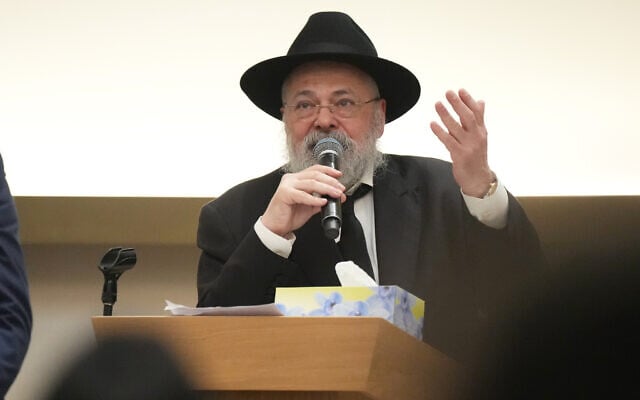
Rabbi Yehoram Ulman, father-in-law of Rabbi Eli Schlanger, a victim in the Bondi Beach mass shooting, speaks at his funeral at a synagogue in Bondi on December 17, 2025, in Sydney, Australia. (AP Photo/Mark Baker, Pool)
“The legacy of those we have lost must be strength, not fear,” he added, urging nations to raise children “with accountability to something higher than themselves.”
In another speech, Rama highlighted Albania’s record during the Holocaust, when the country, which is majority Muslim, sheltered Jews fleeing Nazi persecution and emerged from the war with more Jews than it had before.
Rama attributed that history to a deeply ingrained moral instinct among ordinary Albanians, many of whom risked their lives to protect Jewish families. Antisemitism, he said, is not merely hatred of Jews but “an assault on the moral architecture of humanity itself.”
“Hatred does not begin with violence,” Rama warned. “It begins with language, with indifference, with normalization.” Antisemitism, he added, “is not a Jewish problem. It is a civilizational test — the test of our humanity — and history has already told us what happens when that test is failed.”