
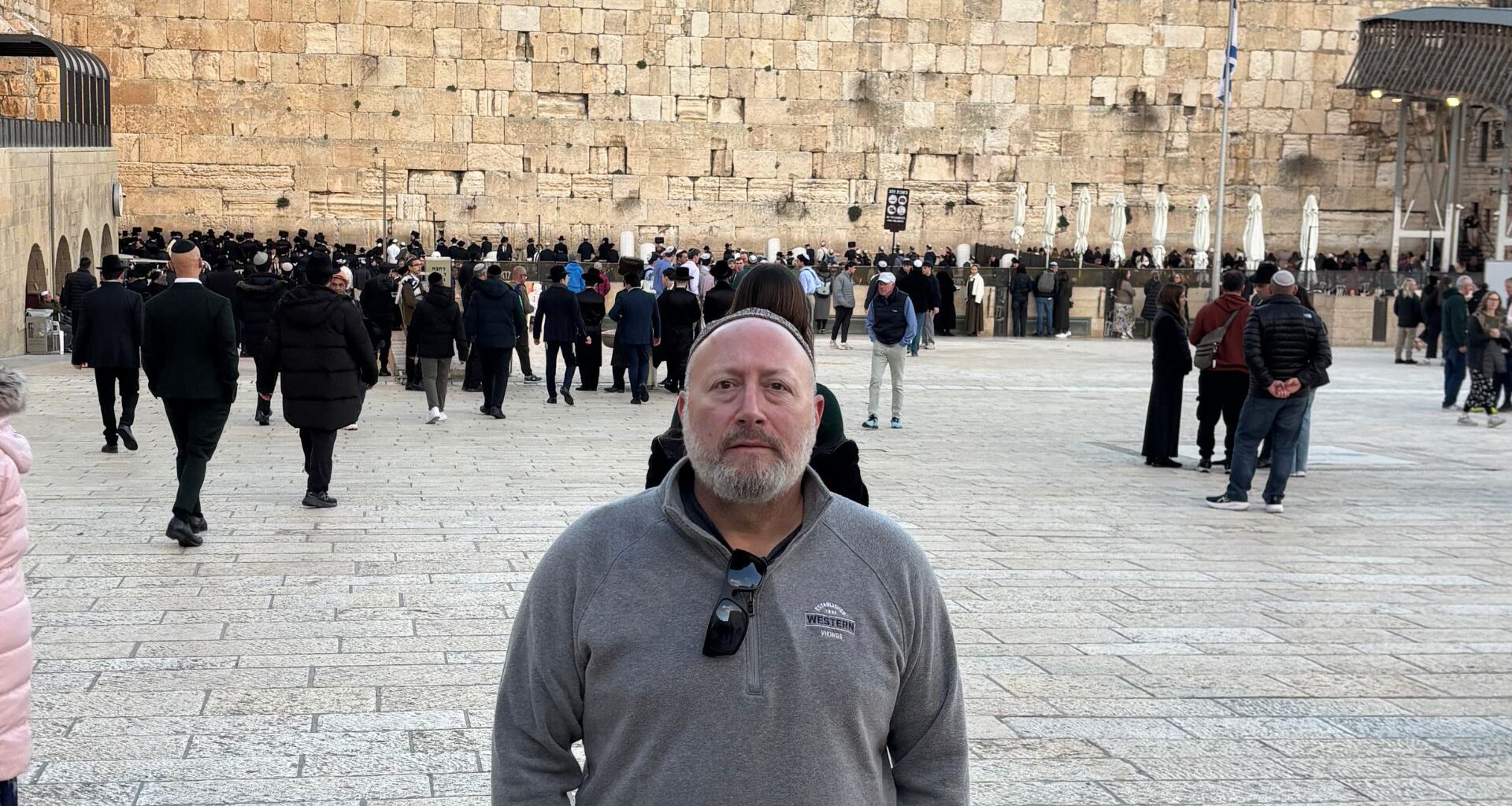
I knew this trip would matter. I just didn’t know how quickly it would get under my skin.
It started on Day 1. Shabbat. Jan. 16. Several members of the Jewish Federation of St. Louis’ Israel & Overseas Partners Committee and I landed after an overnight flight, jet-lagged and stubborn, determined not to sleep. So, we walked. Straight into the shuk.
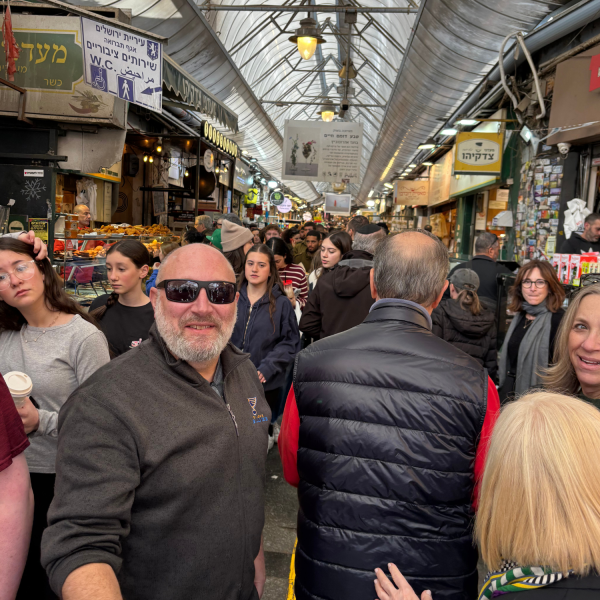 Me at the Shuk.
I’ve been in crowds before. Three World Series. A Stanley Cup. Parades and celebrations that shut a city down. This was different. It was chaos, sure, but joyful chaos. Loud, compressed, moving in every direction at once. And it wasn’t just a crowd. It was a sea of Jews. All kinds. All ages. All rhythms. I found myself literally surrounded, stuck in motion, carried along whether I wanted to be or not.
And it felt incredible.
The only way I can describe it is this: I’ve been a member of the club my whole life, but suddenly I was inside the clubhouse. No explanations required. No introductions. Just belonging. It was illuminating and exhilarating and joyful, even before I knew why.
The Wall
Later that same day, we went to the Kotel.
 Me at the Kotel, just before Shabbat on Jan. 16
As we approached, Elliott Kleiman, the chair of the committee and I had to separate from Karen Sher and Lisa Greening, two others on the trip. As I moved closer to the wall, the crowd thickened. The current shifted. And then, somewhere near the wall, I lost Elliott, too. One moment he was there, the next he wasn’t. I didn’t panic. I didn’t even really look. I just kept moving forward.
By the time Karen found me again and asked what it was like, the only honest answer I had was this: I was lost in a sea of davening.
It wasn’t fully Shabbat yet, but it was filling up fast. Ultra-Orthodox Jews everywhere. Black coats, hats, prayer books worn soft with use. Davening in a language I don’t speak, in a rhythm I don’t know. I don’t daven. I don’t know the choreography. I didn’t know when to sway or stand still.
But I floated there anyway, surrounded by prayer.
I felt connected. I also felt intimidated. Both things can be true. I didn’t understand the words, but I understood the gravity. I understood that something ancient and special was happening around me and that, somehow, I was allowed to be inside it.
Expectations
Before this trip, I was overwhelmed by how much everyone else assumed I was going to love Israel. People were genuinely surprised when they learned I’d never been. That surprised me. I’m Jewish. I’m curious. I’m a journalist. And yet, somehow, I’d never made it here.
Part of me worried Israel wouldn’t affect me at all. That the skeptic in me, the lifelong wise ass, would take over. I braced for indifference. I told myself that was fine. Honest, even.
Day 1 flipped that script almost immediately.
I should explain why I was there. In early 2023, Federation invited me to join a planned trip to Israel after realizing I had never been. We were supposed to leave Oct. 15, 2023. Oct. 7 made that impossible. After multiple postponements, I eventually traveled as an observer with the committee, which oversees the distribution of about $1.5 million annually to Jewish community partners across Israel. The trip lasted 10 days.
Re-wiring
But the final shift, what I’ll call my re-wiring, didn’t come into focus until Day 4, at Kibbutz Nahal Oz.
Kibbutz Nahal Oz, founded in 1951, sits less than half a mile from Gaza. On Oct. 7, 2023, Hamas terrorists overran the kibbutz and nearby military base, killing civilians and soldiers and abducting residents. Eight kibbutz members were taken hostage.
Moran Freibach, the director of agriculture at Kibbutz Nahal Oz, stood with us and pointed.
Just pointed.
Gaza.
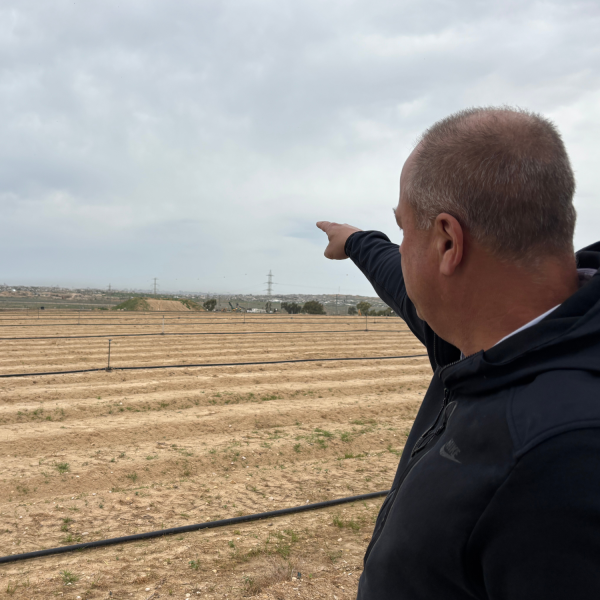 Moran Freibach, the director of agriculture at Kibbutz Nahal Oz.
Less than half a mile away. Six hundred meters. A distance I could walk in a few minutes if there weren’t fences and walls and history in the way.
My whole life, Gaza was a word. A complicated one. A place I knew through headlines, distance and abstraction. The war of 2023 brought it closer emotionally, but it was still 6,500 miles away. Now I was standing there, hearing explosions, watching someone casually indicate a direction that had lived for decades in my head as an idea, not a place.
Borrowed Calm
We heard several loud booms while Freibach spoke. I jumped. Of course I did. Then he said something I won’t forget: if he keeps talking, all is good. If he ducks, duck too.
He kept talking.
So I kept standing.
That’s how I learned something fundamental about this place. People don’t eliminate fear here. They manage it together. You watch each other. You borrow calm. You keep going.
What Stayed
Another image won’t leave me alone. It looks like nothing at first. Foliage. A path. Ordinary greenery.
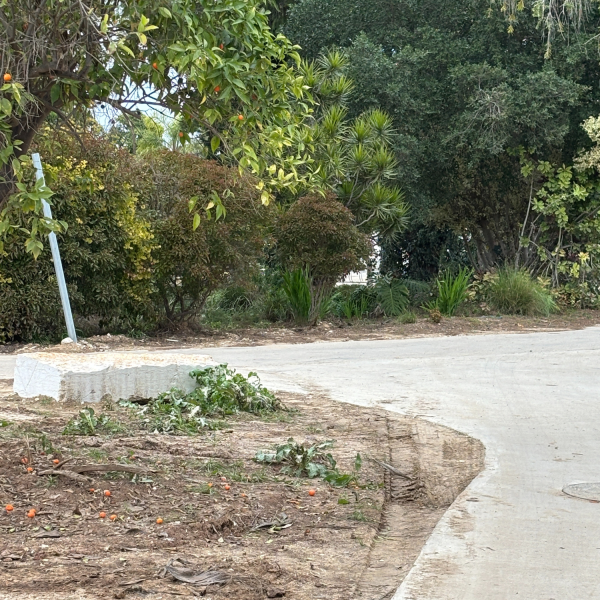
Nadav Tzabari, an attack survivor, pointed to it and told me that after he escaped, he asked another survivor what he saw from his hiding place. The answer: three Hamas terrorists were hiding there. An armored Israeli vehicle happened to be nearby. It rammed them.
After he said this to me, I stood there and took the picture, while the rest of the group moved on. I lingered, then caught up. The image burned into my brain.
Razor Wire
But the moment when I realized I wasn’t just witnessing anymore came quietly, almost mundanely. As we drove the perimeter, I saw the barbed wire up close. Razor wire. Layered. Aggressive. Surrounding a farm.
A wall of razor surrounding a farm and a bunch of Jewish farmers.
That image collapsed everything for me. This isn’t a war zone next to a community. It’s a community forced to armor itself just to grow crops. To exist. To stay.
That’s when the stories stopped being things I was hearing and became things I was carrying.
Coming Home
When I think about going home to St. Louis, I catch myself laughing at what worries me most. Not that people will disagree with me. Not that they’ll challenge what I say. I worry they won’t believe me.
That they won’t believe I was affected. That I get it.
I get the joy. I get the chaos. I get the whole point of Israel. I get why farmers live behind barbed wire and still plant anyway. And I know that coming from someone who has made a career out of skepticism, sarcasm and being a wise ass, that may sound improbable.
But it’s true.
This trip didn’t make me someone new. It stripped away the distance I didn’t realize I was keeping. And once that distance is gone, there’s no honest way to put it back. And I’m cool with that.