
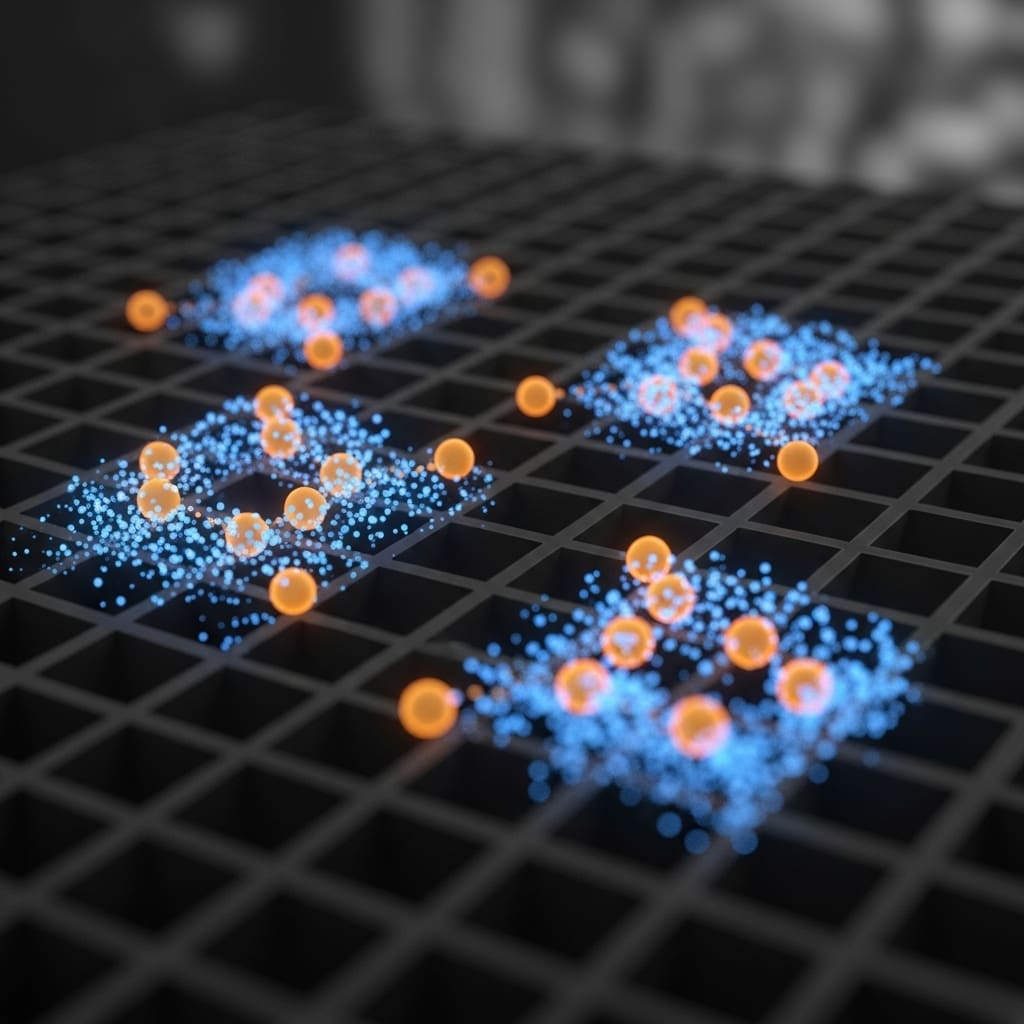
Scientists are now demonstrating precise control over quantum systems, paving the way for the simulation of complex physical phenomena. In a new study published today, Francesco Cesa, Andrea Di Fini, and David Aram Korbany, from the University of Innsbruck and the Universit`a di Bologna respectively, alongside et al., detail a novel technique for engineering discrete local dynamics within globally-driven dual-species atom arrays, essentially creating programmable quantum systems with tailored behaviours. This research is significant because it allows researchers to study emergent digital models using uniform analog controls, potentially unlocking new avenues for exploring quantum chaos and benchmarking the capabilities of current experimental platforms. By exploiting species-alternated driving and generalized blockade regimes, the team showcases how simple protocols can digitize complex Hamiltonians and simulate chaotic dynamics directly within these atom arrays, offering a powerful new tool for quantum simulation and information processing.
This research is significant because it allows researchers to study emergent digital models using uniform analog controls, potentially unlocking new avenues for exploring quantum chaos and benchmarking the capabilities of current experimental platforms. By exploiting species-alternated driving and generalized blockade regimes, the team showcases how simple protocols can digitize complex Hamiltonians and simulate chaotic dynamics directly within these atom arrays, offering a powerful new tool for Quantum simulation and information processing.
Dual-species atoms realise quantum cellular automata
As a practical application, researchers investigated chaotic features within discretized many-body dynamics, successfully benchmarking the ability of their system to discriminate between chaotic evolutionary pathways. The research establishes a pathway to implement a variety of quantum many-body discrete dynamical models using dual-species atom arrays, relying solely on global driving and static processor layouts. This innovative approach leverages the fact that spatially uniform laser beams can be selectively applied to different atomic species, enabling the creation of complex interactions and dynamics. The team’s construction of ‘mediated gates’ allows for effective local control, despite the global nature of the driving lasers, drastically simplifying technological requirements compared to methods requiring mid-circuit rearrangement.
Experiments show that the proposed method offers constant overhead in both space and time, making it particularly well-suited for implementation in forthcoming dual-species experiments. The study unveils a detailed architecture for implementing QCA, providing explicit constructions for representative examples and demonstrating the feasibility of complex quantum simulations. By carefully designing the interactions between atoms, the researchers were able to create a system that mimics the behaviour of digital models, opening up new avenues for exploring quantum phenomena. This approach allows for the investigation of hard questions in non-equilibrium physics, offering a controlled route to understand complex dynamical features of interacting systems.
Furthermore, the research establishes a novel diagnostic for quantum chaos, focusing on an indicator measurable with demonstrated state-of-the-art capabilities of globally-driven dual-species Rydberg experiments. Unlike conventional diagnostics requiring complex, spatially non-uniform operators, this indicator can be measured using only readily available experimental techniques. The work opens exciting possibilities for experimental explorations of quantum-chaotic dynamics and QCA, advancing our understanding of complex quantum systems.
Species-Alternated Driving of Static Neutral Atoms offers new
Researchers designed their approach around static atom arrangements, circumventing the need for complex mid-circuit rearrangements and simplifying technological demands. This innovative technique relies on carefully modulating the laser driving sequences for each species, effectively ‘stitching’ together discrete time steps and mimicking local interactions between atoms. Experiments employ a dual-species atom array, where each atom serves as a qubit, and interactions are mediated by Rydberg states. The team constructed ‘gadgets’, arrangements of atoms representing elementary logic gates, that, when combined, form the basis for implementing complex quantum cellular automata.
These gadgets exploit the blockade mechanism, where exciting one atom inhibits the excitation of its neighbors, creating effective repulsive interactions. By alternating laser drives between the two species, scientists selectively address and manipulate these gadgets, realizing the desired discrete dynamical map. To demonstrate the power of this methodology, the study focused on probing signatures of quantum chaos using a novel indicator measurable with existing globally-driven Rydberg experiments.
Dual-species atoms realise discrete digital dynamics
The core construction involves ‘mediated gates’ which enable the realization of discrete local dynamics, achieved by positioning data and ancillary atoms on vertices and edges of a sub-division graph. Tests prove the use of optimal control methods to design these mediated gates, effectively implementing entangling gates on data atoms by controlling the ancillary species. Data shows that the update rule, U, can be synchronous when interacting updates are simultaneously applied, or asynchronous when local interacting updates do not commute, imposing an ordering. The work interprets U as realizing a Floquet protocol, U = e−iτHDe−iτHD−1…e−iτH1 = e−iτHeff[τ], where Hj are 2-local Hamiltonians and τ is a Floquet time.
Measurements confirm that for small τ, Heff approximates the local Hamiltonian H = P j Hj, allowing the QCA to be understood as a Trotterized evolution under H. For larger τ, Heff typically contains longer-range many-body terms, reproducing complex interacting dynamics and intrinsically Floquet models. The O(τ) correction in Eq. (3) can enrich the properties of Heff, introducing gapped non-Abelian topological phases in Floquet spin liquids. Importantly, the finite-τ discrete local dynamics only generates non-trivial correlations within a sharp light cone, mimicking the Lieb-Robinson bound characterizing local Hamiltonian evolution, and providing concrete theoretical handles to tackle questions in non-equilibrium physics, including quantum-information spreading and entanglement dynamics.
Digitising Dynamics in Neutral Atom Systems offers new
Researchers successfully implemented discretized dynamics, specifically, discretized φ-dynamics, and benchmarked their ability to discriminate chaotic evolution using only demonstrated experimental capabilities. These discrete local dynamics, while simplified, serve as valuable toy models for many-body physics, exhibiting local correlation evolution and providing theoretical tools for investigating non-equilibrium phenomena such as quantum-information spreading and entanglement dynamics. The study highlights the rich physics underlying these systems, which can either embed out-of-equilibrium many-body phenomena within circuit-like dynamics or represent a distinct paradigm with interesting features. The authors acknowledge that their method relies on precise control of laser pulses and atom positioning, which may introduce experimental imperfections.
Furthermore, the current implementation is limited to specific model sizes and geometries due to the constraints of the experimental setup. Future research directions include exploring more complex dynamical models and investigating the scalability of the approach to larger systems, potentially enabling the simulation of more realistic many-body phenomena and the exploration of novel quantum algorithms. This work establishes a promising pathway for bridging the gap between analog and digital quantum simulation, offering a versatile platform for studying fundamental questions in quantum physics and information science.