
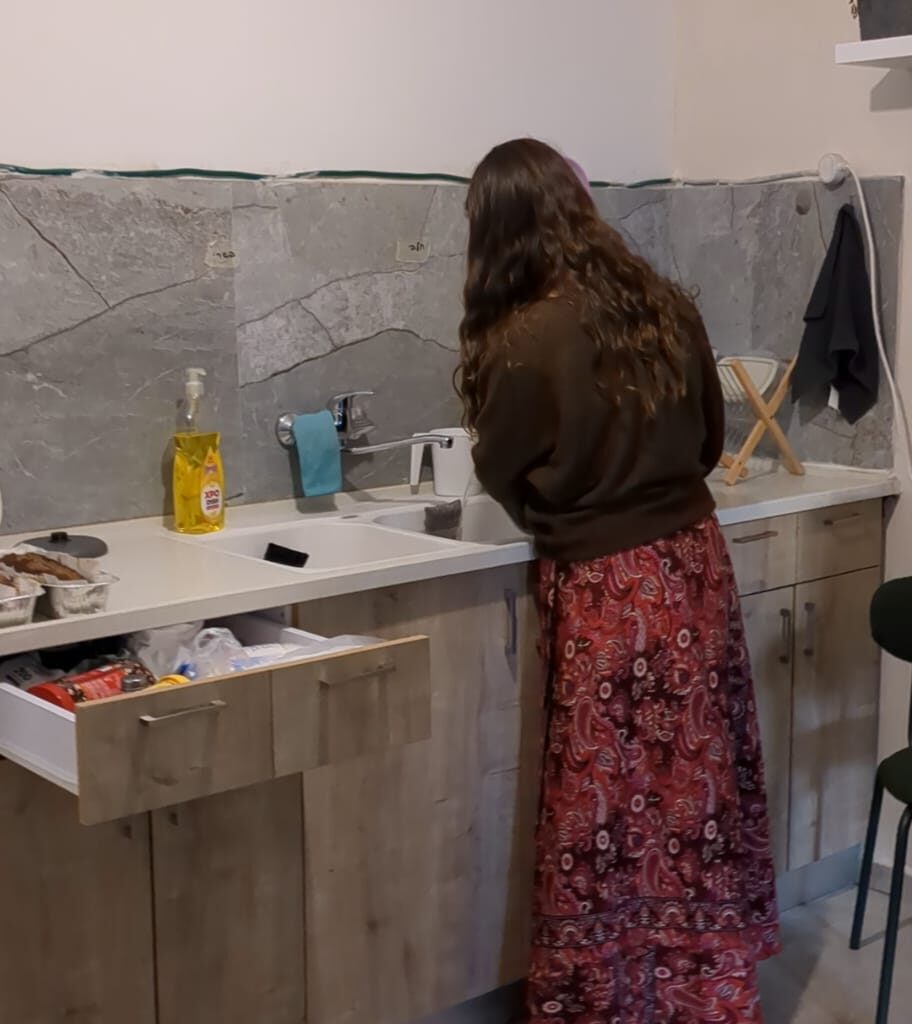
I recently visited my daughter, a 19-year-old American in Israel, to see firsthand the unusual life she has chosen for herself. What I saw astounded me. Despite Israel’s existential threats, Israeli society feels alive, healthy, and hopeful to the young men and women I encountered. Because the first few years of their lives after high school are devoted to compulsory service, young people are compelled to live with purpose, meaning, and community at the outset of adulthood. Seemingly as a result, to an American peeking in, I couldn’t help noticing the contrast with Americans their age. These Israelis seem comparatively happier, less anxious, and more confident.
A year ago, during her gap year, my daughter chose to move to Israel rather than attend college in America–despite being accepted to a top tier program in the field she wants to pursue. She felt drawn to Israel after the events of October 7, concerned about the future of Jewish life in America, and alarmed by the antisemitism and political extremism she saw on college campuses. She also felt inspired by the courage and service of her peers in the Israeli army.
She became an Israeli citizen and as a recent high school graduate, had to make the same choice as other Israeli teenagers on how to spend the next few years giving back to the nation, either by enlisting in the IDF or committing to national service. Choosing the latter, she would serve in a community or institution in need of help, like a hospital, town in the periphery, or supporting at-risk youth. Most Israeli religious young women choose national service. So my daughter applied, and after extensive interviews, was selected to live in a desert town, south of Beer Sheva, not far from the horrifying events of October 7.
As a “lone Bat Sherut,” which means her family is abroad, she receives some extra benefits, like a local host family for Shabbat meals, a tiny washing machine, and an extra armoire for her clothes. Other than these perks, she lives a life of total service alongside 20 other religious young women, in a frontier town surrounded by sand dunes, Bedouin tents, and not much else. One could not feel farther from Tel Aviv–or her roots in Los Angeles.
Yet my daughter could not be happier. I attribute this to several factors, first of which is being part of a community in a small town, where she is respected and needed. This sense of community is created first by her living conditions, which resemble an urban kibbutz. She lives on the fourth floor walkup of a dilapidated building. As one enters the street through a superfluous gate, one climbs an exposed stairwell, with electrical wires and construction debris lying haphazardly everywhere, in total darkness, as the hallway lights work irregularly. The upper floors have been commandeered to communal apartments for twenty girls from all over the country who are living away from home for the first time. There is a large communal kitchen and lounging area; three to four girls are assigned to each bedroom and eight girls share a tiny bathroom. Living conditions are spartan. Yet my daughter does not miss the comparative affluence of her upbringing because this back-to-basics lifestyle feels authentic and purposeful.
I could not help comparing these living quarters to the freshman experience on many campuses in America. Over the past 25 years, universities in the US have been competing with each other to build ever more lavish accommodations: nicer dorms, gourmet dining halls, state-of-the-art gyms and pools. The message this sends to young people who are still teenagers is: you deserve all this. You are that special. We exist for you.
But in Israel, the signal sent to young people of the same age is the opposite. In national service, there is no cleaning staff, meal plan, or administrators eager to cater to every request and complaint. Instead, two girls each night go grocery shopping and cook dinner for all the others after a full day of work, and two others are assigned cleanup duty. When it is their night to cook for each other, they don’t order in. They make homemade bread, salads, and soup for 20. Their rooms and common spaces are sparkling clean, due to a rotation they set up for cleaning. (I’m pretty sure I did not clean my room once my entire freshman year.) No one knows who comes from rich or poor families, as the girls are all on a stipend from the state and live equally modestly together. Social media use and hookup culture among this cohort are virtually nonexistent. And yet these girls are having fun. The nights I was there, my daughter stayed up til 2:00 AM laughing and hanging out with the other girls after a 12 hour work day.
Part of the reason for their happiness may be that when they are not at the apartment building, they are working at jobs imbued with meaning. Some of the girls work with elderly–visiting with them daily, taking them to doctor’s appointments, and providing them with activities. My daughter works at a public elementary school teaching kids English and art. In the evenings, she teaches music to at-risk teenagers and helps them play in a band that performs locally.
After their work day ends, one night a week, my daughter and her friends volunteer to go grocery shopping for women whose husbands are in the army on reserve duty; or they babysit for free so those mothers get a break while their husbands are away. A few nights after I left, my daughter spent her evening packaging baskets and went home to home throughout the town with several girls, delivering treats and warm blankets to homebound elderly, and lighting the menorah for Chanukah.
While no one assigned these evening outings and they are not part of compulsory service, none of the girls seemed to think that they were doing something extraordinary. Everyone they know–including their families–regularly does acts of service as part of daily life in Israel. As a 19-year-old in America, I would have felt put-out to have given my evenings to one of these activities or, alternatively, extremely proud of myself. In Israel, I was struck by how centered the girls seemed, without feeling that what they were doing was unusual or that it made them special.
I also noticed that none of the girls seem anxious about their futures. After national service, they all intend to go to college or vocational school, most while living at home. During or after this next phase, they expect to get married, likely after being set up by friends, with young men in their early 20s who have finished their army service. Then they all want to have large families. There is a sense that life is theirs for the taking, but also that there is a clear path and that their families–whom they see biweekly at a minimum–will support them through the next phases. They are living lives fully present, rather than in toxic online “communities.” These teenagers radiate purpose and direction in the real world.
My daughter, who would be a sophomore in American college now, started ninth grade in her bedroom during the height of Covid lockdown. She grew up with social media isolation before schools instituted phone-free policies, and spent middle school during the height of the transgender craze (and had one young female friend who tragically took her life while “transitioning”). This is her generational group in America.
By living in Israel, my daughter could not be farther from these problems. The young people in her cohort know who they are, what they want from life, and find authenticity in the hard work they pursue each day. As my daughter stood in her tiny bathroom in the early morning near-darkness, preparing for a long work day ahead, she told me how lucky she was because if she tilts her head at the bathroom window at just the right angle, she can see the first glimpses of the sunrise. As I marveled at the simplicity in which my daughter is living, she radiated hope and purpose.
Is this the answer to what is plaguing American youth? Many of them live isolated or with little sense of community, no sense of greater purpose or collective responsibility. As a result, many seem in a free fall of decline–not marrying, having no or fewer children than ever before, and enlisting in radical anti-American and antisemitic causes in confused search of meaning.
Perhaps this segment of Israeli society has something to offer American youth. I identify with the individualism of America far more than the collectivist instincts of Israel. But Israel might offer lessons for some of what is plaguing America. Many Americans would benefit from being part of a community to which they contribute meaningfully in a real and regular way (not online, often through hard work) and feel integral to that effort. There is a profound difference between being a needed and valued member of an authentic community where others care and check in versus relying on internet friends or paid therapists and administrators for support.
In recent years, it has become standard in college life to embrace radical causes that seek to tear down society and destroy traditions. I want my children to be part of those who want to build up our civilization and contribute to it.