
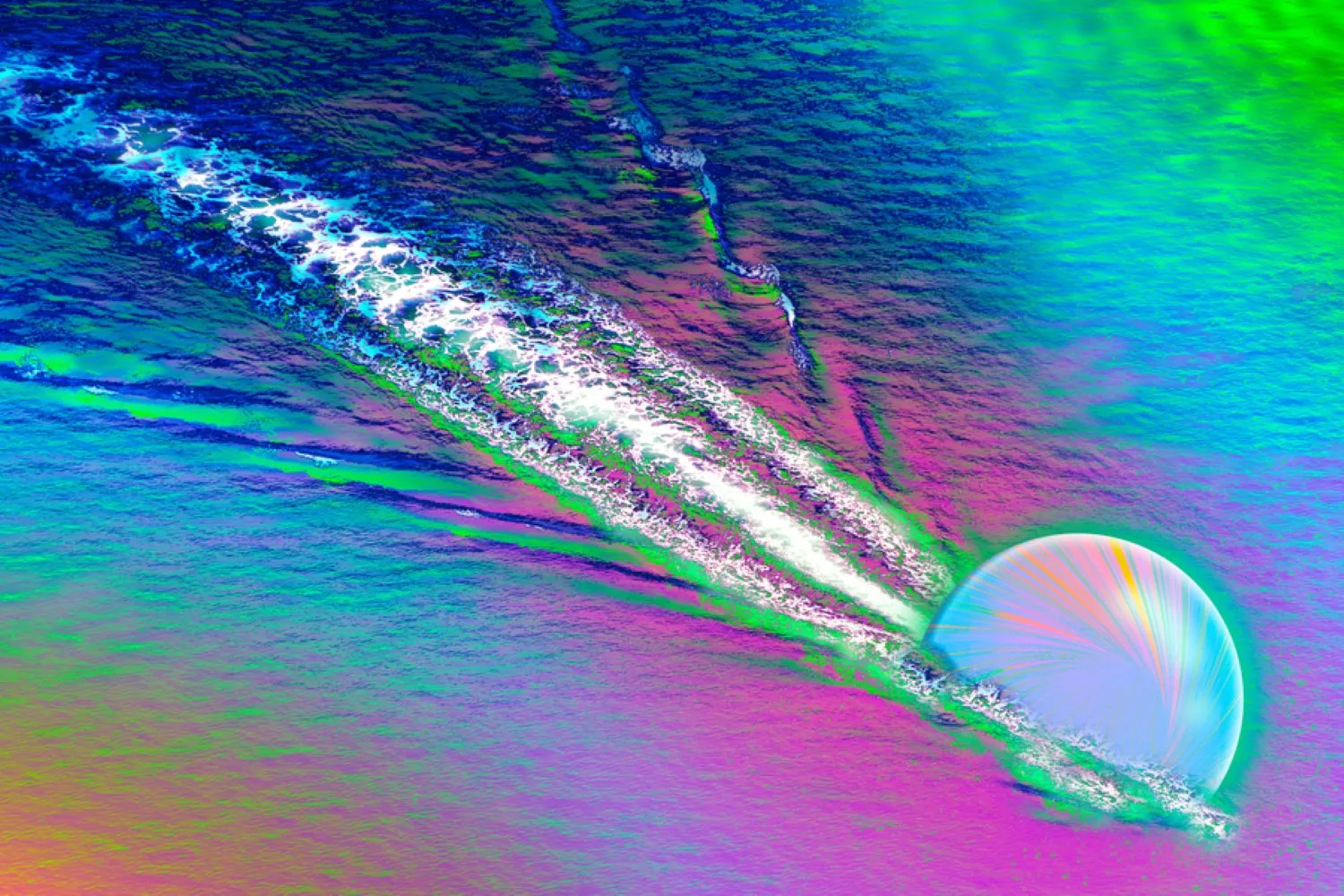
When the universe first came into existence 13.8 billion years ago, there were no stars, planets, or even atoms. Instead, it was in a hot, dense state of the tiniest building blocks of matter, quarks and gluons, swirling together in a state scientists call quark-gluon plasma (QGP).
In the very first moments after the Big Bang, quarks and gluons moved freely like swimmers in a vast cosmic ocean. As the universe cooled, they joined together to form protons and neutrons.
Scientists at CERN, together with MIT physicists, have found strong evidence that the universe’s first “primordial soup” acted like a liquid. They discovered that when quarks zoom through this plasma, they create ripples and swirls. This shows the plasma flows smoothly as a dense fluid rather than breaking apart into scattered particles.
“It has been a long debate in our field, on whether the plasma should respond to a quark,” said Yen-Jie Lee, professor of physics at MIT. “Now we see the plasma is incredibly dense, such that it is able to slow down a quark, and produces splashes and swirls like a liquid. So quark-gluon plasma really is a primordial soup.”
How do Quark-Gluon-Plasma fireballs explode into Hadrons?
This finding settles a long-standing question: Does QGP behave like a fluid when disturbed, or more like a chaotic gas?
The findings show that quark-gluon plasma (QGP) was the universe’s very first liquid, and one of the most extreme. It reached temperatures of trillions of degrees and flowed almost perfectly smoothly.
Detecting these wakes was challenging. Physicists tried to spot them by studying pairs of quarks and antiquarks produced in high-energy collisions. But due to the overlap of these twin trails, it was difficult to isolate the effect of a single quark.
Lee’s team took a different approach. Instead of chasing quark-antiquark pairs, they searched for collisions that produced a Z boson alongside a quark. The Z boson is a neutral particle that interacts very little with its surroundings, making it the perfect “silent partner.”
“In this soup of quark-gluon plasma, numerous quarks and gluons are passing by and colliding with each other,” Lee explained. “Sometimes when we are lucky, one of these collisions creates a Z boson and a quark, with high momentum.”
New details on what happened in the first microsecond of Big Bang
The two particles shoot off in opposite directions. The Z boson leaves no trace, but the quark plows through the plasma, dragging it along and leaving a wake. Tracking the Z boson could reveal where the quark went. It also makes it easier to measure the ripples it left behind.
The team sifted through data from the CMS experiment at the Large Hadron Collider, which smashes heavy ions like lead at nearly the speed of light. Out of 13 billion collisions, they found about 2,000 events that produced a Z boson.
For each event, they mapped the energy patterns within the fleeting plasma droplet, which lasts less than a quadrillionth of a second. Again and again, they saw fluid-like splashes on the opposite side of the Z boson, unmistakable signs of a quark wake.
The observed wakes matched predictions from Rajagopal’s hybrid model, which had long suggested that quarks should stir the plasma like boats cutting through water.
“This is something that many of us have argued must be there for a good many years, and that many experiments have looked for,” said Krishna Rajagopal, the William A. M. Burden Professor of Physics at MIT, who was not directly involved in the study.
Daniel Pablos, professor of physics at Oviedo University in Spain, called the results “What Yen-Jie and CMS have done is to devise and execute a measurement that has brought them and us the first clean, clear, unambiguous evidence for this foundational phenomenon.”
Atomic nucleus unveiled: A glimpse at quarks and gluons
Lee added, “We’ve gained the first direct evidence that the quark indeed drags more plasma with it as it travels. This will enable us to study the properties and behavior of this exotic fluid in unprecedented detail.”
Quark-gluon plasma is more than a curiosity about the early universe. It is a window into the fundamental forces that shape matter. By studying how quarks interact with this fluid, scientists hope to uncover how the universe cooled from chaos into order, and why matter exists in the form we see today.
The discovery also demonstrates the power of creative experimental design. By using Z bosons as “tags,” physicists isolated the elusive wakes of single quarks, a breakthrough that could open new paths to understanding the plasma’s properties.
Independent experiments and models have long suggested that QGP was the universe’s first liquid, and perhaps its most perfect one. The new evidence paints a clear picture. It shows a primordial ocean where quarks and gluons flowed together smoothly. They splashed and swirled when disturbed.
Journal Reference:
The Cms Collaboration. Evidence of medium response to hard probes using correlations of Z bosons with hadrons in heavy ion collisions. Physics Letters B. DOI: 10.1016/j.physletb.2025.140120