
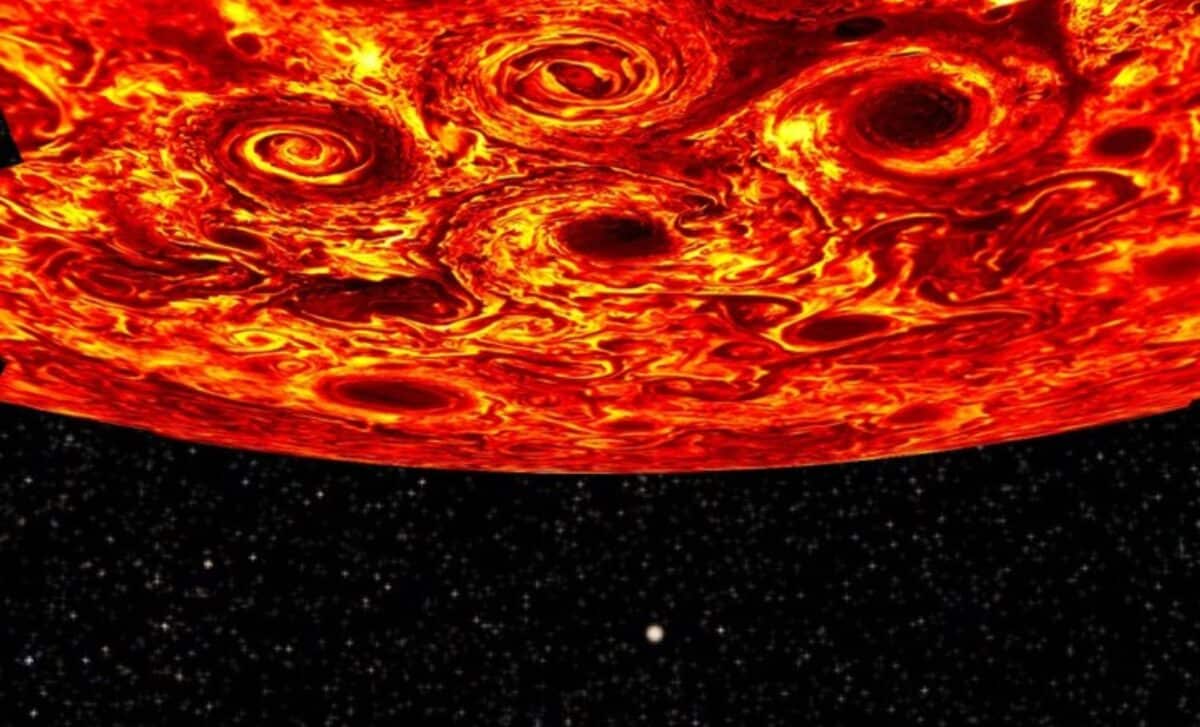
Jupiter and Saturn may be similar in size and made of the same gases, but the weather at their poles tells a different story. While Saturn’s north pole is home to a single, massive hexagonal vortex, Jupiter’s is a chaotic gathering of multiple cyclones. Scientists at MIT believe they have finally figured out why.
Using fluid simulations, researchers found that the answer is not in the clouds but buried deep below them. The structure of these planets’ polar storms appears to depend on the nature of the material at the base of each vortex, a feature that could reveal what lies inside these gas giants.
Now, thanks to a study published in Proceedings of the National Academy of Sciences, a physical mechanism has been identified that links the storms we see from space to unseen dynamics deep within each planet.
Polar Swirls May Trace Back to Deep Layers
The research team led by Wanying Kang and Jiaru Shi at MIT developed a two-dimensional simulation model to study the evolution of polar vortices. Their approach focused on a concept called the “softness” of a vortex’s base, which refers to how light or dense the material is below the storm. Jupiter’s softer base keeps storms from getting huge, which is why there are so many smaller ones packed together.
If the base is heavier, like Saturn’s, the storm keeps building and pulls in the others, leaving just one giant vortex. The study suggests a direct connection between a planet’s interior and the atmospheric structures observed from above.
“Our study shows that, depending on the interior properties and the softness of the bottom of the vortex, this will influence the kind of fluid pattern you observe at the surface,” said Kang.
This link between deep planetary material and surface weather had not previously been explored in this way.
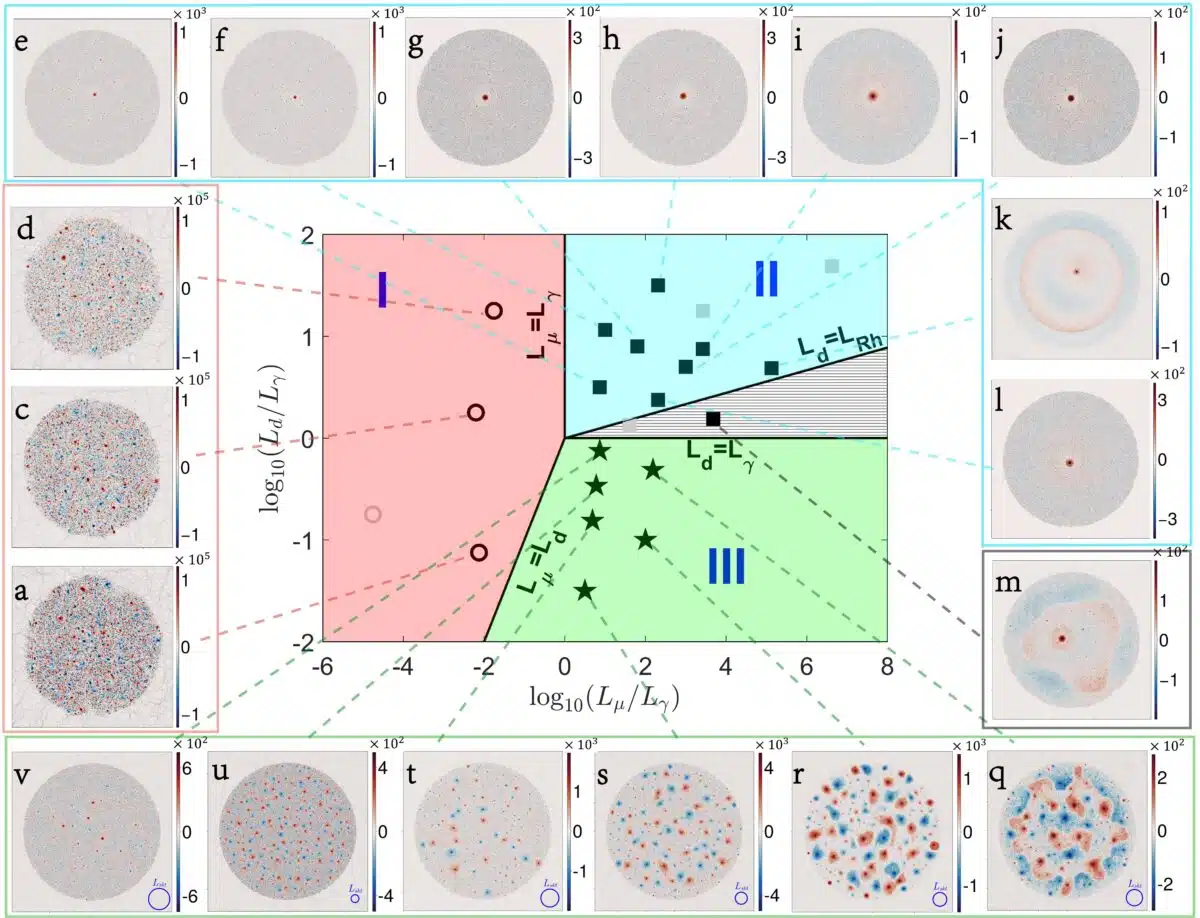 Phase diagram showing how different interior conditions produce distinct polar vortex patterns. Credit: Proceedings of the National Academy of Sciences
Same Planet, Different Storms
The clear difference in storm structure between Jupiter and Saturn may indicate a fundamental difference in what lies beneath their cloud tops. Based on the model results, the researchers propose that Saturn could have a more metal-enriched and denser interior than Jupiter. This would allow its polar vortex to grow larger and dominate the pole.
This idea aligns with long-term observations. NASA’s Cassini spacecraft recorded Saturn’s enormous hexagon-shaped vortex, about 18,000 miles across, during its 13-year mission. Meanwhile, Juno has revealed that Jupiter’s north pole contains a central cyclone surrounded by eight smaller ones, each about 3,000 miles wide. According to Shi:
“The planets are about the same size and are both made mostly of hydrogen and helium. It’s unclear why their polar vortices are so different.”
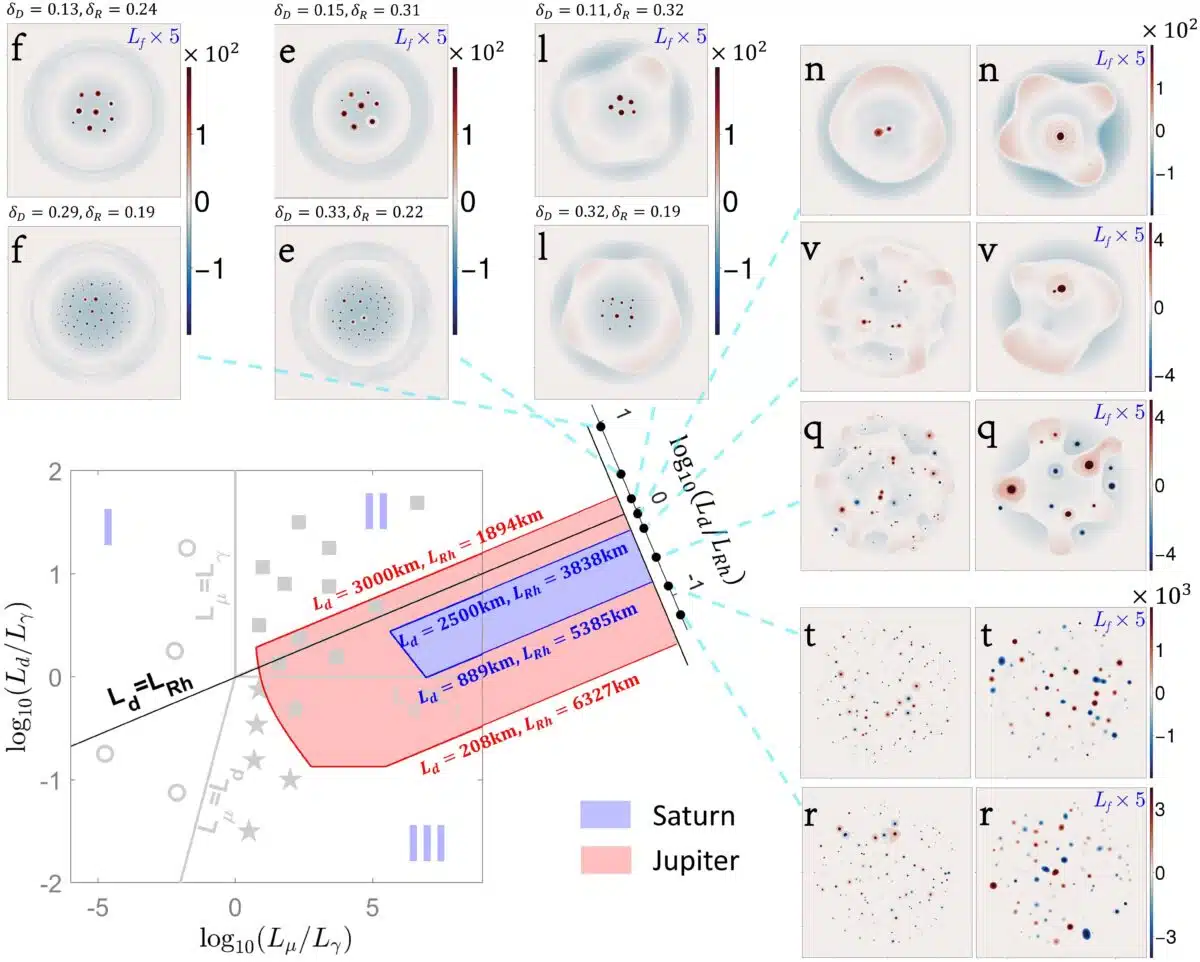 Simulations showing how interior parameters control polar vortex patterns on Jupiter and Saturn. Credit: Proceedings of the National Academy of Sciences
2D Models Turn Complexity Into Clarity
To build the simulation, the MIT team made use of the fact that fast-rotating planets like Jupiter and Saturn tend to have fluid motion that is consistent along the rotation axis. This allowed them to reduce the complex three-dimensional behavior of atmospheric vortices into a two-dimensional model.
Kang explained that the method made simulations hundreds of times faster while still capturing the core physics. The team adapted a fluid dynamics equation used for Earth’s cyclones to model polar conditions on gas giants. They started with random fluid motion and observed how vortex patterns formed.
“This equation has been used in many contexts, including to model midlatitude cyclones on Earth,” he said. “We adapted the equation to the polar regions of Jupiter and Saturn.”
After testing various parameters, they identified the softness of the vortex base as the main factor shaping the storm structure.