
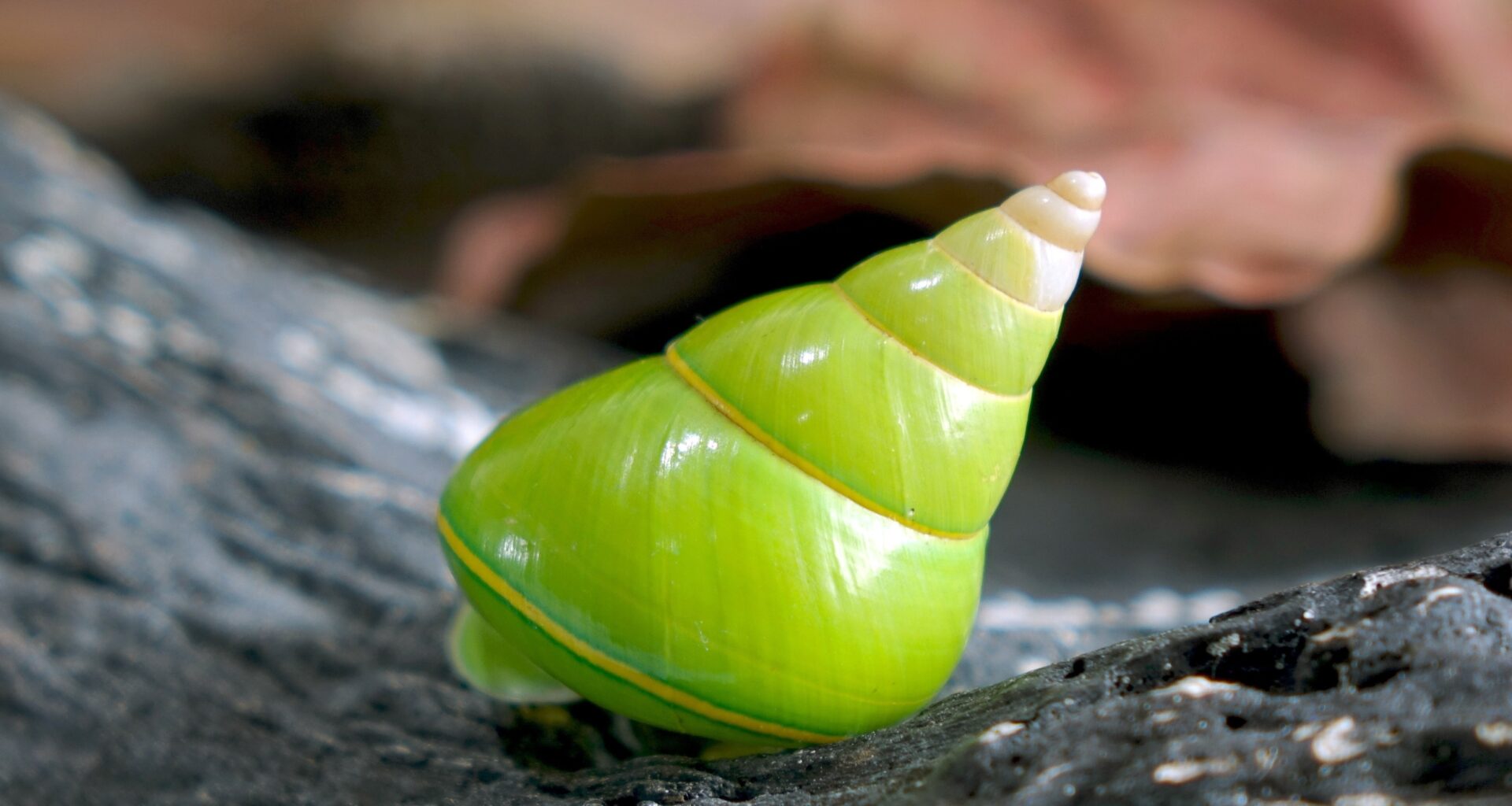
If you want a quiet but brutally clear signal of how badly biodiversity is unraveling on islands, look at land snails.
A major new review led by Robert Cowie at the University of Hawai‘i at Mānoa argues that the scale of loss isn’t just alarming – it’s “devastating.”

Across many high volcanic islands, extinction rates for land snails commonly range from 30 to 80 percent, making them one of the most heavily impacted groups of animals on Earth.
The paper takes a global view, but it zooms in on Hawai‘i and other Pacific islands for a simple reason: no other region has lost so many land snail species.
Researchers stress that this is not just a story about obscure creatures disappearing unnoticed. It is a collapse unfolding in ecosystems that were once global hotspots of evolutionary experimentation.
The snails’ decline offers a stark warning about what happens when isolated biodiversity collides with human expansion.
Islands as extinction hotspots
One problem with tracking invertebrate extinctions is that many species vanish before anyone even realizes they existed. Land snails, oddly, have a built-in archive that most small animals don’t: their shells.
When a snail dies, its shell can persist in soil for decades, sometimes centuries. Over time, dead shells pile up into what researchers call a “shell bank.”
That shell bank becomes a kind of time capsule – evidence of species that may have disappeared long before modern scientists ever recorded them.
The review points to a famous case in the Gambier Islands of French Polynesia, where shells revealed an entire burst of snail diversity that would otherwise have been invisible.
The authors note that many islands are remote and that land snails attract little attention in global biodiversity conservation, leaving the conservation status of many species outdated.
This means that we’re not only losing snails – we’re often losing them without even keeping proper score.
Ancient losses written into the landscape
Not all snail extinctions are recent. The review notes that during and after the last Ice Age, shifts in climate and sea level helped form “fossilized” sand dunes that buried numerous species.
On O‘ahu, for example, some of those extinct snails can still be seen preserved in exposed deposits along the trail to Ka‘ena Point from the Wai‘anae side.
These losses unfolded slowly, shaped by natural environmental change over thousands of years.
People reshape island ecosystems
But the overwhelming driver of modern loss is human activity. Habitat destruction is the first big punch: clearing forests, changing watersheds, and fragmenting the damp, stable microhabitats snails rely on. Then comes the knockout blow on many islands: invasive species.
High volcanic islands often evolved snail communities that were both extremely diverse and highly endemic.
Even small islands could host 50 to 100 endemic species, like Rapa in the Austral Islands. Hawai‘i was on another level entirely.
“The Hawaiian Islands, especially, were home to at least 750 known species,” said Cowie, who is a research professor with the Pacific Biosciences Research Center.
“All but a tiny handful of which are found nowhere else on Earth. Estimates have suggested that only 10 to 35 percent of this spectacular diversity, including some of the well-known and beautiful Hawaiian tree snails, still survive, a mere fraction of the unique native Hawaiian natural heritage.”
When you lose a Hawaiian snail species, you’re not losing a local version of something common. You’re losing a one-off evolutionary experiment.
When people arrive, snails disappear
The review highlights a repeating trajectory across islands. Extinctions start soon after humans arrive, often through deforestation and habitat change.
Then, after Western colonization, things intensified – more land transformation, more trade, and far more introductions of non-native predators.
Some of the worst culprits are well-known. Rats, for one, are devastating on islands. But in the snail story, there are also deliberate introductions that turned into ecological disasters – especially predators brought in to control other snails.
Two notorious examples show up again and again: the rosy wolf snail (Euglandina) and the New Guinea flatworm (Platydemus manokwari), both effective snail hunters.
“These have probably been the ultimate cause of extinction following the devastating habitat loss that initiated the extinction process,” Cowie said.
The pressures on island snails
There are also smaller, less obvious pressures. While most island communities don’t eat land snails regularly, collecting shells – especially visually striking ones – can matter when populations are already shrinking.
The review also notes ornamental uses, such as decorating lei or hats with shells. That kind of harvesting may not start the fire, but it can slow recovery and make it harder for endangered species to rebound.
Climate change has not yet driven many documented island snail extinctions, the review argues – but it is likely to become a major threat.
Species living in cool mountain habitats face a hard limit: as temperatures rise, they cannot move “up” forever, and eventually their climate zone disappears.
What’s keeping island snails alive
Despite the grim numbers, the paper isn’t purely hopeless. Conservation programs are actively trying to save what remains, with much of the focus on places like Hawai‘i and the Society Islands.
Similar efforts are underway in Japan’s Ogasawara Islands, as well as in Bermuda, the Desertas Islands of Madeira, and the Mascarene Islands in the Indian Ocean.
Protecting snails in the wild is hard when invasive predators are already embedded in the ecosystem. Many programs are also relying on captive breeding.
The goal is not a permanent solution, but a way to prevent ancient lineages from vanishing entirely while habitat protection and predator control efforts take hold.
In other words: the shells tell us what we’ve already lost. Captive programs are one of the few tools keeping the “what’s left” column from shrinking even faster.
The review is published in the Philosophical Transactions of the Royal Society B.
—–
Like what you read? Subscribe to our newsletter for engaging articles, exclusive content, and the latest updates.
Check us out on EarthSnap, a free app brought to you by Eric Ralls and Earth.com.
—–