
ROBUST GROWTH:
Data last year reflected the nation’s export-driven growth, resilient domestic consumption, and integral role in the global AI and semiconductor ecosystem
By Crystal Hsu / Staff reporter
The economy last year grew at its fastest pace in nearly 15 years, fueled by a surge in exports tied to artificial intelligence (AI) and advanced computing, the Directorate-General of Budget, Accounting and Statistics (DGBAS) said yesterday.
GDP expanded 12.68 percent in the fourth quarter — the strongest quarterly pace in nearly 38 years — lifting full-year GDP growth to 8.63 percent.
That significantly exceeded the government’s 7.37 percent forecast, highlighting the nation’s importance in the global technology supply chain.
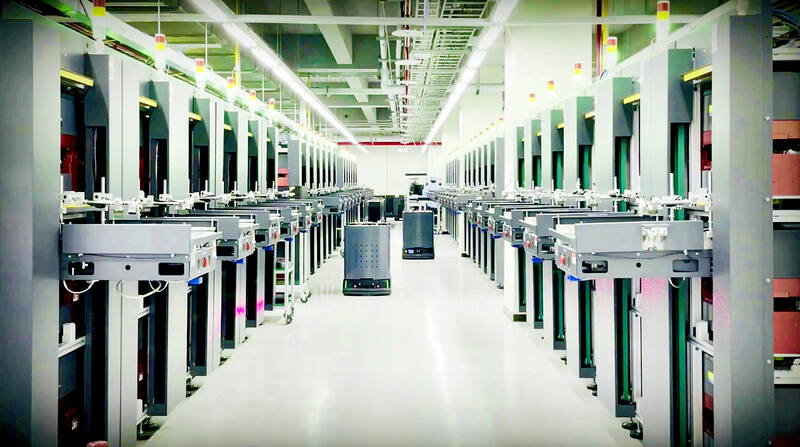
Photo courtesy of Hon Hai Precision Industry Co
“Taiwan’s economy has outpaced expectations, thanks to a remarkable surge in exports, particularly in technology and AI-linked products,” DGBAS senior official Chiang Hsin-yi (江心怡) said.
Goods exports in the fourth quarter, measured in US dollars, jumped 49.4 percent from a year earlier, surpassing prior forecasts by nearly 4 percentage points.
The agency cited strong demand from global cloud service providers as they accelerated capital spending to meet surging demand for AI and advanced computing applications.
Imports also rose sharply, increasing 24.27 percent year-on-year, as local companies boosted purchases of agricultural and industrial raw materials by 22.72 percent, and capital equipment by 40.44 percent.
Machinery and equipment imports climbed 22.86 percent, which included a 23.89 percent gain in semiconductor production tools, reflecting firms’ efforts to expand capacity in response to global demand.
Domestic demand contributed to the growth momentum, albeit at a more modest pace.
Private consumption increased 3.43 percent in the fourth quarter, slightly above earlier forecasts, supported by year-end holiday promotions, government cash handouts and expanded vehicle tax incentives that bolstered auto sales.
Government spending grew 1.83 percent, contributing 0.25 percentage points to overall GDP growth, although it was slower than projected.
Overall domestic demand rose 0.89 percent, accounting for 0.77 percentage points of the economy’s expansion.
Chiang dismissed concerns that Taiwan Semiconductor Manufacturing Co’s (TSMC, 台積電) investments in the US might displace private investment.
Since TSMC announced its expansion in the US in 2020, private-sector investments have maintained an average annual growth rate of more than 6 percent, while the economy grew at an average of 4.8 percent, the official said, adding that overseas expansion has not crowded out domestic investment.
Per capita GDP reached US$39,477 last year, approaching the US$40,000 milestone and highlighting Taiwan’s rising economic standing amid strong global demand for technology goods, Chiang said.
The data reflected export-driven growth and resilient domestic consumption, underscoring Taiwan’s integral role in the global AI and semiconductor ecosystem.
The economy is poised to sustain its robust expansion into this year, and the DGBAS is scheduled to give an official growth update next month.