
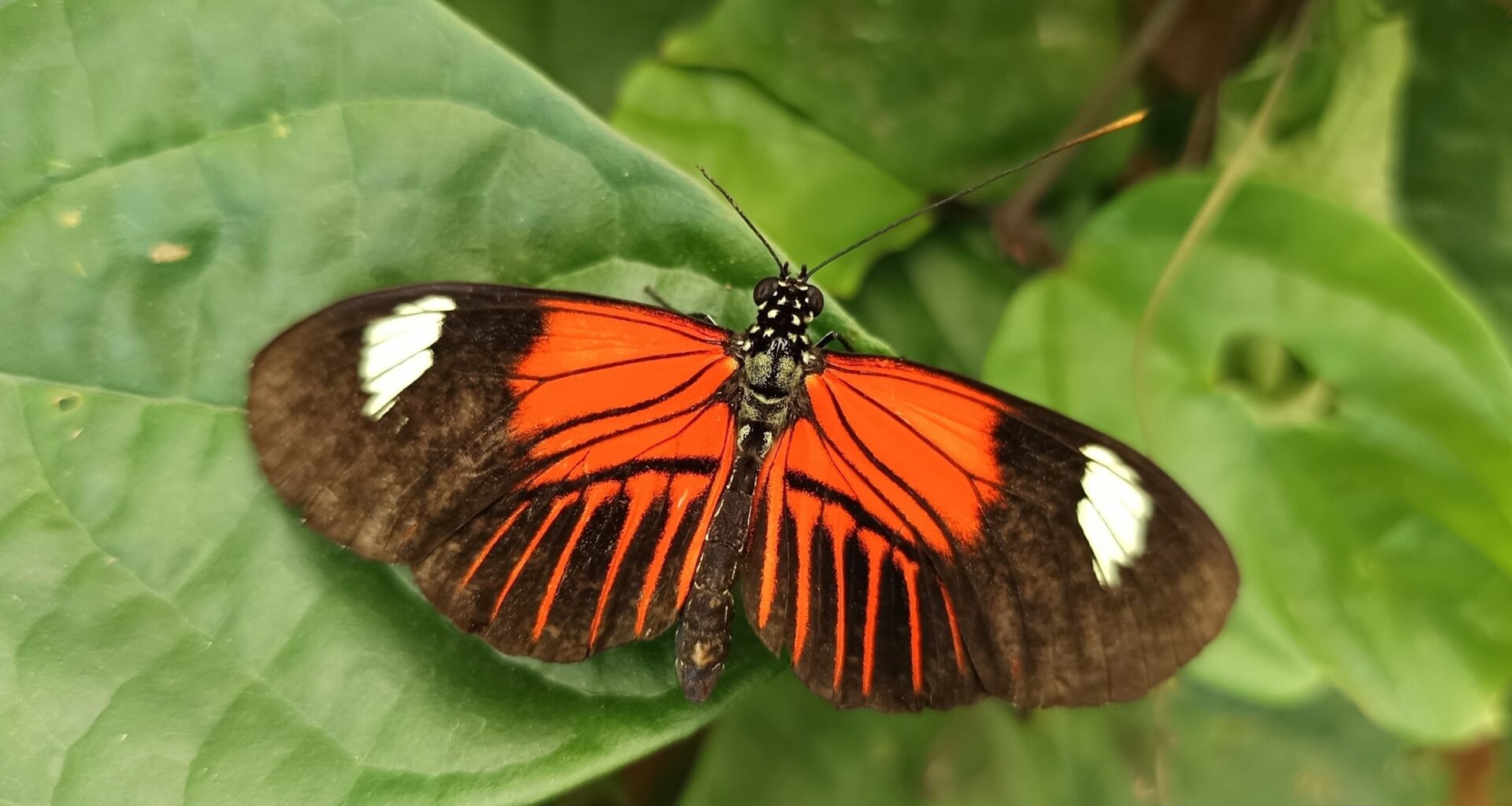
Butterflies closer to the equator have been shown to evolve shared wing patterns faster than their relatives at higher latitudes.
That gradient reframes tropical diversity as an active process, shaped by pressures that speed up adaptation rather than merely preserving it.
Mapping butterfly relatives

The pattern emerges within Adelpha, a widespread group of American butterflies whose lookalike wings long obscured their relationships.
Decades of work by Keith Willmott at the Florida Museum of Natural History (FLMNH) brought those relationships into focus by documenting how similar patterns recur across distant branches of the group.
Viewed across roughly 25 million years of history, some wing designs persist through inheritance while others reappear independently under similar pressures.
That distinction sets limits on what appearance alone can explain and opens the question of why those pressures intensify toward the equator.
Similar looks, different species
Wing markings in Adelpha can vary inside one species, while distant relatives sometimes wear nearly identical colors.
In a 1984 review, the paper described how looks alone kept taxonomists stuck for generations across tropical America.
“The result has been a hopeless tangle,” wrote entomologist Annette Aiello at the Smithsonian Tropical Research Institute.
By treating wing patterns as evolving signals instead of fixed labels, the new tree avoided that dead end.
Fast flight saves lives
Many Adelpha butterflies appear to lack the chemical toxins that protect other well-known mimics, yet they still converge on a small number of shared wing patterns.
Instead of advertising that they taste bad, these butterflies seem to signal something else to predators: they are difficult to catch.
Their fast, erratic flight, marked by sudden dives and sharp turns, means a bird that fails once is likely to fail again and waste energy trying.
Over time, that repeated failure can teach predators to avoid anything with that look, creating a shared visual warning among multiple hard-to-catch species, a pattern consistent with Mullerian mimicry that still needs direct testing in the wild.
Three wing designs in butterflies
Across tropical America, most Adelpha fit three recurring pattern groups that scientists track by their wing marks.
One common look pairs dark amber wings with two bright white streaks and bold orange bands that cut across the front wings.
Another replaces most of the orange with wide white bands, leaving only small orange marks behind, while a third drops the white entirely and relies on slanted orange stripes alone.
In parts of Venezuela, several species independently added a second orange band, showing how local pressures can tweak that basic design.
Patterns repeat over time
The evolutionary tree turned those pattern labels into a history that reached back about 25 million years.
Closely related species often shared the same design because descendants inherited the genes that guide wing scales.
The study inferred Iphiclus as the oldest common pattern, appearing more than 20 million years ago in ancestors.
Two other designs resurfaced on distant branches of the family tree, hinting that predators kept rewarding the same visual signals whenever they appeared.
Tropics speed up evolution
After mapping patterns over time, researchers compared how often lineages changed their look in different regions.
Species living closer to the equator switched patterns more frequently, creating new matches for local predator communities.
The northern edge of the group reached Colorado and Nevada, and those populations showed slower pattern turnover.
This link between latitude and wing pattern change strengthens a long-standing idea, but it cannot yet name the cause.
Why tropics have diversity
In the latitudinal diversity gradient pattern, species numbers rise as you move toward the equator.
One explanation argues that stable tropical habitats keep species interacting year-round, so predators and prey keep driving each other.
A 2009 review gathered evidence that pressure from other species rises at lower latitudes across plants, insects, and vertebrates.
If those interactions stay stronger in the tropics, butterflies may face more incentives to copy, split, and diversify.
Measurable pattern in butterfly wings
More than a century ago, Alfred Russel Wallace argued that geography shapes diversity through climate and competition.
The 1878 book linked ice ages to extinctions and stressed uninterrupted tropical interactions between species.
“Equatorial lands must always have remained thronged with life. In one, evolution has had a fair chance; in the other it has had countless difficulties thrown in its way,” wrote naturalist Alfred Russel Wallace.
His claim now lines up with a measurable pattern in butterfly wings, where evolution speeds up near the equator.
A new genus emerges
The family tree also exposed six mountain species that looked like Adelpha but sat on a separate branch.
Those butterflies shared genetic signals and larval host plants that differed from most relatives, so names kept failing.
Researchers created a genus, a formal group of closely related species, and named it Adelphina.
Clearer boundaries should help future work on conservation status and on how mimicry patterns spread between communities.
By linking wing-pattern change to latitude, the work connects butterfly survival tricks to the broader pattern of species richness.
Further field studies must measure real predator attacks and chemical defenses to pin down what, exactly, drives the pattern.
The study is published in the journal Systematic Entomology.
—–
Like what you read? Subscribe to our newsletter for engaging articles, exclusive content, and the latest updates.
Check us out on EarthSnap, a free app brought to you by Eric Ralls and Earth.com.
—–