
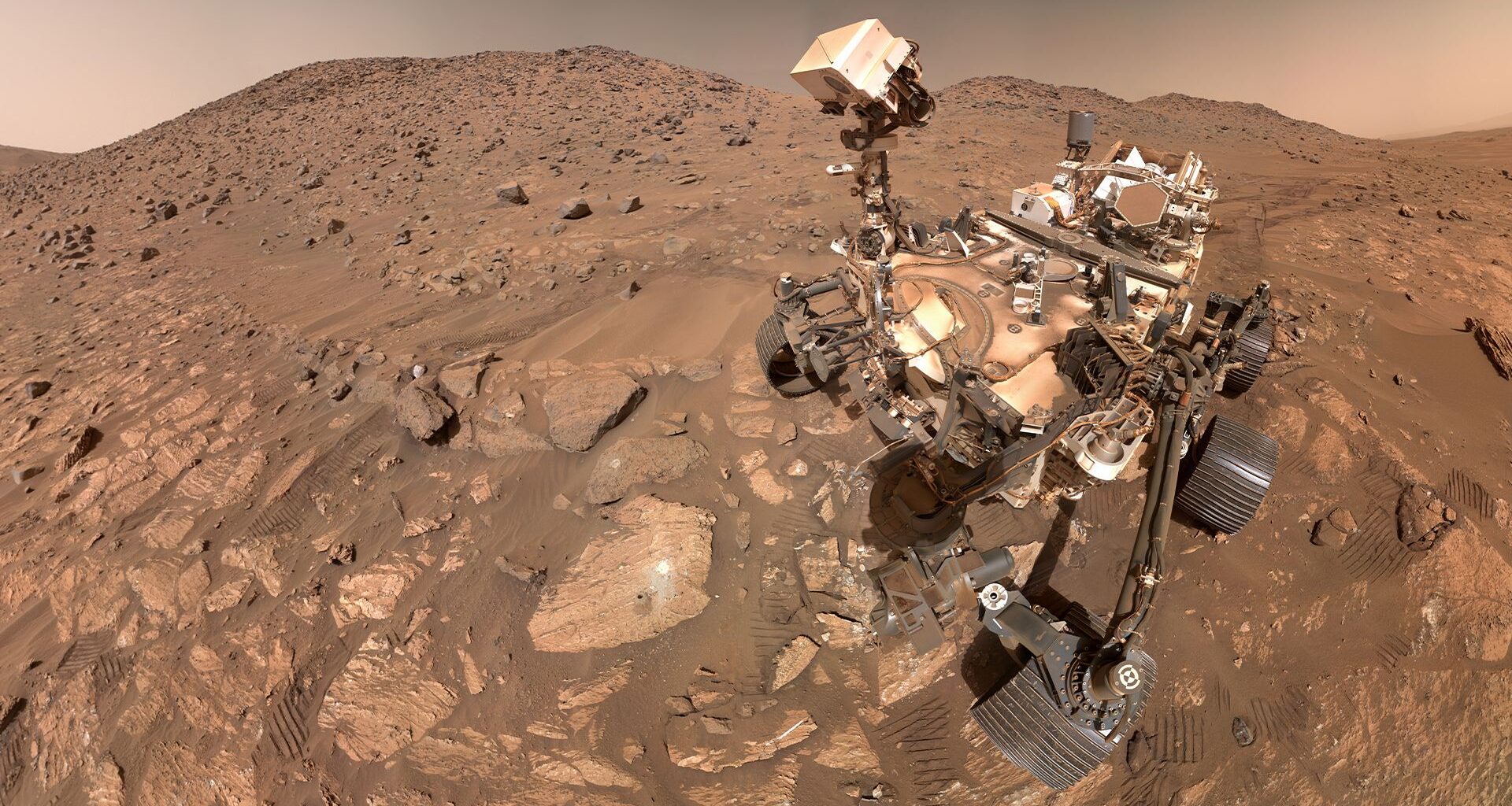
NASA’s Perseverance rover has completed the first AI-planned drives on another world, marking a milestone in autonomous space exploration.
In early December, the six-wheeled robot followed routes generated by artificial intelligence rather than human planners, navigating Mars using machine-driven decision-making for the first time in mission history.
The demonstration took place on Dec. 8 and Dec. 10 and was led by NASA’s Jet Propulsion Laboratory in Southern California.
Engineers used generative AI to create waypoints for Perseverance, a task traditionally handled by experienced rover drivers on Earth.
The rover safely executed both drives without human-designed routes, proving that AI can plan complex surface navigation on another planet.
“This demonstration shows how far our capabilities have advanced and broadens how we will explore other worlds,” said NASA Administrator Jared Isaacman.
“Autonomous technologies like this can help missions to operate more efficiently, respond to challenging terrain, and increase science return as distance from Earth grows. It’s a strong example of teams applying new technology carefully and responsibly in real operations.”
The JPL team relied on vision-language models, a form of generative AI that can interpret images and text together.
The system analyzed the same surface data that human planners normally use.
This included rover imagery, terrain maps, and hazard information. Based on that data, the AI generated a continuous driving path with safe waypoints.
The project ran from JPL’s Rover Operations Center in collaboration with Anthropic, which provided its Claude AI models.
The AI assessed features such as exposed bedrock, sand ripples, steep slopes, and boulder fields. It then selected a route that avoided hazards while keeping the rover on course.
For Perseverance’s 1,707th Martian day, or sol, the rover drove 689 feet, or 210 meters. Two sols later, it completed a second AI-planned drive of 807 feet, or 246 meters.
Both traverses matched expectations and stayed within operational safety limits.
Testing before Mars commands
Despite the autonomy, engineers did not send AI commands directly to Mars. The team first verified every instruction using JPL’s digital twin of Perseverance.
This virtual replica checked more than 500,000 telemetry variables to confirm compatibility with the rover’s flight software. Only after passing those tests did engineers uplink the commands.
Mars sits about 140 million miles from Earth on average, creating long communication delays. Because real-time control is impossible, rover teams usually plan routes in advance, step by step.
AI-driven planning could reduce that workload and speed up daily operations.
“The fundamental elements of generative AI are showing a lot of promise in streamlining the pillars of autonomous navigation for off-planet driving,” said Vandi Verma, a space roboticist at JPL and a Perseverance engineer.
“We are moving towards a day where generative AI and other smart tools will help our surface rovers handle kilometer-scale drives while minimizing operator workload.”
NASA views this test as groundwork for future exploration. AI-assisted navigation could support longer rover drives and help identify scientifically interesting targets faster.
It may also play a role in future robotic and human missions beyond Mars.