
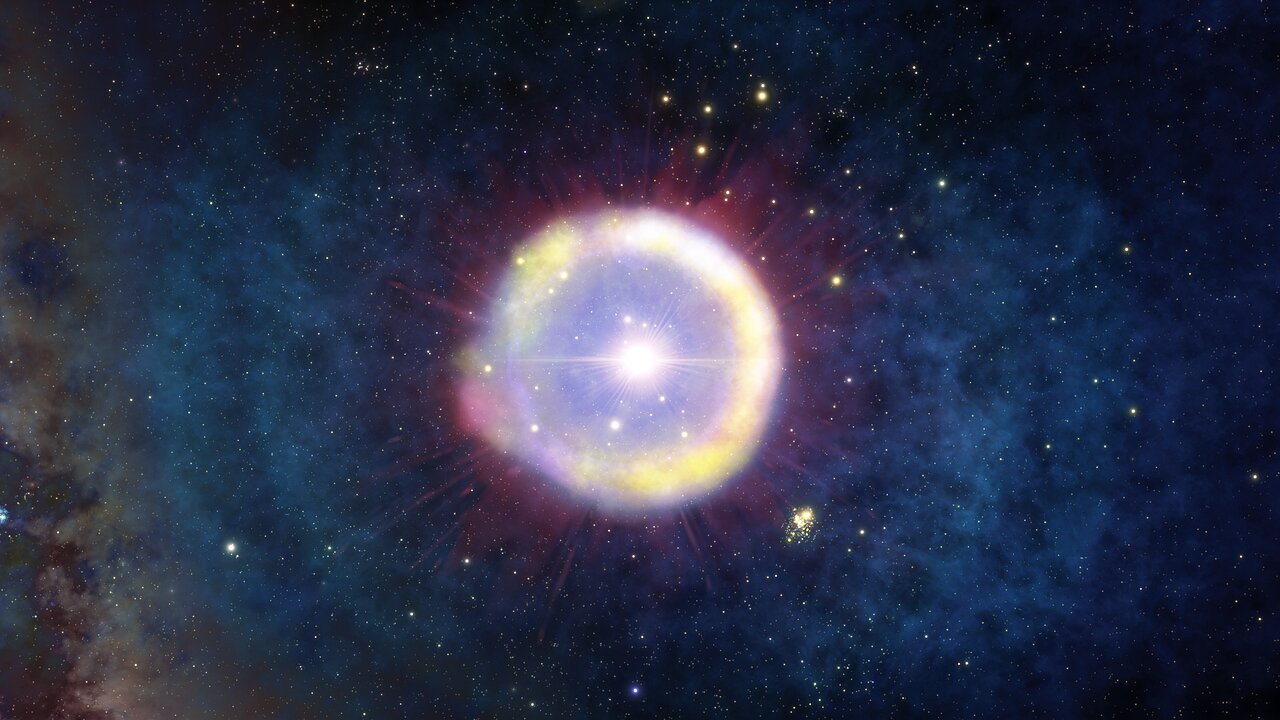
Researchers from Tsinghua University have recently discovered a “living fossil”. It’s a cosmic relic of a galaxy that’s extremely deficient in metals and possibly hosts some of the universe’s oldest, most elusive stars.
Astronomers have searched for the primordial Population III (Pop III) stars for decades. The first to light up the infant universe, these massive, scorchingly short-lived stars were made of hydrogen and helium, which they fused into the metals that enriched the successive generations of galaxies, stars, and planets, making life as we know it possible.
But there’s something even more surprising about the newly described galaxy, known as CR3: it dates to around 11.5 billion years ago. That’s seemingly way too late to be so elementally pristine and hold such pure, metal-poor stars. In fact, CR3 inferred to be the most metal-poor galaxy discovered during a period known as cosmic noon.
A First-Generation Galaxy Long after its Supposed Death
As described in an intriguing new study, researchers observed CR3’s curious composition using data from a trio of telescopes, the James Webb Space Telescope (JWST), the Very Large Telescope (VLT) in Chile, and the Subaru Telescope in Hawaii.
Overall, CR3 matches theoretical models that predict how first-generation galaxies should look: strong hydrogen and helium emission lines and “no detectable metal lines.”
Further matching models, CR3 is dust-free, low mass, and very young. It presents a stellar age of about 2 million years and only around 600,000 solar masses for its stellar population, which is consistent with a “metal-free burst of star formation.”
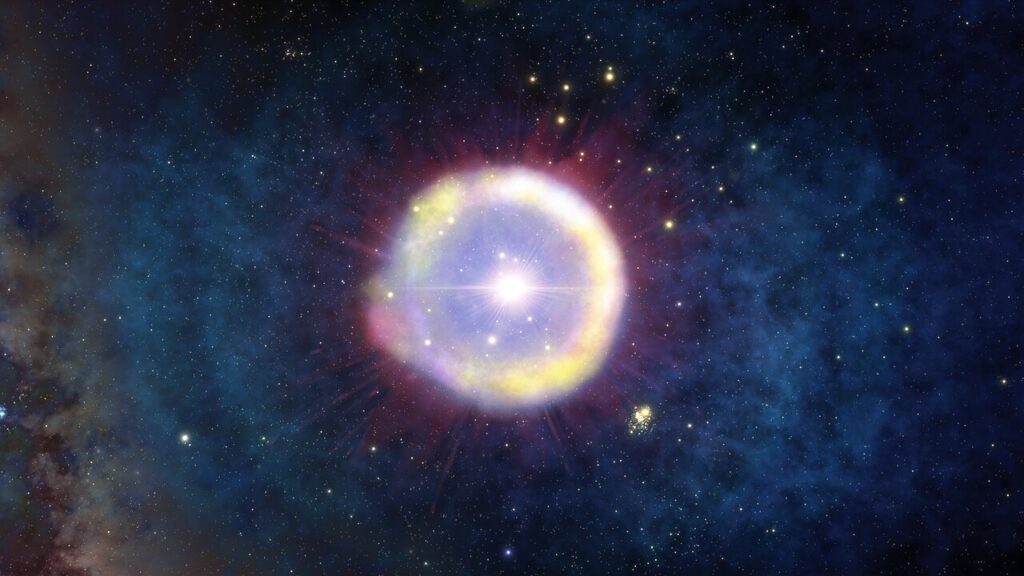 Artist’s impression showing a field of massive, primordial Population III stars as they would have appeared around 100 million years after the Big Bang. Credit: Credit: NOIRLab/NSF/AURA/J. da Silva/Spaceengine/M. Zamani
But how is it so surprisingly metal-poor? Possibly because CR3 exists in an “underdense” cosmic environment that has left it isolated. As a result, it has mostly avoided galaxy mergers and interactions, and the metal-rich outflows from neighboring galaxies have yet to reach it.
However, astronomers failed to detect the emission lines for helium II, or ionized helium, which is associated with Pop III stars due to their high ionizing power. This may be due to observation limits, as the helium II signal may be drowned out by other emissions. Alternatively, the signal may have already petered out at this stage of star evolution, approximately 2 million years after stellar formation.
Shaking up the Cosmic Timeline?
CR3 may inspire a rethink in cosmic chronology. The enigmatic Pop III stars are thought to have exploded or collapsed by around 12.7 billion years ago, so this galactic fossil is challenging current cosmological models. If Pop III stars should have emerged during the first billion years – at a pivotal moment in the history of the universe known as the Epoch of Reionization – then what are they doing at this spot in spacetime, so seemingly late to the party?
However, this apparent billion-year disparity provides hopeful news in the search for the universe’s primordial stars. It highlights “the possibility of detecting first-generation star formation in isolated, faint galaxies during cosmic noon,” the researchers explain. A follow-up to more precisely analyze CR3’s composition is warranted to explain how it’s managed to remain so pristine and defy cosmic aging theories.