
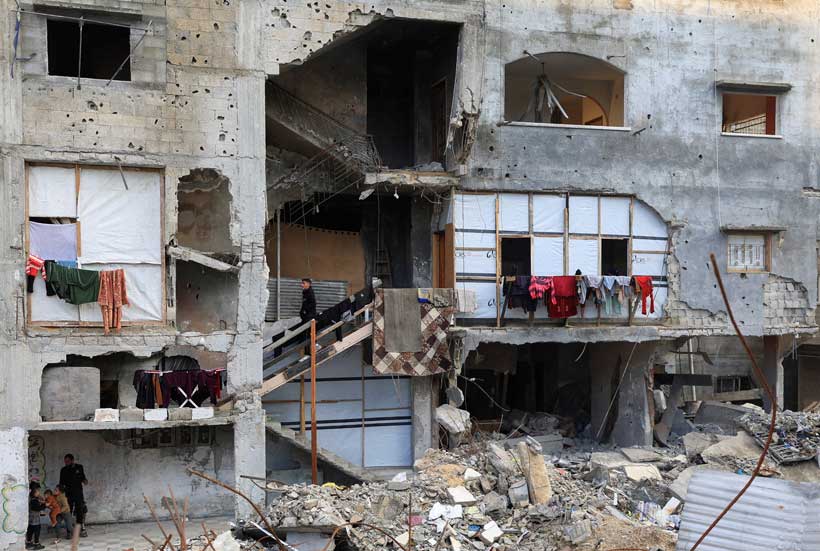
It has been over two years since the start of the Gazan War and the ensuing genocide against the Palestinians living there. Earlier this week, the United States unveiled a plan for the development of Gaza, with seaside resorts, skyscrapers, and industrial centers.
The plan exposes the tension between top-down geopolitical engineering and on-the-ground political realities. Promising skyscrapers and jobs while bypassing the people of Gaza, the plan risks being perceived less as a practical road to peace and more as an “imperial” agenda that prioritizes economic normalization over self-determination, raising profound questions about agency, sovereignty, and the future of conflict resolution.
The Davos Blueprint: Tourism, Trade, and Top-Down Planning
The development plan for Gaza envisions a rebuilding of the territory from the grown up. The existing refugee camps would be demolished and replaced with coastal resorts, industrial centers, and parks, with specific areas set aside as residential areas. According to Point 11 of Trump’s 20-point peace plan, Gaza would also become “a special economic zone … with preferred tariff and access rates to be negotiated with participating countries.”
This ambitious redevelopment plan would require years and at least tens of billions of dollars of investment in a geopolitically tense region to carry out.
Donald Trump has a background as a real estate developer, as does his son-in-law Jared Kushner, who recently unveiled the plan for a “New Gaza” with gleaming skyscrapers and beaches packed with tourists. He has not been unwilling to use the presidency to enrich himself, having already made billions since the start of his second term. There is thus the real possibility of Trump and his family also investing in Gaza to profit from a successful rebuilding of the territory. While unethical, Trump’s personal involvement and possibility of further enrichment from his own peace plan would deepen his commitment to it.
The Agency Gap: Development Without Consultation
A strong point of criticism regarding Trump’s peace plan is that it is top-down and externally imposed, lacking Palestinian local input and thus political legitimacy. And it is true that Palestinians will likely not be entirely accepting of a peace in which they had no say.
In the modern era, there are limited examples of external powers imposing development without the input of locals or local elites. Trump’s development plan for Gaza, overseen and supervised by a “Board of Peace” headed and chaired by himself with the participation of other figures such as Jared Kushner and former British Prime Minister Tony Blair, harks back to the 19th and early 20th centuries, when imperial powers engaged in development projects in newly-acquired territories for the benefit of the imperial core.
The fact that in February 2025, Trump suggested the permanent removal of all Palestinians from Gaza in order to turn the territory into a “Riviera of the Middle East” is also reminiscent of colonial projects in which the native inhabitants were removed to make way for projects that would enrich elites of the core.
As of now, it is unknown what Palestinians will be serving on the technocratic and apolitical committee envisioned by Trump’s peace plan. However, being chosen by the Board of Peace would be little different from the days in which colonies were run through useful local collaborators. At the same time, the committee presents a real opportunity for greater Palestinian engagement in the development process.
Geopolitical Theatre or Serious Statecraft?
Trump’s desire to win himself a Nobel Peace Prize is no secret, and his Gaza peace plan was likely timed to be part of the considerations of the Nobel Committee when choosing the winner. Earlier this month, he connected not winning the prize, which he considered a snub, to his desire to seize Greenland, writing “Considering [Norway] decided not to give me the Nobel Peace Prize for having stopped 8 Wars PLUS, I no longer feel an obligation to think purely of Peace, although it will always be predominant, but can now think about what is good and proper’ for the US.”
Trump has also mentioned that he envisions his Board of Peace of replacing the United Nations. Trump has already significantly shaken up the world order and sees creating this new organization as part of his legacy. To that end, Trump is likely genuine in his desire for developing Gaza.
Israel is also central to any successful peace plan and lasting security. Gaza is critical to Israeli security as is Israel to Palestine. Israeli policy has consistently framed reconstruction as conditional on Hamas’s removal, demilitarization, and long-term security guarantees, meaning that economic development is deferred until political and military prerequisites are met. Israeli Prime Minister Benjamin Netanyahu has also reiterated that Israel remains opposed to a future Palestinian state, while his far-right coalition partners have argued for annexation of the territory, putting into question whether there can be a lasting peace despite the current peace plan.
On-the-Ground Realities: Feasibility and Conflict
Trump’s plan for Gaza will be tricky to implement. Gaza is a warzone and continues suffer from genocide at the hands of Israel. The United States’ most recent plans for redevelopment in Iraq and Afghanistan ended in failure.
Gaza’s development under the current peace plan will occur funded by foreign capital and under what essentially amounts to foreign occupation. The territory will continue to be a tricky security environment, being home to a population that will remain resentful of the genocide conducted against it by Israel, and the possibility of a reignition of conflict will remain high.
Economic development cannot be completely divorced from a political resolution of the Israeli-Palestinian conflict. A successful and lasting peace plan will require Palestinians to feel secure, in control of their destinies, and materially benefitting from any kind of development plan. Unlike in Gaza prior to the outbreak of the recent war, Palestinians must no longer feel that they have nothing to lose when it comes to resisting a decades-long occupation.
The Israeli-Palestinian conflict has been a source of serious instability for the entire Levant. Peace will benefit all those who live in the Middle East.