
Key events
Show key events only
Please turn on JavaScript to use this feature
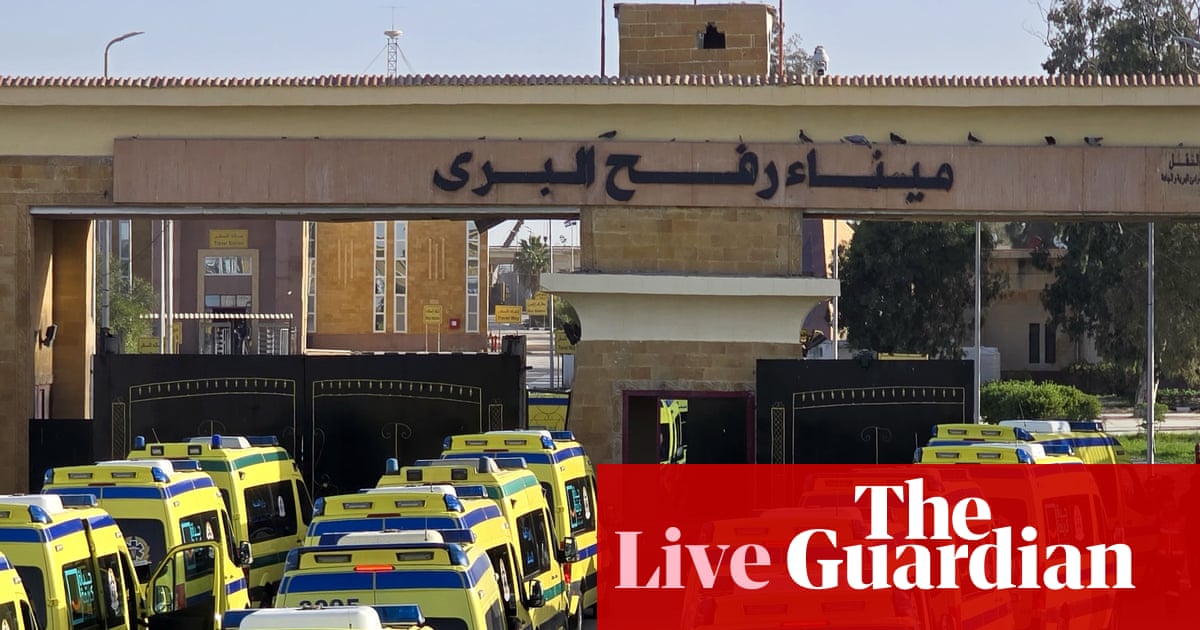
Key things to know about the Rafah crossing
As we mentioned in a previous post, a small number of Palestinian people are expected to enter the Rafah border crossing between the Gaza Strip and Egypt after it reopened for the movement of people, not humanitarian aid and commercial goods. Here are some key things to know about the crossing:
Before the war, the Rafah crossing with Egypt was the only direct exit point for most Palestinian people in Gaza to reach the outside world as well as a key entry point for aid. It has been largely shut since May 2024.
Cogat, the Israeli agency charged with administration of Gaza, said the crossing would reopen in both directions for Gaza residents on foot only and its operation would be coordinated with Egypt and the EU.
Israel has said the crossing will open under stringent security checks only for Palestinians people who wish to leave the territory and for those who fled the assault in the first months of the war to return. Many of those expected to leave are sick and injured people in need of medical care abroad.
Reopening the border crossing was a key requirement of the first phase of the US president Donald Trump’s plan to end Israel’s war on Gaza. Israeli attacks in Gaza have killed more than 500 Palestinians since the ceasefire began, local health officials say.
On Sunday, Israeli officials said a trial opening of the crossing was carried out and completed.
The Egyptian authorities will carry on controlling the crossing on their side of the border. The names of people wanting to return to Gaza will first be approved by Egypt, and then by Israel a day in advance.
Location map of Rafah crossingShare
Updated at 04.41 EST
In a post on X, Francesca Albanese, the UN special rapporteur for the occupied territories, has responded to the news of the Médecins Sans Frontières ban in Gaza by saying Israel lacked the “authority” to make such a decision in the territory. She wrote:
Israel has NO authority to block anyone from entering the Palestinian territory it illegally occupies. Stop normalising the illegal occupation by bending to its diktats. Respect the ICJ deliberation: force Israel to end the occupation. Time for justice is NOW.
Albanese, a human rights lawyer, has been vocal in calling for an end to what she describes as the “genocide” that Israel has waged against Palestinian people in Gaza.
Sanctions on Albanese were imposed by the US state department last year for what it called her “shameful promotion” of action by the international criminal court against the US and Israel.
Israel has faced accusations of genocide at the international court of justice and of war crimes at the international criminal court (ICC) over its assault on Gaza, which has killed at least 71,795 Palestinian people since October 2023, according to the latest update from the territory’s health ministry, whose figures have been deemed reliable by the UN. The death toll is likely to be higher given the number of people thought to buried in the rubble of bombed buildings.
Despite the evidence, Israel denies it is carrying out a genocide, and has said the war is one of self-defence after cross-border attacks led by Hamas on 7 October 2023 killed 1,200 people.
ShareIsrael to ban MSF from working in the Gaza Strip over refusal to provide staff list
Israel says it will suspend Médecins Sans Frontières’s operations in Gaza after the humanitarian organization refused to hand over personal details of its staff members to Israeli authorities.
In a statement released over the weekend, MSF said:
Following many months of unsuccessful engagement with Israeli authorities, and in the absence of securing assurances to ensure the safety of our staff or the independent management of our operations, Médecins Sans Frontières (MSF) has concluded that it will not share a list of its Palestinian and international staff with Israeli authorities in the current circumstances.
It went on to add that despite repeated efforts, Israel was not able to provide “concrete assurances” including “any staff information would be used only for its stated administrative purpose and would not put colleagues at risk; that MSF would retain full authority over all human resource matters and management of medical humanitarian supplies, and that all communications defaming MSF and undermining staff safety would cease.”
Israel’s Ministry of Diaspora Affairs and Combating Antisemitism confirmed its decision to halt MSF’s activities, saying that it was due to “MSF’s failure to submit lists of local employees, a requirement applicable to all humanitarian organisations operating in the region.” “In accordance with the regulations, MSF will cease its operations and depart the Gaza Strip by February 28, 2026,” the ministry added.
According to MSF, at least 15 of its employees have been killed by Israeli forces since October 2023. Last year, MSF carried out critical life-saving operations amid shortages in medical supplies due to Israeli blockades.
In addition to having provided 800,000 consultations, MSF assisted in one in three births and supported one in five hospital beds, services “that cannot be easily replaced,” the organization said.
A Palestinian receives treatment at a Doctors Without Borders (MSF) hospital, amid severe shortages of medical equipment, medicines and essential materials needed for burn treatment, in Zawaida, in the central Gaza Strip, January 26, 2026. Photograph: Mahmoud Issa/ReutersShare50 Palestinians expected to cross the border in each direction, Egyptian state-run media reports
The number of people moving through the crossing is expected to be very limited, with the restriction that only those travelling on foot can move across the border.
In the first days of the reopening, just fifty people are expected to cross the border between Gaza and Egypt in each direction, Egyptian state-linked media reported on Monday.
Updated at 04.24 EST
Earlier, an Israeli defence official said the crossing could hold between 150 and 200 people altogether in both directions. There would be more people leaving than returning because patients left together with escorts, the official added. Lists of people due to pass through the crossing had been submitted by Egypt and approved by Israel, the official said.
Reopening the border crossing was a key requirement of the first phase of the US president Donald Trump’s plan to end the conflict. But the ceasefire, which came into effect in October after two years of fighting, has been repeatedly shaken by rounds of violence.
Israeli attacks in Gaza have killed more than 500 Palestinians since the ceasefire began, local health officials say, and Palestinian militants have killed four Israeli troops, according to Israeli authorities.
For the full story, click here:
ShareOpening summary
Hello and welcome to our live coverage of the situation in Gaza, where Israel has reopened the border between Gaza and Egypt in a limited capacity. The crossing has largely been closed since May 2024.
The reopening is being coordinated with Egypt and the European Union, Cogat, the Israeli agency charged with administration of Gaza, said.
It added that the movement of Palestinians between Egypt and Gaza, permitted on foot only, would be allowed “only after prior security clearance by Israel,” with both Israel and Egypt imposing caps on the number of travellers crossing through the border.
Earlier, Cogat said it expects “movement of residents in both directions, entry and exit to and from Gaza.”
Many of those hoping to leave are sick and wounded people in need of medical care abroad – but the process may be a slow one.
Following initial identification and screening at the crossing crossing by the EU mission, there will be another screening process at a “designated corridor, operated by the defence establishment in an area under IDF control,” Cogat said.
The Palestinian health ministry has said there are about 20,000 patients waiting to leave Gaza.
The reopening of the Rafah border crossing comes as Israel launched some of its deadliest strikes in Gaza in months over the weekend, killing at least 30 Palestinians, including those who were seeking shelter in tent cities.
Since the start of ceasefire last October, more than 500 Palestinians have been killed by Israeli forces, according to Gaza’s health ministry.