
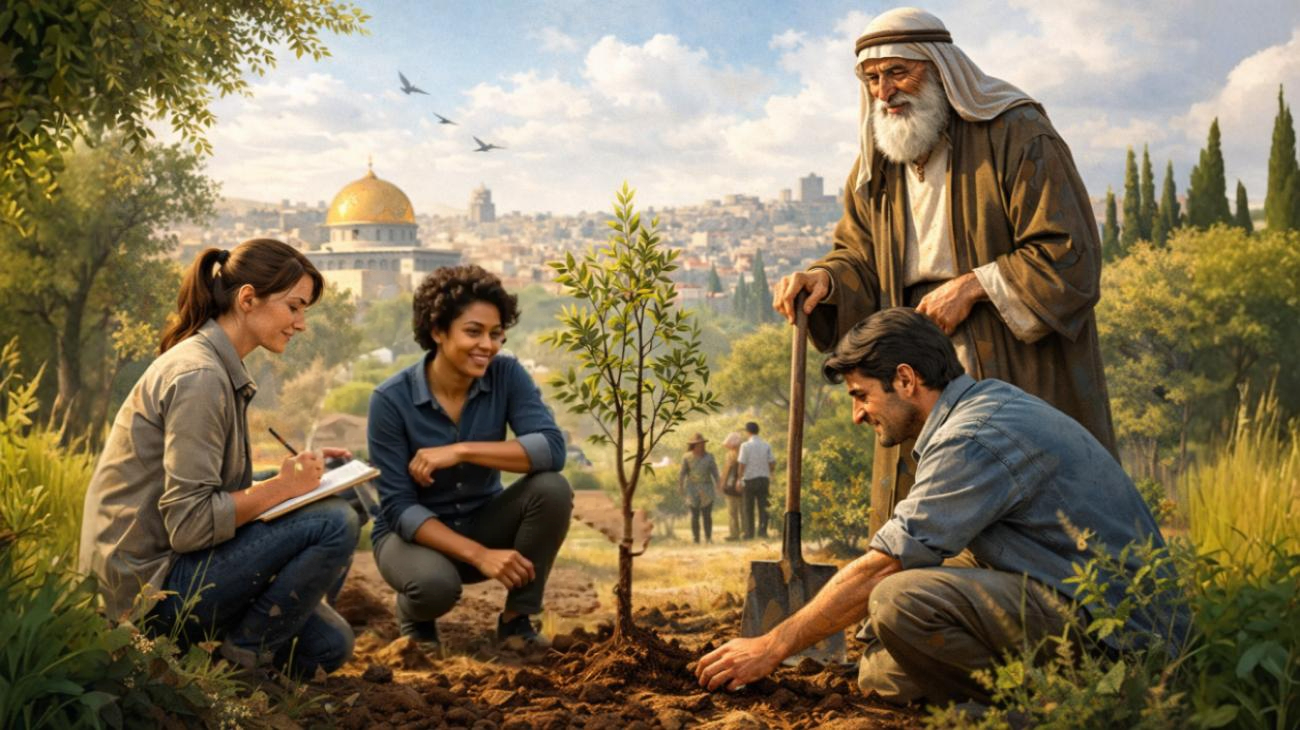
Communities across Israel are marking Tu B’Shvat today the way they have for generations: children clutching saplings, teachers herding classes into parks and forests, families gathering around tables piled with fruit, particularly the seven fruits and grains associated with the land of Israel—wheat, barley, grapes, figs, pomegranates, olives, and dates. It’s a simple holiday, almost stubbornly practical. No fireworks. No parades. You dig a hole, plant a tree, and trust the future to do the rest.
Tu B’Shvat, the 15th of the Hebrew month of Shevat, began as an agricultural marker in Jewish law—the “New Year of the Trees,” the date used to calculate the age of fruit trees for tithes. Over time, it grew into something broader: a day about stewardship, responsibility, and thinking past your own lifetime. In modern Israel, it functions like a national Arbor Day. Schools close the books and head outdoors. The message is clear: If you want shade tomorrow, you plant today.
The spirit of the holiday is captured in one of the most famous passages in the Talmud. In Ta’anit 23a, Honi the Circle-Drawer sees an old man planting a carob tree. Honi asks the obvious question: How long until it bears fruit? Seventy years, the man answers. (This is an exaggeration to make the moral point clear, rather than a precise horticultural fact.) “Do you expect to live 70 years and eat from it?” Honi presses. The man replies, in essence: Just as my ancestors planted for me, I plant for those who come after me.
No poetry. No drama. Just duty.
That story is Tu B’Shvat in a nutshell. You build what you may never personally enjoy.
At The Media Line, that same logic guides our work every day. Journalism—real journalism—isn’t improvised. It’s cultivated. Reporters aren’t born knowing how to verify sources, navigate conflict zones, or ask hard questions of powerful people. Those skills are taught, sharpened, and passed down, generation to generation, like an orchard tended over decades.
Through our Press and Policy Student Program, we train young journalists to cover Israel and the Middle East with rigor, fairness, and backbone. Students learn reporting in the field, policy analysis, and ethical standards that too often get lost in today’s fast, noisy media environment. They interview decision-makers, file real stories, and develop the habits that separate serious correspondents from social-media spectators.
In other words, we plant.
Some of these students will become foreign correspondents. Others will shape policy, edit major publications, or influence how the region is understood worldwide. We may not see every fruit they produce. But someone will read their work, rely on their facts, and make decisions because they got the story right.
That’s the long game. That’s Honi’s carob tree.
This Tu B’Shvat, as Israelis put saplings into the ground, we invite you to do the same—in a different way. Support The Media Line’s Press and Policy Student Program. Help us plant the next generation of responsible, clear-eyed journalism.
Because forests don’t grow overnight. And neither do great reporters.