
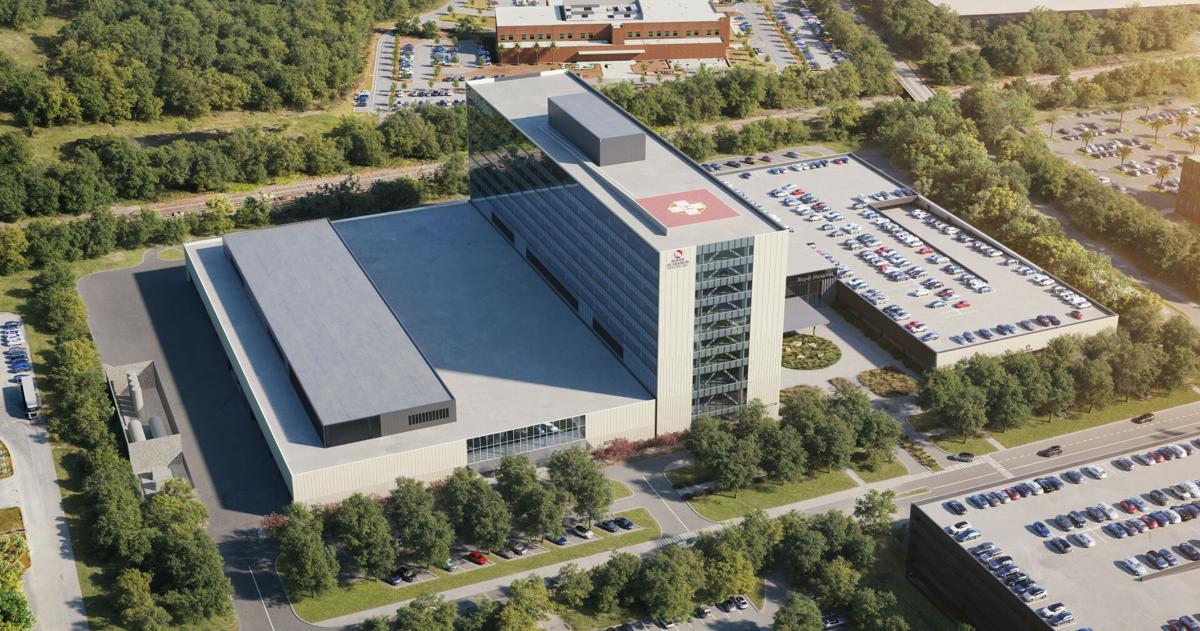
NORTH CHARLESTON — For now, the $1.2 billion Roper Hospital project is a large, flat lot with a tall crane in the center, huge mounds of dirt to one side, and seemingly random concrete forms and giant holes sprinkled across. Come 2029, though, the development will not only tower over the area, but create a new environment around it, with multi-family homes and pedestrian-friendly streets and greenways.
The massive project is more than three years from completion but every step, every week is carefully planned out in charts and blueprints that stretch across a large conference room and will eventually draw nearly 1,000 workers a day to the site.
The Roper development is more than just a hospital with parking decks and a medical office building. It is a transformation of the area near North Charleston City Hall and around Mall Drive that will also change how the hospital system and its employees deliver care.
The goal is to open the 880,000-square foot hospital in June 2029 and that remains on schedule, said Charles Fletcher, vice president of construction, real estate and support services for Roper St. Francis Healthcare. They have not adjusted that date from the start “and we’re not going to,” he said.
Inside a massive conference room in the old Verizon building, located next door to the construction site, hospital officials and those with Barton Malow and Edifice General Contractors have hung a timeline for the construction of the 10-story tower along most of the back wall.
The schedule is divided into weeks, with every 7-day stretch studded with brightly colored sticky notes affixed by the various subcontractors. Each sticker signals a commitment they’ve made to perform a certain task at a certain time. The notes were placed over a two-day planning session and while they look flimsy and adjustable, those pledges are now solidly locked into place, Fletcher said.
“The good news is you have the commitment from everybody,” he said.
With so many people working on the hospital and not enough parking available, Fletcher said the big parking deck across from the main hospital site is one of the first structures that needs to go up.
At the peak, there could be as many as 1,000 people on a given day working on the site, said Joey Weir, a superintendent for construction on the project.
“It’ll be a logistical challenge,” he said. Weir then added, “I need a parking structure for a break area” for those workers,.
It’s hard to imagine how the hospital will take shape from what exists now, but different areas offer hints at its massive size. There is a large sunken concrete area, roughly 16 feet below the surface, that will be the foundation for an enormous bank of 12 elevators for use by both patients and staff. Further down, regularly spaced blocks of concrete and steel have been placed at the visible end of more than 4,300 pilings. They go down 60 feet or so to secure the building to the Cooper marl, a thick clay and mineral deposit below, and will work together to form a single base for the soaring construction above, Weir said.
The new hospital will be built to withstand a 500-year-flood — a legitimate concern in the Lowcountry. The strength is a sharp contrast to Roper’s current downtown location, where heavy rains or a big high tide can flood the area around the emergency department, forcing ambulances to go elsewhere, Fletcher said. The new building is also constructed with a potential earthquake in mind. If a strong tremblor hits, the earth just beneath the hospital can liquify, so the plumbing is attached to the structure above it to hang safely in case the ground drops out below, Weir said.
These safety factors were part of the reason from the move downtown, and the spot in North Charleston was further chosen for its proximity to interstates 26 and 526 and other major roadways.
The new construction also provides an opportunity to change the way patients receive care, Fletcher said. The parking garage that will initially serve contractors eventually will be allocated for staff, with a separate parking area just for patients and visitors. That will lead to a single entry area for patients and visitors to pass through security and weapons screening.
After registering, patients and visitors will be guided to services, with many contained on a single floor. Previously, Roper facilities had multiple entry points and patients had to figure their way out through the building.
“It’s all about patient access,” Fletcher said.
Adding to the forethought of the development, the future campus will have more of a community feel, Fletcher said, as evidenced in an aerial view of the surrounding properties. A proposed tree-lined greenway extends down the sides of the hospital along Mall Drive and Lacross Road to City Hall. The idea is to create “almost a campus-like feel” with benches and spots for food trucks to come in and park, encouraging people to get out of the hospital and the nearby buildings and walk around, Fletcher said.
Future projects will play a big part in that social aspect. Right now, anyone trying to walk along the side of Mall Drive toward Rivers Avenue runs into a narrow two-lane bridge over railroad tracks that has no room for pedestrians, Fletcher said. But options will come more into focus in the future when the Lowcountry Rapid Transit is built. It has a stop at Rivers, opening up the opportunity for someone to take mass transit and walk to the hospital — if the surroundings were more pedestrian-friendly.
“Improving bike and pedestrian access to the new Roper campus is a priority project for the city,” North Charleston spokesman Tony Tassarott said.
Replacing that rail overpass, in particular, is a major initiative on the Charleston County Transportation Sales Tax extension, as it was on a previous extension that failed to pass, Tassarott said.
Walkability would not just benefit Roper and the future medical office building it plans to add later, Fletcher pointed out. MUSC Children’s Health Summey Medical Pavilion, a large pediatric multi-specialty clinic, is also on the same route, along with other medical offices in the area.
Then there’s the future residents of the large parcel of land just north of the new hospital site that is being developed for multi-family units. A similar parcel across Lacross Road, a former Borden’s dairy, may see multi-family units as well. Roper’s commitment to the area is helping to stimulate that, Fletcher said.
“As the hospital develops, we’re going to see lots of other economic benefits,” he said. “You know, this area is going to be completely changed.”