
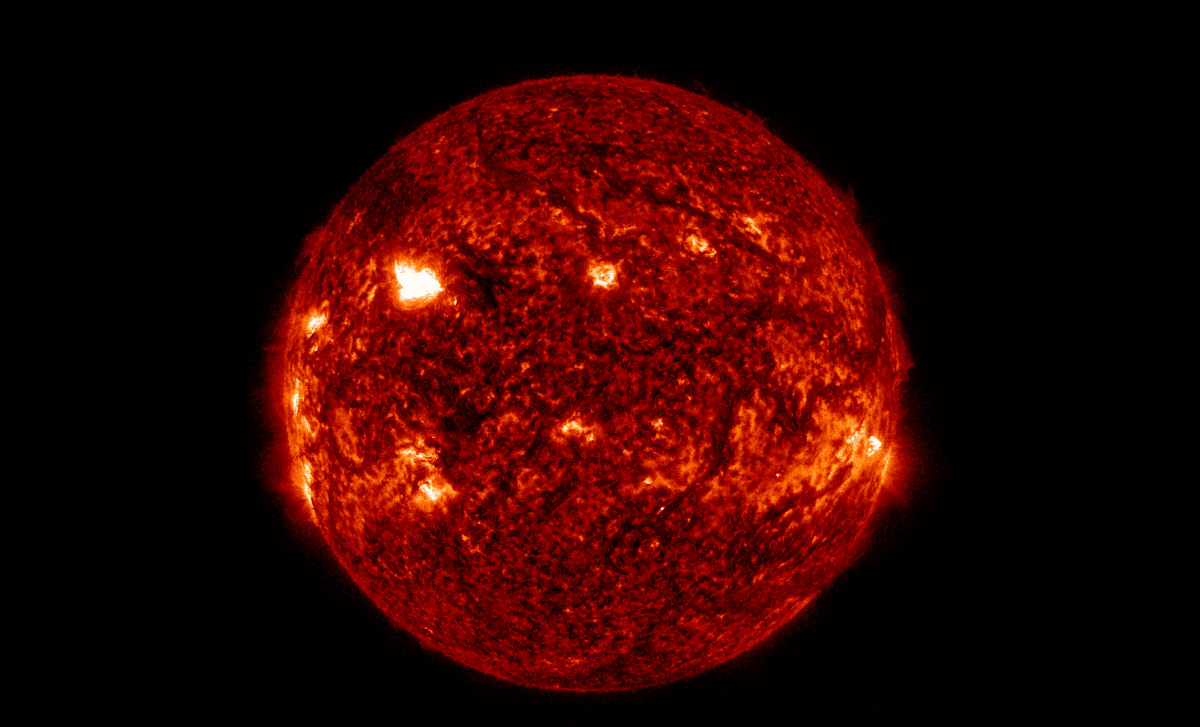
A volatile solar region has rotated into Earth’s line of sight, triggering an intense series of solar flares closely tracked by Spaceweather.com and monitored by NOAA, raising fresh attention on space weather conditions around our planet.
A Newly Aligned Sunspot Shows Unstable Behavior
Solar observers are focusing on a rapidly evolving sunspot that has just turned toward Earth, revealing an unusually unstable magnetic structure. According to ongoing observations, this active region has produced a sustained barrage of flares within a short timeframe, signaling a complex and stressed magnetic field. The geometry of the sunspot suggests tightly wound magnetic lines that are prone to sudden realignments, a configuration known to favor energetic solar eruptions.
As the Sun continues its climb toward the peak of Solar Cycle 25, such hyperactive regions are becoming more frequent. Astronomers note that the sheer cadence of recent flares sets this sunspot apart, even by current solar maximum standards. Each flare represents a rapid release of magnetic energy, emitting radiation across the electromagnetic spectrum and offering scientists a live demonstration of solar dynamics at work.
What Spaceweather.com And NOAA Are Tracking Right Now
Specialists at Spaceweather.com and forecasters from NOAA’s Space Weather Prediction Center are closely monitoring the region as it remains geoeffective, meaning it is well-positioned to influence Earth. Their instruments track flare intensity, timing, and associated emissions such as X-rays and extreme ultraviolet radiation.
The primary concern lies not only in flares themselves, but in the potential for accompanying coronal mass ejections. While flares are flashes of radiation that travel at light speed, CMEs are clouds of magnetized plasma that can arrive days later. Data released by NOAA indicates that, so far, several flares have been radiation-heavy without clearly Earth-directed plasma clouds, though that assessment can change as the sunspot continues to evolve.
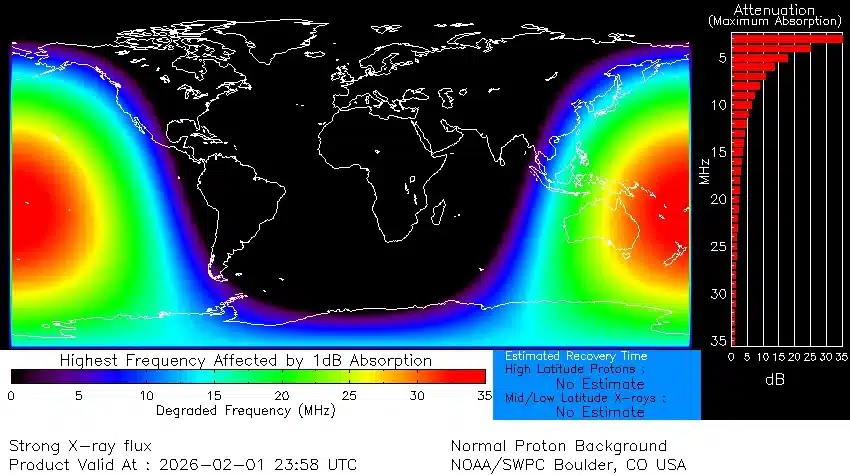 The X8.3 solar flare sparked strong radio blackouts across eastern Australia and New Zealand. (Image credit: NOAA Space Weather Prediction Center)
Possible Effects On Earth And Near-Earth Space
When strong solar flares occur on the Earth-facing side of the Sun, their immediate impact is felt in near-Earth space. High-frequency radio communications can experience brief disruptions, particularly on the sunlit side of the planet. Aviation routes over polar regions are also watched carefully, as increased radiation levels can interfere with navigation and communication systems.
Longer-term effects depend on whether powerful CMEs are launched toward Earth. If such material interacts with Earth’s magnetic field, it can energize the magnetosphere, leading to geomagnetic storms. These storms are known to stress power grids, affect satellites, and expand the visibility of auroras to lower latitudes. Scientists emphasize that Earth’s magnetic shield remains highly effective, though modern technological systems are more sensitive than ever to solar disturbances.
NASA model showing the slow-moving CME eruption from the sun during the X8.3 flare event. (Image credit: NASA)
A Reminder Of The Sun’s Growing Activity Phase
This flare barrage serves as another indicator that the Sun is entering a particularly active chapter of its cycle. Researchers studying solar physics see these events as valuable data points, offering insights into how magnetic energy builds and releases on a star. Each eruption helps refine predictive models that aim to improve space weather forecasting.
For now, experts urge awareness rather than alarm. Continuous monitoring by ground- and space-based observatories ensures that significant developments are detected quickly. As the restless sunspot continues its transit across the solar disk, scientists expect further activity, making the coming days an important window for observation and analysis.