
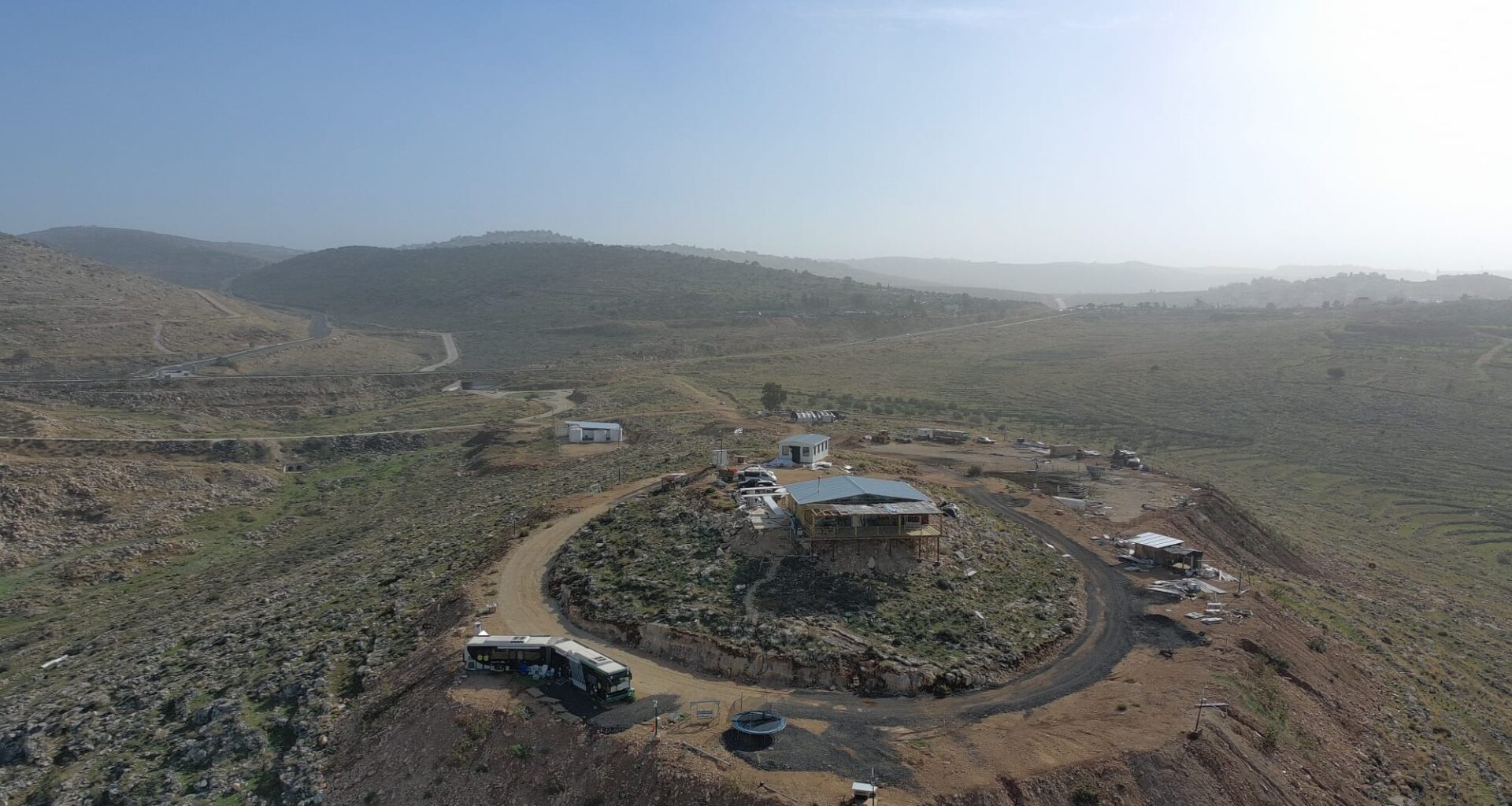
Defense Minister Israel Katz announced on Monday that he is advancing the legalization of some 140 unauthorized farming outposts in the West Bank, and is being supported in this effort by Prime Minister Benjamin Netanyahu and Finance Minister Bezalel Smotrich.
Speaking in a video message to a “conference of appreciation” for illegal farming outposts, Katz lauded those involved in those endeavors as “the pioneers of our days” and praised them for their work in “weakening the Palestinians’ efforts to establish themselves in the region.”
Some of these farming outposts have become hotbeds for settler violence that terrorizes nearby Palestinian communities, as far-right activists use the agricultural communes to expand Israel’s grip over West Bank territory.
A spokesperson for Netanyahu did not immediately respond to a question about whether the prime minister supports the legalization of the 140 farming outposts. However, he has reportedly expressed support for the move in the past.
Smotrich and Settlements Minister Orit Struck attended the conference, which was held at the illegal farming outpost of Hesed Olam and organized by the Mateh Binyamin Regional Council, within whose jurisdiction the outpost lies.
Get The Times of Israel’s Daily Edition
by email and never miss our top stories
By signing up, you agree to the terms
The establishment of illegal farming outposts in the West Bank, which usually involved the grazing of sheep, goats, or cattle across large areas of land, has in recent years become a tactic widely used by settler activists, in coordination with regional settlement councils and individual settlements, with the explicit goal of exerting control over large swaths of West Bank land.
The outposts are frequently established on what is defined as state land — land that is not privately owned — in order to stave off immediate removal by the security services. But the outposts are built without cabinet authorization, meaning they are illegal under Israeli law.
Government ministries, including the Settlements Ministry and the Agriculture Ministry, have directly funded the farming outposts, providing them with security equipment and subsidies for raising livestock.
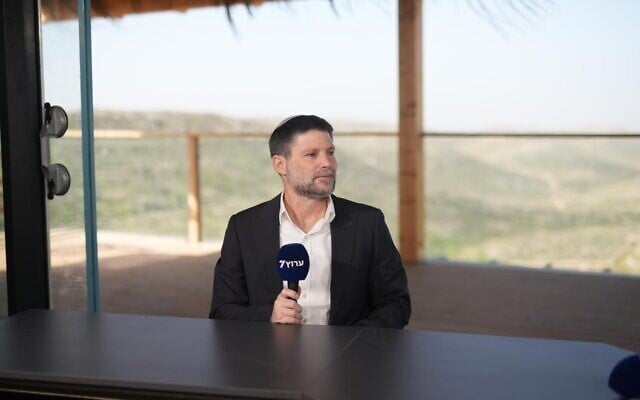
Finance Minister Bezalel Smotrich speaks at a “conference of appreciation” for illegal farming outposts in the West Bank, February 2, 2026. (Courtesy Arutz 7)
But the establishment of the farming outposts is frequently accompanied by violence from their residents against local Palestinian civilians, and has resulted in the depopulation of numerous rural Palestinian villagers in recent years.
The Peace Now organization, which campaigns against Israeli settlements in the West Bank, says that some 120 illegal farming outposts have been established in the three-plus years since the government too power.
“Whoever wants to see Zionism at its best, [to see] what deep commitment to the Land of Israel is, and what true connection to the soil of the land is, will find all of this is the agricultural farms in Judea and Samaria,” said Katz in his message to Monday’s conference.
“This wonderful and important project is the direct continuation of the pioneering settlement across the generations, from the beginnings of Zionism until today.
“This is a good opportunity to express recognition and appreciation for you, the pioneers of our days, the people of the farms who live in difficult circumstances and continue to protect, on the ground, the open spaces and the future of the entire region.”
The defense minister praised Mateh Binyamin Regional Council leader Israel Ganz for “strengthening” the farming outposts “out of a strategic vision for the security of the region against the Palestinian enemy,” and said he would continue to act “out of a sense of commitment” to the settler residents of the West Bank.
“On this day on which we are lauding the contribution of the agricultural farms, we are blessed by a historic step that I am advancing with the support of Prime Minister Benjamin Netanyahu and with the cooperation of Finance Minister Bezalel Smotrich: the legalization of 140 farms in Judea and Samaria [the West Bank]. This is another step in strengthening the settlements and weakening the Palestinians’ efforts to establish themselves in the region,” declared Katz.
Speaking at the conference, Ganz praised the Settlements Ministry as well as the Settlements Administration, a department of the Defense Ministry, for helping advance the spread of farming outposts.
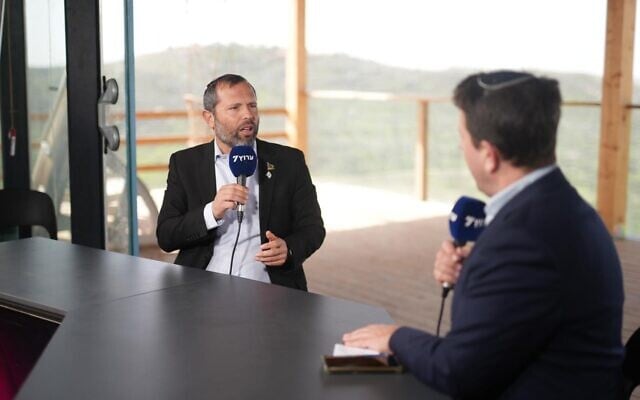
Head of the Mateh Binyamin Regional Council Israel Ganz speaks at a “conference of appreciation” for illegal farming outposts in the West Bank, February 2, 2026. (Courtesy Arutz 7)
But, he said, his regional council was coordinating the establishment of the outposts on the ground.
“In the end, all the pipes pass through the regional council,” said Ganz.
“There is a department, the Land Department [in the Mateh Binyamin Regional Council] that examines where there is state land, how it can be protected and how it can be developed,” said Ganz.
“Dozens of additional communities will be established here in the coming years,” he added.
Addressing at the conference, Smotrich once again hailed the impact of his policies and those of the government more broadly in expanding settlements as a way of ensuring permanent Israeli control over the West Bank and preventing the establishment of a Palestinian state.
“We are doing a final elimination of the idea of the Arab state, the state of terror in the heart of the Land of Israel,” said Smotrich, who also opposes granting equal rights to Palestinians living in the territory he seeks to annex.
“This government’s tenure will be remembered as a turning point that killed the idea of the Palestinian state and established our existence,” the finance minister said, adding that the formal annexation of the West Bank by Israel would also be achieved.
US President Donald Trump said last year that he would not allow Israel to annex the West Bank, and government proposals with that aim have since ceased.
Is accurate Israel coverage important to you?
If so, we have a request.
Every day during the past two years of war and rising global anti-Zionism and antisemitism, our journalists kept you abreast of the most important developments that merit your attention. Millions of people rely on ToI for fact-based coverage of Israel and the Jewish world.
We care about Israel – and we know you do too. So we have an ask for this new year of 2026: express your values by joining The Times of Israel Community, an exclusive group for readers like you who appreciate and financially support our work.
Already a member? Sign in to stop seeing this
You appreciate our journalism

You clearly find our careful reporting valuable, in a time when facts are often distorted and news coverage often lacks context.
Your support is essential to continue our work. We want to continue delivering the professional journalism you value, even as the demands on our newsroom have grown dramatically since October 7.
So today, please consider joining our reader support group, The Times of Israel Community. For as little as $6 a month you’ll become our partners while enjoying The Times of Israel AD-FREE, as well as accessing exclusive content available only to Times of Israel Community members.
Thank you,
David Horovitz, Founding Editor of The Times of Israel