
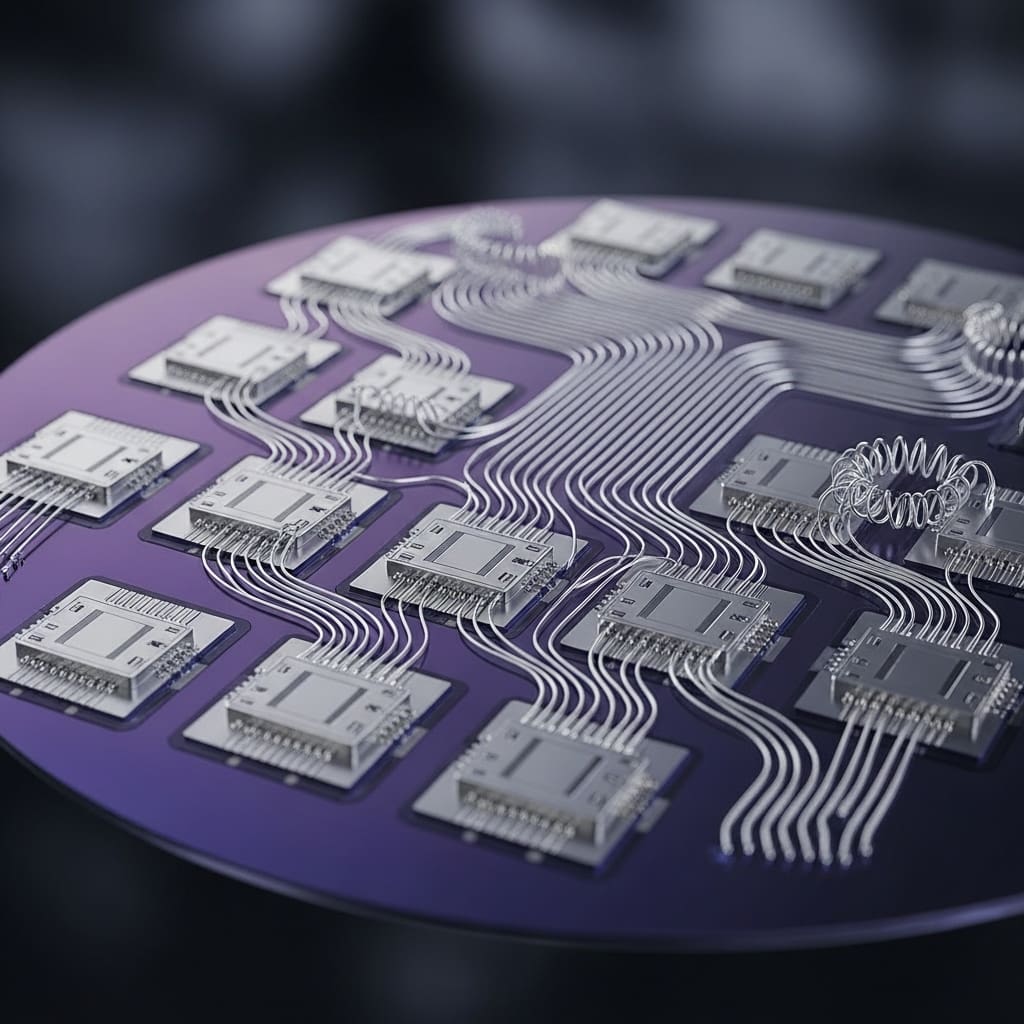
Scientists are developing faster readout systems for cryogenic detectors used in the search for neutrinoless double beta decay, a rare process that could reveal fundamental properties of neutrinos. M. Adamič, M. Beretta, and J. Camilleri, along with colleagues from institutions including Berkeley Lab and McGill University, have demonstrated a new frequency-domain multiplexed (fMux) readout system capable of sampling detectors at 156kHz, three orders of magnitude faster than previous designs. This advancement is significant because it allows for improved background discrimination and the potential to scale up to the thousands of channels required for next-generation experiments, while minimising thermal load and radioactive contamination.
Adapting millimetre-wave telescope technology for cryogenic neutrinoless double-beta decay searches offers unique sensitivity
Scientists have demonstrated a new high-bandwidth readout system for transition-edge sensors, crucial for the next generation of cryogenic neutrinoless double-beta decay experiments. These experiments, operating at approximately 10 mK, traditionally utilise neutron transmutation doped (NTD) thermistors for readout, offering good energy resolution but limited by response times around 1ms.
Transition-edge sensors, however, provide superior timing performance with resolutions of roughly 100μs, making them ideal for improving background discrimination in these sensitive searches. To implement this technology across the thousands of channels anticipated in future experiments, a multiplexed readout system is essential to minimise thermal load and radioactive contamination.
The team achieved a significant advancement by adapting frequency-domain multiplexing (fMux) readout, previously employed in mm-wave telescopes with 100Hz sampling rates, to meet the demanding bandwidth and noise requirements of cryogenic calorimeters. This new system samples detectors at 156kHz, representing a three-order-of-magnitude increase in speed compared to its cosmology-focused predecessor.
Each multiplexing module incorporates ten superconducting resonators operating in the MHz range, coupled with a superconducting quantum interference device (SQUID), and interfaced to high-bandwidth field programmable gate array (FPGA)-based electronics for digital signal processing and low-latency feedback. This breakthrough is particularly relevant for experiments like CUPID, which aims to detect neutrinoless double beta decay from 100Mo.
CUPID employs scintillating Li1002MoO4 crystals coupled to light detectors, and is designed to discriminate alpha particle backgrounds via a heat/light double readout. The research addresses a critical challenge in CUPID, the potential for timing pileup from the 2νββ decay of 100Mo, which could contribute significantly to background noise.
By utilising TES detectors with significantly faster response times, approximately 100μs versus the 1ms of NTDs, the system promises improved rejection of these pileup events, crucial for tonne-scale 0νββ searches. The study establishes a system capable of handling signals in the kHz range, essential for capturing the fast risetime of TES sensors and enabling pulse shape discrimination techniques.
Furthermore, the design prioritises minimising material near the detectors, a key consideration for reducing radioactive backgrounds, by positioning readout hardware up to 1-2m away from the sensors within the CUPID cryostat. A multiplexing factor of 10-15 is sufficient for the CUPID cryostat to achieve sufficiently low thermal load at 10 mK, while also limiting potential channel loss due to hardware failures.
Frequency-domain multiplexed transition-edge sensor readout for high-resolution neutrinoless double-beta decay searches requires advanced signal processing
Scientists engineered a new readout system for next-generation cryogenic neutrinoless double-beta decay experiments, addressing limitations in existing technologies. This new system samples detectors at 156kHz, representing a three-order-of-magnitude increase in speed compared to cosmology-focused predecessors.
Each fMux module comprises ten MHz-range superconducting resonators and a superconducting interference device (SQUID), interfaced with high-bandwidth field programmable gate array (FPGA) electronics for digital signal processing and low-latency feedback. Experiments employ a configuration where each TES is integrated into a series LC circuit, tuned to a unique resonant frequency between 1-5MHz.
The readout electronics generate a comb of carrier tones, providing a voltage bias to each TES and maintaining operating points via electro-thermal feedback. Resulting bias currents are summed and inductively coupled to a DC-SQUID, functioning as a transimpedance amplifier. Energy deposition within a TES alters its resistance, inducing amplitude modulation of the current at the associated LC filter frequency, which is then digitised and demodulated.
The study pioneered Digital Active Nulling (DAN), dynamically injecting current to cancel flow through the SQUID input coil, ensuring linear operation and encoding the science signal in the nuller line. This modern implementation of high-bandwidth fMUX represents a substantial advancement over previous CMB fMUX conversions, which lacked dynamic nulling and operated at lower frequencies.
Tests were conducted using IrPt bilayer TES devices with critical temperatures of 35 mK or 55 mK, deposited on 500μm thick silicon wafers and diced to 45 × 45 mm2. These TESs were mounted on the mixing chamber at 12 mK, while LC filters and the SQUID were positioned on a printed circuit board on the still stage at approximately 700 mK.
High-speed frequency-domain multiplexing readout for cryogenic detectors enables pulse shape discrimination with improved sensitivity
Scientists have developed a new readout system for superconducting detectors, achieving a sampling rate of 156kHz, three orders of magnitude faster than previous cosmology-oriented systems. This breakthrough addresses the need for faster readout in next-generation cryogenic neutrinoless double-beta decay experiments, crucial for improved background discrimination.
The system utilises frequency-domain multiplexing (fMux) with ten superconducting resonators operating in the MHz range, coupled to a superconducting interference device (SQUID) and high-bandwidth field programmable gate array (FPGA) electronics. Experiments revealed that the new fMux system is designed to handle signal bandwidths in the kHz range, capturing the 100μs risetime of TES sensors and enabling pulse shape discrimination techniques.
Measurements confirm that TES detectors offer a significant speed advantage over traditional neutron transmutation doped (NTD) thermistors, exhibiting response times of approximately 100μs compared to 1ms for NTDs. This enhanced timing performance is critical for rejecting pileup events from the 2νββ decay of 100Mo, which could otherwise contribute up to half of the total background in the CUPID experiment.
The team measured a multiplexing factor of 10-15, sufficient for the CUPID cryostat while limiting potential data loss from hardware failures. Tests prove the system is scalable to tonne-scale calorimeters with thousands of channels, reducing thermal load and radioactive contamination. The design prioritises minimising material near the detectors, with cabling extending 1-2m between the TES and SQUID amplification stage, a necessity given the CUPID cryostat’s configuration.
Data shows the system’s resonant circuits have resonance widths on the order of tens of kHz, adapting the technology to the faster scintillation light signals expected in CUPID, which are orders of magnitude quicker than those measured in cosmic microwave background experiments. The breakthrough delivers a viable pathway for future tonne-scale upgrades of the CUPID experiment, enhancing sensitivity in the search for 0νββ decay.
Faster Readout Enables Improved Neutrinoless Double-Beta Decay Detection sensitivity
Researchers have developed a new readout system for transition-edge sensors (TESs) intended for use in next-generation cryogenic calorimeters searching for neutrinoless double-beta decay. Current experiments utilise neutron transmutation doped (NTD) thermistors, but these are limited by relatively slow response times of around one millisecond.
This new system employs frequency-domain multiplexing (fMux) to achieve significantly faster readout, sampling detectors at 156kHz, three orders of magnitude quicker than previous cosmology-focused iterations. The system comprises ten superconducting resonators and a superconducting interference device, coupled with field programmable gate array (FPGA)-based electronics for digital signal processing and low-latency feedback.
This advancement is particularly relevant for experiments like CUPID, which aims to detect neutrinoless double-beta decay from 100Mo. Faster detectors are crucial for discriminating between signal events and background noise, specifically to mitigate timing pileup from the two-neutrino double-beta decay of 100Mo, which could otherwise dominate the background budget.
TESs offer a ten-fold increase in speed compared to NTDs, enabling better rejection of these pileup events and improving the sensitivity of tonne-scale searches. The authors acknowledge a limitation in that the current system is a prototype and further development is needed for full-scale deployment. Future work will focus on scaling up the system to accommodate the thousands of channels required for large-scale experiments and refining the digital signal processing algorithms.
This new readout system represents a significant step towards realising the potential of TES detectors in rare event searches, offering improved timing resolution and the possibility of reducing background contamination in cryogenic calorimeters. The demonstrated technology could substantially enhance the sensitivity of future neutrinoless double-beta decay experiments, bringing scientists closer to understanding the fundamental nature of neutrinos.
👉 More information
🗞 High-bandwidth frequency domain multiplexed readout of transition-edge sensors for neutrinoless double beta decay searches
🧠 ArXiv: https://arxiv.org/abs/2601.23106