
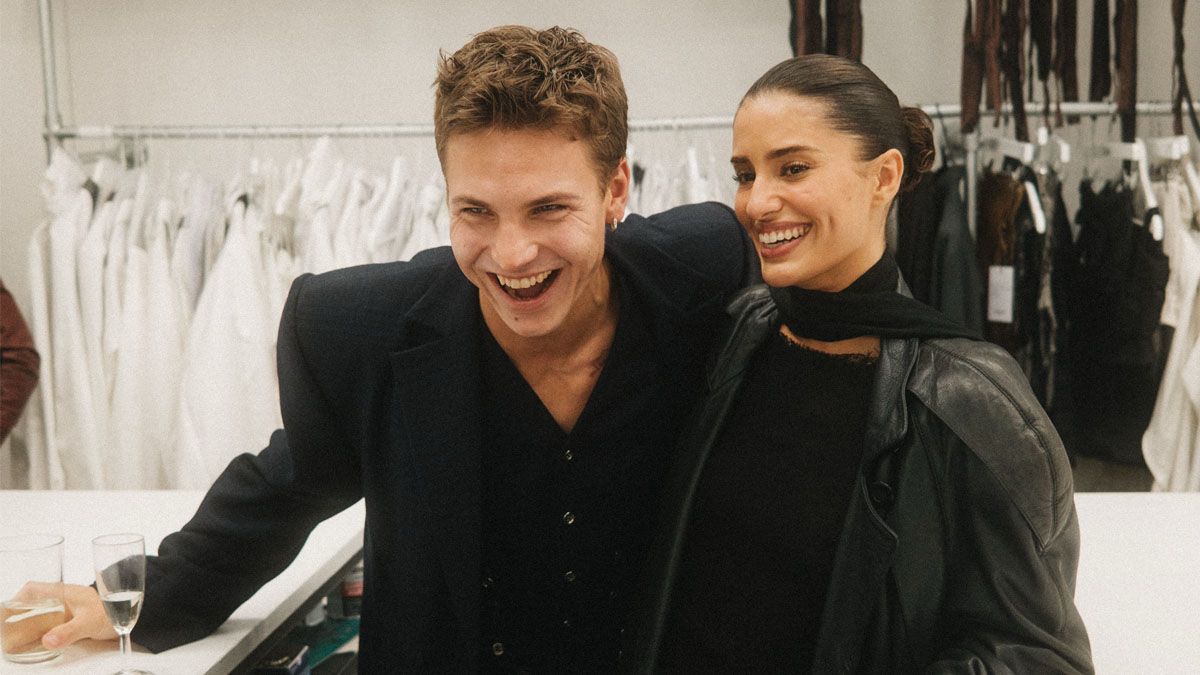
When people think of shopping in Berlin, they picture vintage stores in Kreuzberg or Neukölln, niche concept spaces, or weekend markets, rather than flagship luxury boutiques. International houses have long operated mono-brand outposts in the German creative capital, while Kadawe, Zalando, and Mytheresa dominate the multi-brand retail space. Yet, independent German brands have largely steered clear of bricks-and-mortar. Berlin has fewer wealthy residents than Munich or Düsseldorf, and many of its homegrown brands remain small, leaving founders fearful of the rising costs of operating a store.
But this cautiousness is beginning to fade. In November, premium gender-fluid brand Haderlump Atelier Berlin opened its first store in the bohemian neighborhood of Kreuzberg. Womenswear designer William Fan has renovated and reopened the boutique he’s operated for a decade in the city’s Mitte district (starting out as a student in its basement, before expanding to a full house that he’s operated since 2024). And fellow independent label Richert Beil is completing its Kreuzberg space, set to launch this spring.
Together, these Berliner labels signal a new commercial confidence in a city better known for experimentation than sales. Each brand has a distinct aesthetic and clientele, but they share a belief that Berlin’s growing class of arts and culture professionals — collectors, gallery owners, musicians, entrepreneurs — are ready for a more elevated, personal shopping experience. Rather than traditional boutiques, the founders are creating hybrid spaces that function as studios, event venues, and private client salons.
“Shopping in Berlin is not like shopping in New York or Paris,” says Julius Weissenborn, managing director of Haderlump, which he co-founded with designer Johann Ehrhardt in 2021. “There are great secondhand stores, but there’s an opportunity to elevate the experience.” Haderlump has grown quickly by producing almost everything at its Berlin atelier, avoiding the minimum order quantities that constrain many young labels (Haderlump produces around 20 pieces per day). The brand employs six people, and revenues have risen around 100% annually for the last three years, surpassing €500,000 in 2024. Bestsellers include a black hoodie secured with a metal screw instead of drawstrings for around €180, a wrinkled bomber jacket for just over €300, and a zip-up shirt for around €280.
The Haderlump store emerged almost by accident. “Our atelier was listed on Google Maps, and people would show up out of the blue,” Weissenborn recalls. “They’d find it cool, but sometimes we were on lunch break or in the middle of production.” The turning point came when Anita Tillmann, founder of trade show Premium, introduced the founders to entrepreneur Marc Sasserath, who invested as an angel and alerted them to a neighboring available space.
William Fan’s path was more deliberate. “When I started I thought, God, I’m such an ’80s kid opening a boutique, while everyone was going to Paris or New York or they were [stocked] at cool stores like Ssense,” he says. “But I had an instinct that wholesale would be very tough for an independent brand. I decided very early to focus on the customer.” The majority of Fan’s sales come through his Berlin store, where clients from the art world spend an average of €5,000 to €10,000 per visit. Ready-to-wear represents about 80% of turnover, supported by fine jewelry in 18-karat white gold and diamonds, leather goods, and ceramics. The company has 10 employees and reached record sales in 2025 (the brand declined to share that figure, but it was up 35% on the year prior), enabling the recent renovation.
.jpg)
William Fan’s store has a front of house and back of house. To acces the back of house (pictured on the left), customers have to ring a bell. His FW26 show (titled, ‘Ring the Bell’) was inspired by the analog, humanness of this, he says.Photo: Clemens Poloczek