
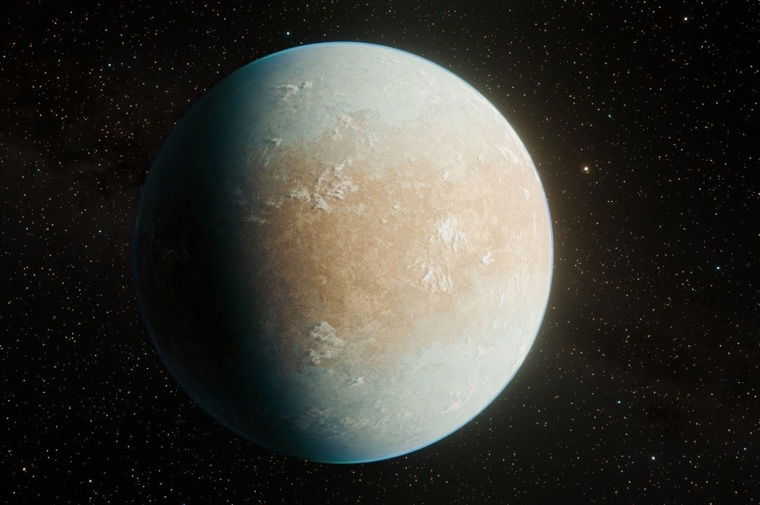
NASA scientists have announced the detection of an Earth-like planet orbiting a Sun-like star with a size and orbital period similar to Earth’s. Dubbed HD 137010 b, the newly spotted exoplanet may also lie within the star’s habitable zone, adding to its list of similarities to Earth.
Although future observations are needed to confirm the candidate Earth-like planet’s existence, the quality of data originally captured over a decade ago by the Kepler Space Telescope has the research team behind the discovery optimistic about any potential follow-up studies.
“This is the first planet candidate with Earth-like radius and orbital properties transiting a Sun-like star bright enough for substantial follow-up observations,” they explain in their recently published study.
Elusive Search for Earth-like Planets in Habitable Zone of Sun-like Stars
According to a NASA statement, a team led by astrophysics Ph.D. student Alexander Venner of the University of Southern Queensland, Australia, began searching for Earth-like exoplanets orbiting Sun-like stars within the habitable zone (HZ) by taking a fresh look at Kepler data captured during its 4-year operational period.
“The search for Earth-sized exoplanets in the HZs of Sun-like stars was “the core scientific aim” of the Kepler mission,” the NASA statement explains.
During its ‘quasi-continuous’ northern sky observation period, Kepler made several key discoveries, including the first potential Earth-sized HZ planet orbiting a Sun-like star. However, the researchers note, the majority of the stars targeted during the Kepler mission were faint. As a result, detecting these planets as they pass in front of their host star (the transit method) lies “close to the detection limits” for Sun-like exoplanets.
“The validity of some of these planets has been questioned,” the study authors note, adding that the lack of data was “exacerbated” by Kepler’s premature demise at the end of 2013 due to instrument failure.
Now, Venner and colleagues have employed new techniques to reanalyze data collected during Kepler’s operational period, resulting in a planet candidate similar to Earth in several critical ways.
New Analysis and Observations ‘Strongly Indicate’ Astrophysical Event
During the search, the team spotted the tell-tale signs of a planetary transit around a Sun-like star roughly 146 light-years from Earth. Although the signal strength of the candidate planet was comparatively shallow, the researcher said it was detected at a high signal-to-noise ratio “thanks to the exceptionally high photometric precision” of the observation.
“Our analysis of the K2 photometry, historical and new imaging observations, and archival radial velocities and astrometry strongly indicate that the event was astrophysical, occurred on-target, and can be best explained by a transiting planet candidate, which we designate HD 137010 b,” they write.
Further analysis revealed a planet transiting across its star’s face for approximately 10 hours. For comparison, an Earth transit to an outside observer would take around 13 hours.
To exclude false positives that can mimic the presence of a planet, the team said they performed a “comprehensive analysis of the K2 observations, historical low-resolution imaging and new high-resolution speckle imaging data, archival HARPS RVs, and Hipparcos–Gaia astrometry,” resulting in a transiting exoplanet as the ‘most plausible explanation’ for Kepler’s detected signal.
New Planet Shares Several Features with Earth
Along with a similar orbit to Earth, which models suggest the new planet 355 takes days to complete, the new analysis found numerous other striking similarities. For example, the planet is likely only a few percent larger than Earth. It is also orbiting a star similar to ours. The majority of Earth-sized exoplanets have been discovered orbiting much dimmer red and brown dwarf stars, and few of those have an orbital period close to Earth’s. If confirmed, the new candidate planet would be the first to boast all three characteristics.
Another potential similarity to Earth that requires further analysis involves the possibility that it lies within its host star’s habitable zone. A star’s habitable zone is defined as an orbital distance where life-sustaining liquid water can exist on an orbiting planet’s surface.
When modelling the star’s habitable zone, the researchers suggested that its slight dimness compared to our Sun (about 80%) may mean the new planet’s average surface temperature is closer to that of Mars. Specifically, they note that the planet’s surface high could be “no higher than minus 90 degrees Fahrenheit (minus 68 degrees Celsius).” For comparison, the average surface temperature on Mars is about minus 85 degrees Fahrenheit (minus 65 degrees Celsius).
Still, the researchers say many of their models suggest the planet could still have liquid water on its surface. For example, if HD 137010 b has an atmosphere richer in carbon dioxide than Earth, it could maintain surface liquid water.

After modelling the possibilities, the team gave their new planet a 40% of falling within the conservative estimate of the star’s habitable zone. When they expanded that to include the “optimistic” habitable zone, the odds increased to 51%.
“We estimate that the planet candidate receives a low incident flux, which may place it near the outer edge of the HZ, or potentially even beyond,” they explained.
A Small Milestone in the Search for Earth-like Exoplanets
Due to the planet’s nearly year-long orbit, follow-up observations that could confirm its presence and further characterize its composition and orbit are not likely to come soon. For example, the team notes that finding the types of planets that share so many similarities with Earth is “largely beyond the reach” of NASA’s Transiting Exoplanet Survey Satellite (TESS).
The team also suggested that the European Space Agency’s CHEOPS (CHaracterising ExOPlanets Satellite) could confirm the discovery. If not, NASA said that gathering any additional data on HD 137010 b “might have to wait for the next generation of space telescopes.”
“In the near future, missions such as PLATO and Earth 2.0 aim to detect Earth-sized planets orbiting in the HZs of Sun-like stars through a Kepler-like ‘stare’ observing strategy,” the research team writes. “If past Kepler results provide a comparable benchmark, the detection of planets with Earth-like orbital periods will require several years of observations.”
When discussing the implications of locating an exoplanet with an unprecedented number of similarities to Earth, the researchers said their finding represents a ‘significant addition’ to the relatively small sample of previously discovered cool Earth-sized exoplanets, and “presents a small milestone in the search for Earth-like exoplanets around nearby Sun-like stars.”
The study “A Cool Earth-sized Planet Candidate Transiting a Tenth Magnitude K-dwarf From K2” was published in the Astrophysical Journal Letters.
Christopher Plain is a Science Fiction and Fantasy novelist and Head Science Writer at The Debrief. Follow and connect with him on X, learn about his books at plainfiction.com, or email him directly at christopher@thedebrief.org.