
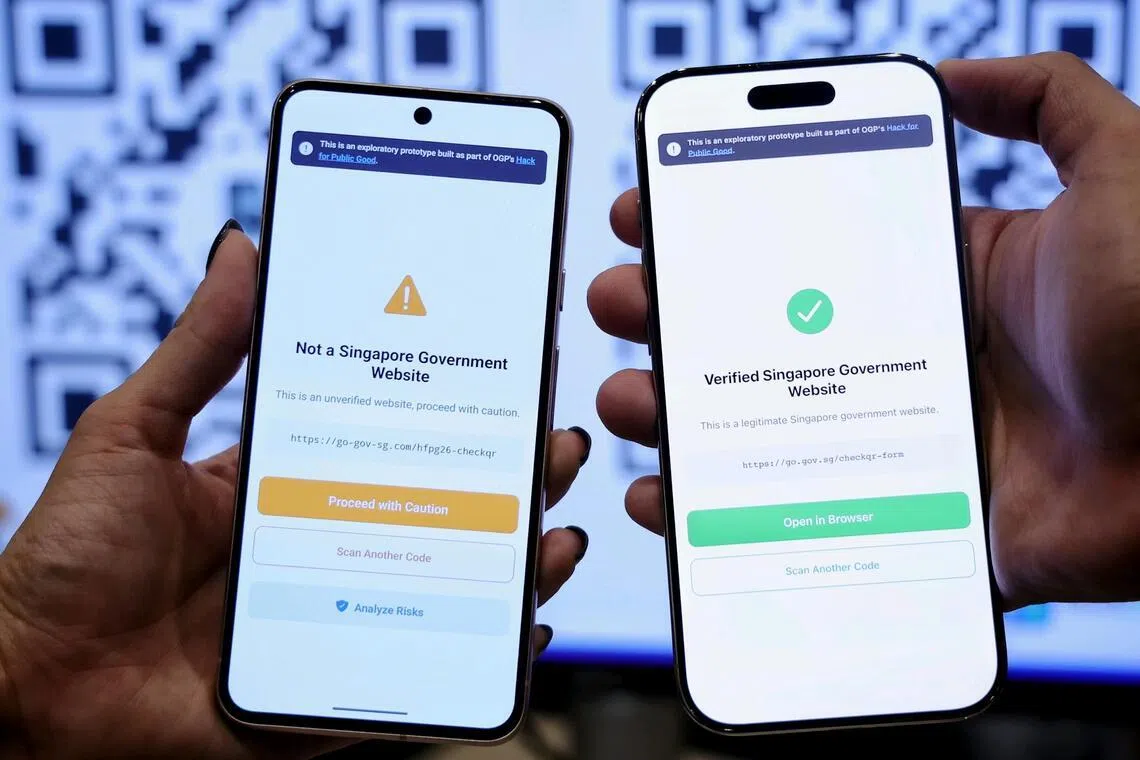
SINGAPORE – An app is being developed to help Singaporeans detect fraudulent QR codes that lead them to harmful sites when they are trying to access government services instead.
Currently available for download as a beta version via the app TestFlight, CheckQR is the brainchild of four Open Government Products (OGP) officers, who created a working prototype during Hack for Public Good 2026.
OGP is a division of the Government Technology Agency of Singapore, in charge of platforms and tools such as ActiveSG, ScamShield, and Parking.sg.
In its seventh edition, the hackathon is held annually in January, when some 200 OGP officers dedicate the entire month to creating a solution that tackles a problem of public good.
The CheckQR app can scan a QR code to validate that it is from a genuine government website, and will alert users if the site is a spoof. It does so by verifying if the link carries the “.gov.sg” domain, which is used by all government agency websites.
“After speaking to more than 70 seniors during the hackathon, we realised that many don’t check the link after scanning a QR code to see if it’s actually from the Government,” said Mr Preshant Achuthan, a team member who works in product operations at OGP.
Scammers are also becoming increasingly sophisticated in mimicking a government website – for instance, by using a hyphen in place of a full stop in the domain. “Even if (users) do take a second look, they would just trust the link after seeing that there’s a ‘gov’ and ‘sg’ within.”
Scanning a QR code with a regular smartphone camera often shows a small label that is not the full link, which makes it doubly hard for seniors to verify that the site is genuine, said Mr Achuthan.
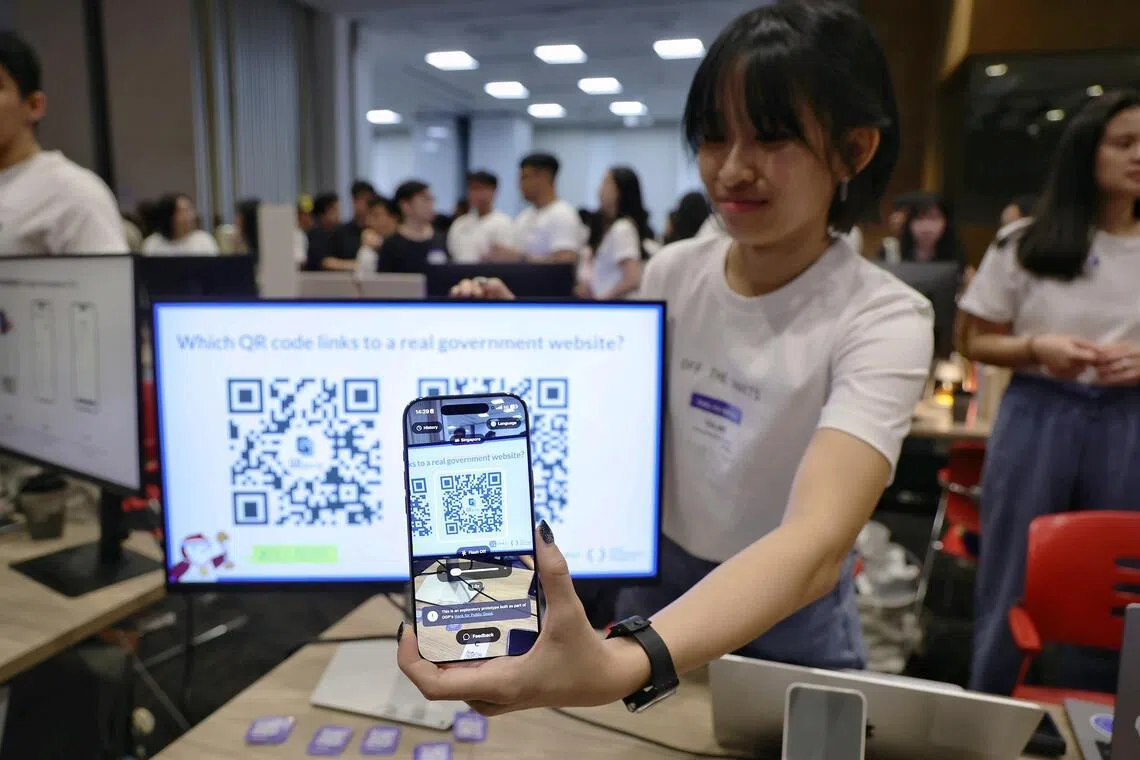
User experience researcher Celine Leo demonstrating the use of the CheckQR app.
ST PHOTO: KEVIN LIM
Seniors told the team they most often encounter QR codes at community centres when trying to sign up for activities, or in fliers plastered at the foot of HDB blocks that promote town council events.
In 2023, a fake QR code made to resemble the Municipal Services Office’s QR code was used in posters that were
put up around HDB blocks in Bukit Batok
.
The fake code led residents to a phishing site, where they were prompted to fill in personal information such as their name, e-mail address, contact number and residential address.
CheckQR could be especially useful for seniors who use older Android phone models that are not able to scan QR codes, and have to download third-party scanner apps that come with many pop-up advertisements, said teammate Qilu Xie, who works as a software engineer.
Though the team set out to create an app focused specifically on verifying government websites, they are also testing a feature that analyses the risk level of non-governmental websites and surfaces potential red flags to users.
Mr Achuthan said: “The hackathon lasts one month, intentionally meant to be intense so that teams can focus on the core problems. Moving forward, with the help of users testing our app, we want to see if CheckQR actually helps them. Once we’re clear that is solved, then we will look at what’s next.”
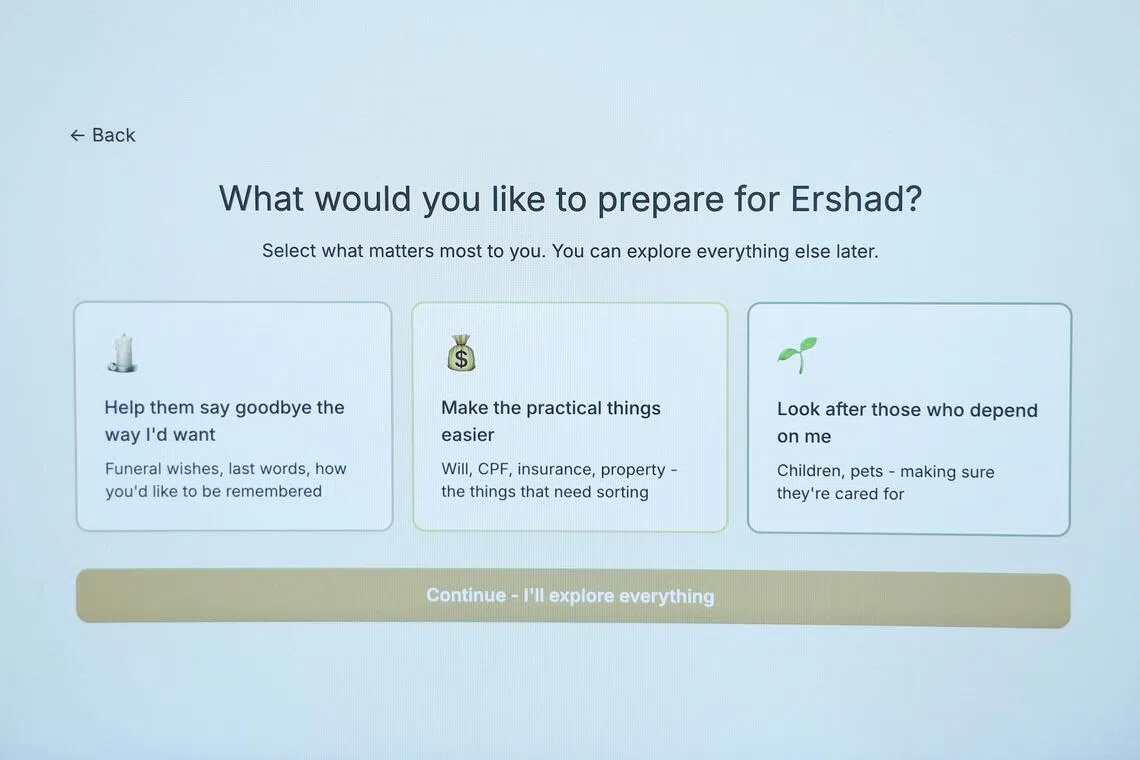
The Envelopes website was created to help people write down what they want to happen after they die.
ST PHOTO: KEVIN LIM
End-of-life planning is often considered morbid, but it can help to avoid frustration and extra costs for the loved ones of a person who died.
website dubbed Envelopes
was created to help people write down what they want to happen after they die – such as what they want for their funeral service and any last words they would like to convey.
It also educates users on what they need to consider regarding their finances, such as how to nominate a loved one to receive their remaining CPF savings. With asset distribution, it takes users through possible scenarios depending on whether one has a spouse, parents, or children.
This information will be sealed and sent to a chosen nominee after the user dies.
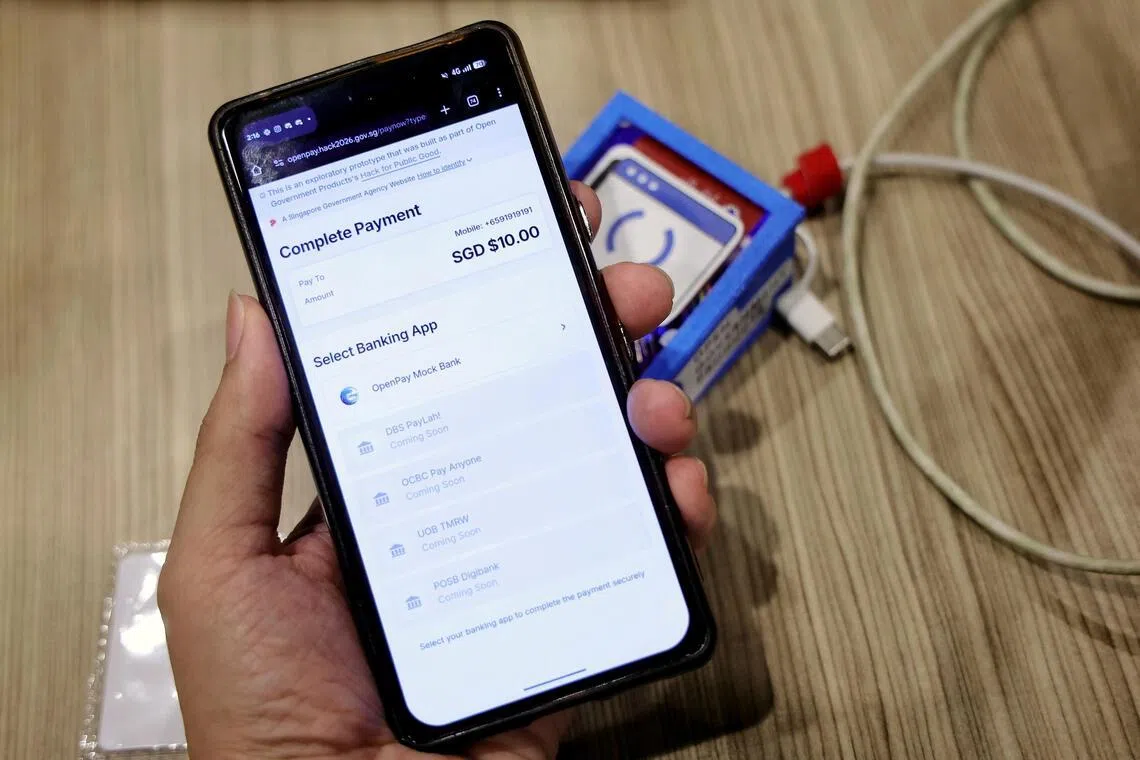
The team behind OpenPay seeks to simplify PayNow payments into a three-step process.
ST PHOTO: KEVIN LIM
Paying merchants via PayNow can be a time-consuming process which requires users to ask for the price of a product, find their bank app, and type in a mobile number.
But the team behind OpenPay seeks to simplify this into a three-step process – simply tap one’s phone on a POS (point of sale) machine, which will automatically open a webpage that prompts users to choose the bank account they want to pay from. The price of the item and merchant’s number are automatically filled in, and users just click to pay.
The web app is still a prototype, and an eventual public roll-out would require integration with local banks. A member from OpenPay told ST that the team is in talks with the Monetary Authority of Singapore and DBS Bank to potentially release this as a working feature for public use.
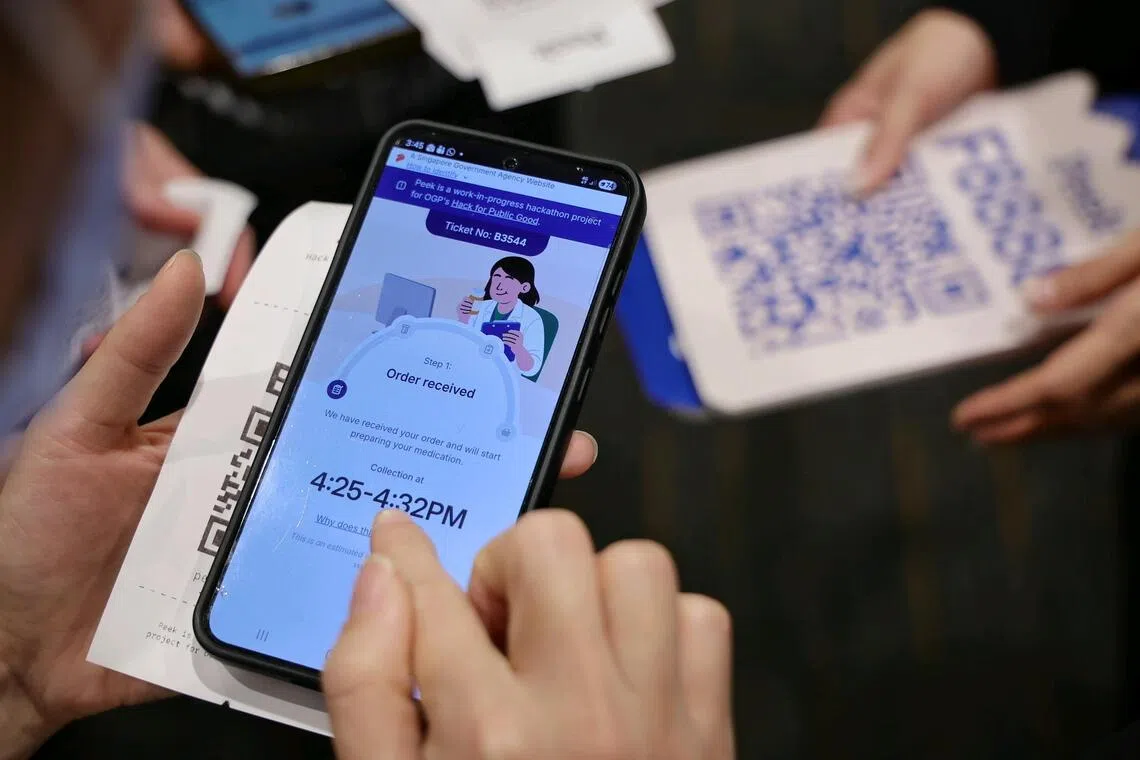
The Peek web app shows patients how long they need to wait to collect their medication at a hospital pharmacy.
ST PHOTO: KEVIN LIM
A web app that shows patients how long they need to wait to collect their medication is currently being trialled at Tan Tock Seng Hospital (TTSH).
Usually, patients receive a queue number via a printed slip of paper, and must keep a close eye on digital boards for their number to be called. The addition of a QR code on the same paper, however, gives an estimated collection time, so patients can go about other business without fear of missing their number.
The team behind Peek used six months’ worth of waiting time data from TTSH to train a model that can accurately estimate waiting time.
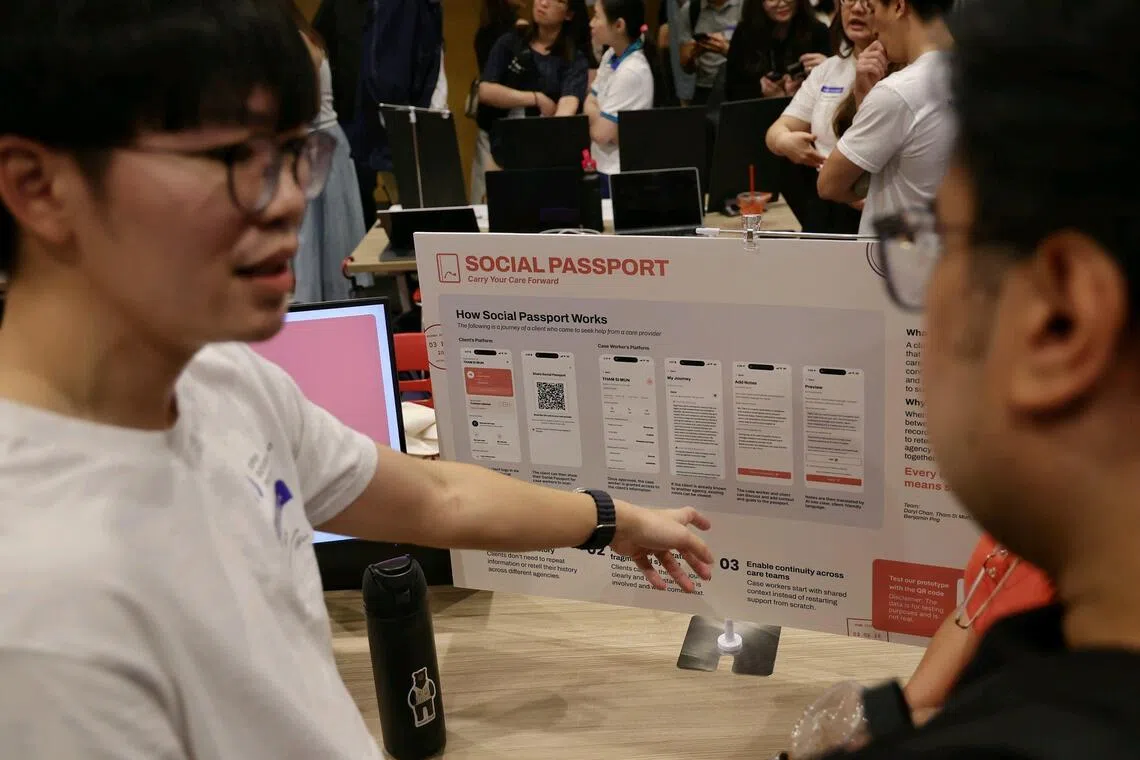
Social Passport reduces the need for clients to repeat their story to various case workers they meet.
ST PHOTO: KEVIN LIM
Clients who approach social service agencies for different types of help – such as for financial assistance or psychological care – often need to repeat their story to the various case workers they meet.
To avoid this, the team behind Social Passport created a digital passport that clients can access at any time via Singpass. This passport includes notes that can be drafted by their case workers, allowing any future care providers to be up to date on the client’s background.