
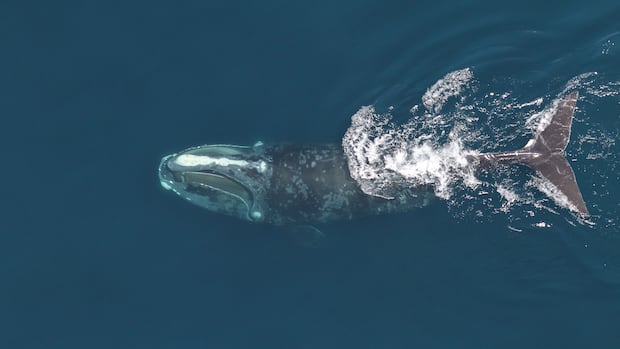
The Department of Fisheries and Oceans has released its Whalesafe Fishing Gear Strategy, a five-year plan aimed at preventing whale entanglements, with an initial focus on the Atlantic provinces.
The strategy released Tuesday would expand the use of “whalesafe gear” for fish harvesters and identify high-risk areas for whales.
Brett Gilchrist, DFO’s director of national programs, said they will begin on the East Coast by protecting multiple whale species, including the endangered North Atlantic right whale, from fishing line entanglements.
“The focus is clearly on endangered, highly endangered whale species to start,” Gilchrist said. “That gives you a sense of where we’re focusing on on the East Coast, North Atlantic right whale is frankly the priority right now.”
Gilchrist said DFO wants to improve whale protection by working with harvesters, not closing fisheries.
At the centre of the strategy is what the department calls “whalesafe gear,” equipment specifically designed to prevent entanglements or reduce their severity.
The gear is not new, but it hasn’t been widely adopted yet, according to Hanna Vatcher, a right whale advocate with Oceana Canada.
“Fishers are not out there intentionally harming whales,” said Vatcher. “It’s just an unfortunate byproduct of the industry that involves humans going into the ocean. But there’s been a lot of fishers that have come on board, have stepped up to test it.”
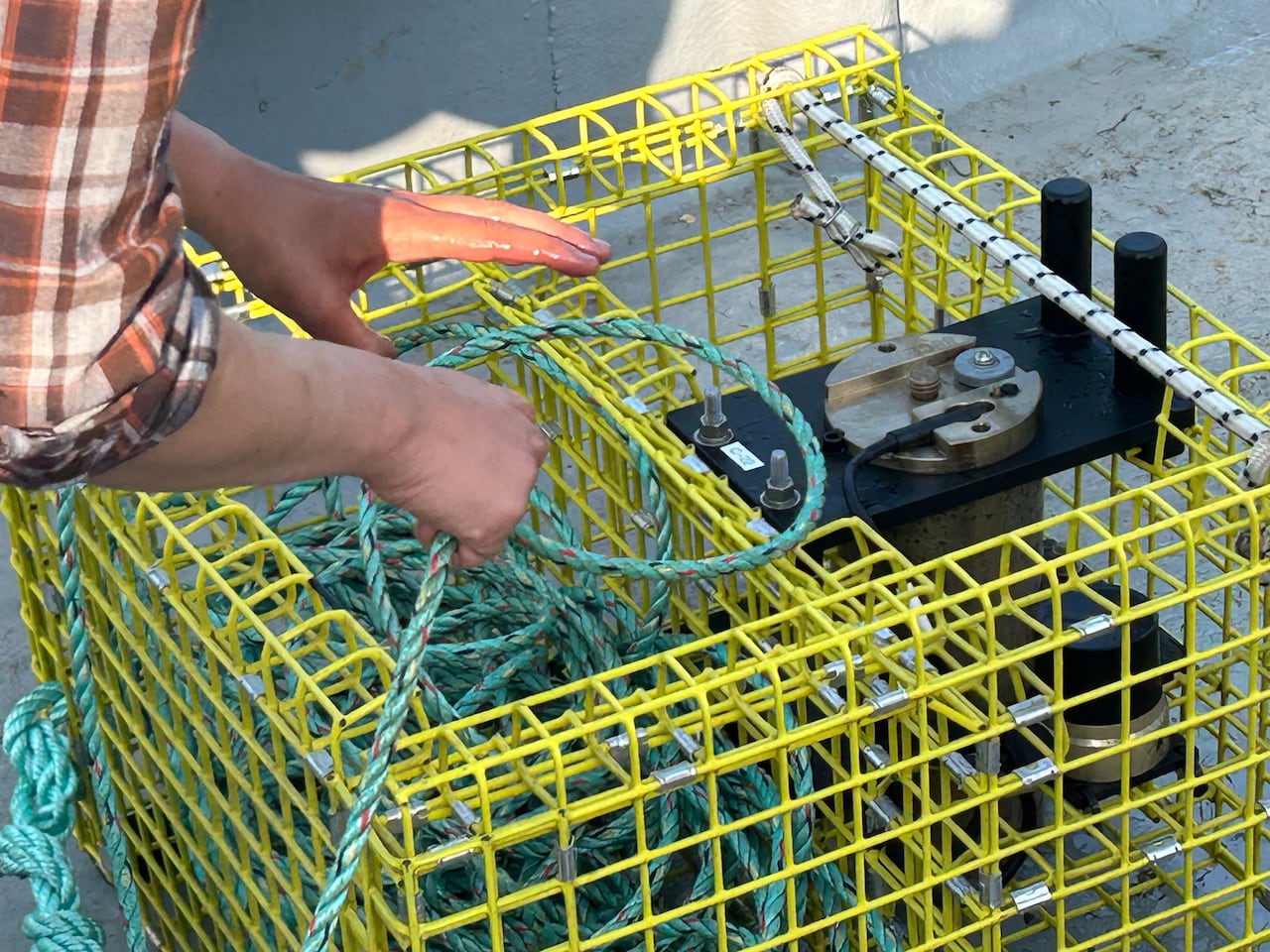 This is an on-demand fishing trap. The rope is contained in a cage. It attaches to the traps and can be recalled to the surface by an acoustic signal through a cellphone app. (Rhythm Rathi/CBC)
The strategy report said the new gear won’t work for everyone and different options will need to be available.
Gilchrist said not all fisheries have been able to test whalesafe gear and the strategy seeks to expand testing.
He said high-risk entanglement areas will be identified and on-demand whalesafe gear will be used there.
Identifying high-risk areas is something that Vatcher and Oceana Canada have been calling for. Vatcher said Oceana Canada recommended DFO put this in the strategy.
Overall, Vatcher is pleased with the strategy and said it portrays years of collaboration with government, industry, Indigenous partners and conservationists.
“It provides clarity and direction on the next steps to address entanglements,” Vatcher said. “I think it does a good job of balancing the risk to whales, also the risk to our seafood trade and the risk to market access.”
She said having no new funding attached to the strategy is a concern, however.
“I think a big question is funding for the strategy and where the money is going to come from to, you know, move forward these objectives.”
Objectives are laid out over the next few years, and Vatcher said harvesters will face closures in the meantime with no new tools to access whalesafe gear.
Two types of gear
DFO has listed two main categories of gear: on-demand and low breaking-strength gear.
On-demand gear allows the trap to sit on the sea floor with a buoy and rope or an air bag attached to it. Harvesters can send a signal to the trap to release the buoy or air bag.
The alternative is similar to traditional fishing except the fishing line has a special link so it’ll break under force.
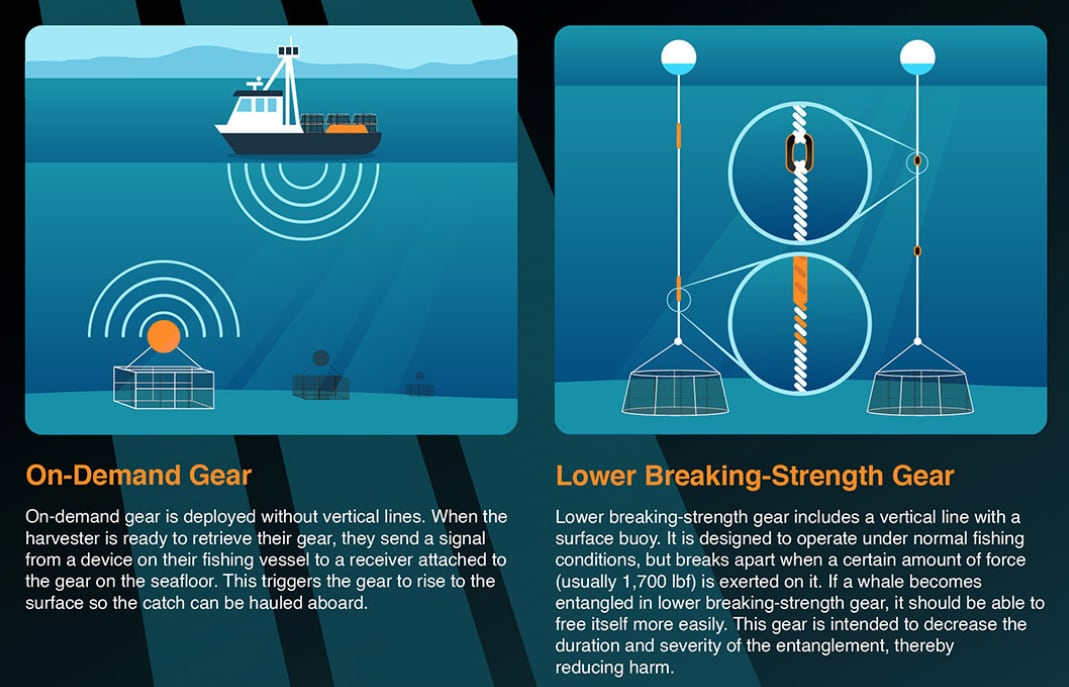 DFO hopes to improve and expand the use of whalesafe gear. The two categories of gear are on-demand gear and lower breaking-strength gear. (Department of Fisheries and Oceans)
The typical practice for commercial lobster and snow crab fishing is to drop the pot into the water with a rope attached to a buoy. The rope will run from the sea floor to the surface, leaving a risk for whales to run into it and get tangled, which can be fatal.
Another strategy priority is to create a system to authorize gear and use standards for manufacturers and harvesters.
On-demand gear is already available for free in the Maritimes through the CanFish gear lending program which was created by the Canadian Wildlife Federation.
Vatcher said there are 200 sets of gear and the system has been used to catch one million pounds of snow crab.
But, she said, whalesafe gear use is “still very low.”
Vactcher would’ve like to have seen mention of CanFish’s program in the strategy, since DFO said cost and access are barriers to whalesafe gear adoption.
Focus on East Coast
DFO said it’s most concerned with the North Atlantic right whale population.
Vatcher said 20 calves have been born so far this season, which is the most in 15 years. She said 50 calves a year would be the target to recover the endangered species.
“This is really good news. It’s been a very productive calving season so far. … So very hopeful news. Really shows the resilience of the species. But, you know, we also still have to be cautious,” said Vatcher.
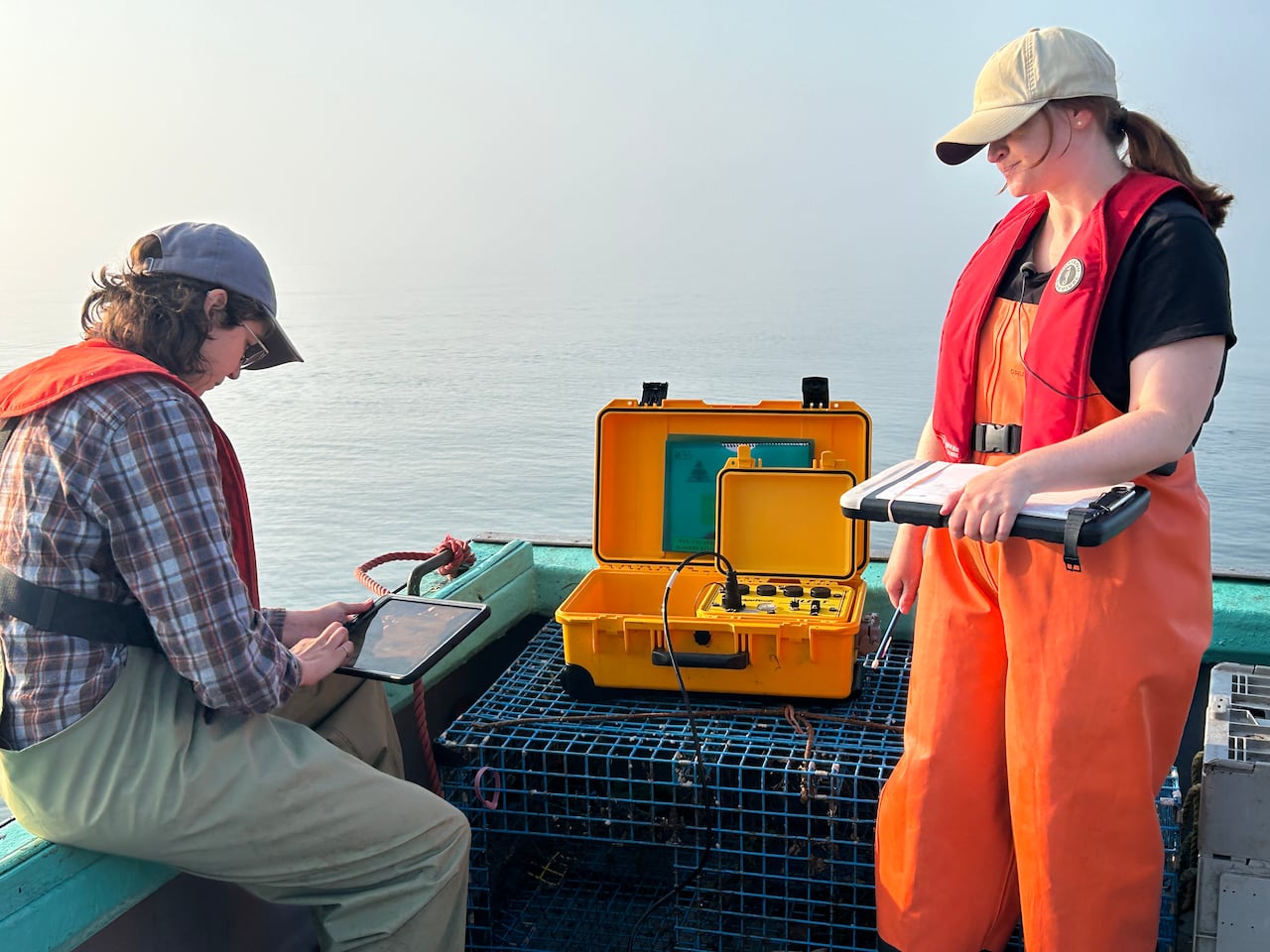 Canadian Wildlife Federation technologist Hannah Drake, left, and Hanna Vatcher, who now works with Oceana Canada, are pictured sending a signal to resurface an on-demand system. Vatcher is also collecting data. (Rhythm Rathi/CBC)
In October, there were roughly 380 other right whales, including around 70 reproductive females.
She said there were 11 calves born last year and in 2018 there were no calves born.
‘Fine tuning these approaches’
Harvesters and organizations have been testing methods like on-demand gear for over five years now.
Martin Maillet, executive director of the Maritime Fishermen’s Union, said the new strategy charts a path to polish these whale protection.
“As we learn how to live together with these whales in our ecosystem, we’re fine tuning these, these approaches. So that’s, I think, for the next 5 years, that’s what we’re doing — fine tuning,” said Maillet.
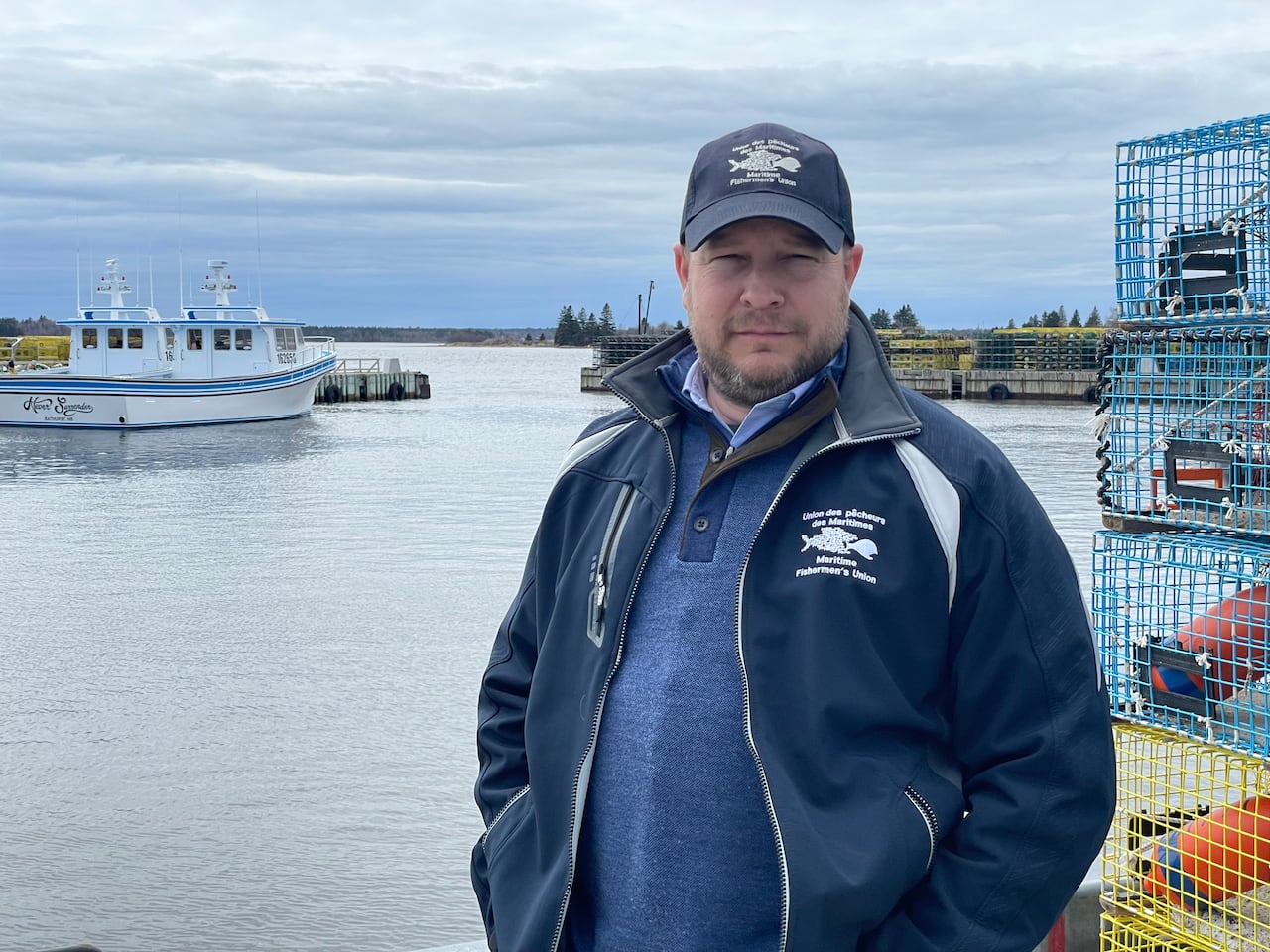 Martin Maillet, executive director of the Maritime Fishermen’s Union, said much of the new whalesafe strategy has already been in motion. (Alexandre Silberman/CBC)
He said the expectation is not to replace whole fleets of traps since costs are high but to have some whalesafe gear to use in high-risk areas.
Maillet said testing has also proved whalesafe approaches ineffective in some cases.
“It depends on the conditions, depends on the water depth, currents, the proximity between fishermen. … In eastern New Brunswick, where you can have many, basically a lobster trap every 100 feet.”