
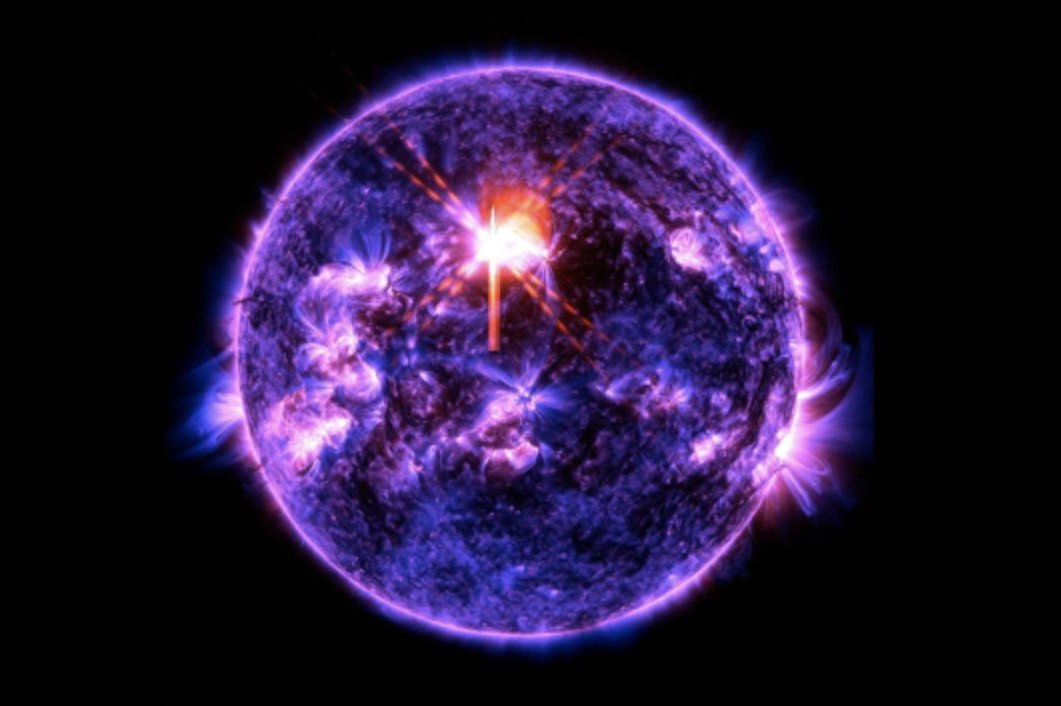
A newly active area on the sun is responsible for dozens of eruptions known as solar flares, including back-to-back X-class flares earlier this week.
Solar flares typically originate from active regions on the sun, which are marked by groups of sunspots — such as Region 4366.
NASA’s Solar Dynamics Observatory was watching as Region 4366 unleashed multiple X-class flares, the strongest category on the space weather scale. X-class flares are the most intense type of solar flare, and the number that follows the “X” indicates the flare’s relative strength.
On Wednesday, Region 4366 blasted out an X4.2 flare just hours after producing another strong X1.5 flare. Earlier in the week, the same sunspot region generated one of the strongest flares of the year — an X8.1 event.
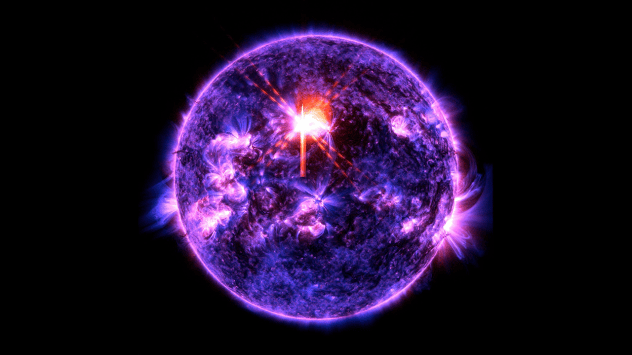
The flash from Wednesday’s X4.2 flare can be seen above in imagery from SDO as an intense burst of extreme ultraviolet light, highlighting super-heated solar material in red and blue.
According to NOAA’s Space Weather Prediction Center, since the region emerged on Jan. 30, it has produced 21 C-class flares, 38 M-class flares and six X-class flares.
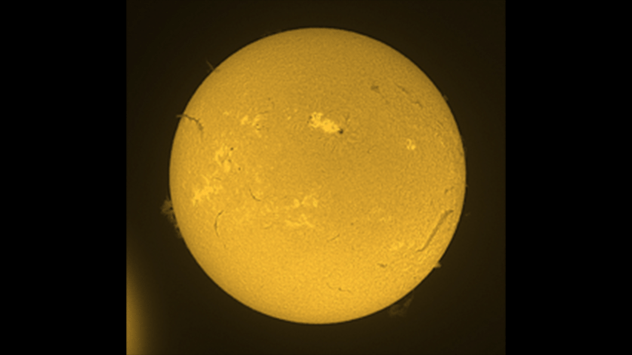 An H-alpha image from Slooh’s northern hemisphere observatory at the Institute of Astrophysics of the Canary Islands taken on Wednesday. Photo courtesy Slooh
“The sun is putting on quite a show right now,” said Emma Cain Louden, astrophysicist and president of Slooh. “This H-alpha image from Slooh’s northern hemisphere observatory, located at the Institute of Astrophysics of the Canary Islands (IAC), reveals filaments, prominences and active regions — all signs we’re near solar maximum. When these features erupt, they can send charged particles toward Earth, potentially affecting satellites and creating auroras.”
Cain Louden added that the sunspot released a flare on Sunday that resulted in a coronal mass ejection reaching Earth’s atmosphere on Wednesday.
SWPC forecasters say they expect continued activity from this region in the coming days. Any additional CMEs could trigger geomagnetic storms on Earth and lead to enhanced displays of the northern lights.