

As public pushback against data center proposals raged, a nonprofit seeking to grow economic development in the St. Louis area took public officials and Ameren employees on multiple trips to visit hyperscale data centers.
One such trip took place in December, when officials from Greater St. Louis Inc. and Ameren traveled to a Google data center in Nebraska with city and county officials from communities in Missouri and Illinois, according to newly obtained documents.
The officials were from Troy and Madison County in Illinois and Festus and Jefferson County in Missouri.
Festus City Administrator Greg Camp, who did not end up going on the trip, wrote that the purpose was to give “an opportunity to see first-hand what sort of impact a data center would have in our community, so that you can make an informed decision about data center proposals that you may be asked to consider” in a November email previously shared with St. Louis Public Radio.
Greater St. Louis Inc. paid the cost of hotel rooms and ground transportation, while the public officials were expected to cover their flights, according to communication between the organization and trip participants obtained by STLPR.
Madison County Board Chairman Chris Slusser, along with Cathy Hamilton, the county’s economic development director; Granite City Mayor Mike Parkinson; Troy City Administrator Jay Keeven; Jefferson County County Executive Dennis Gannon, and Festus City Council member Jim Trinnin attended the trip. Three Ameren employees from Missouri and Illinois were also on the trip.
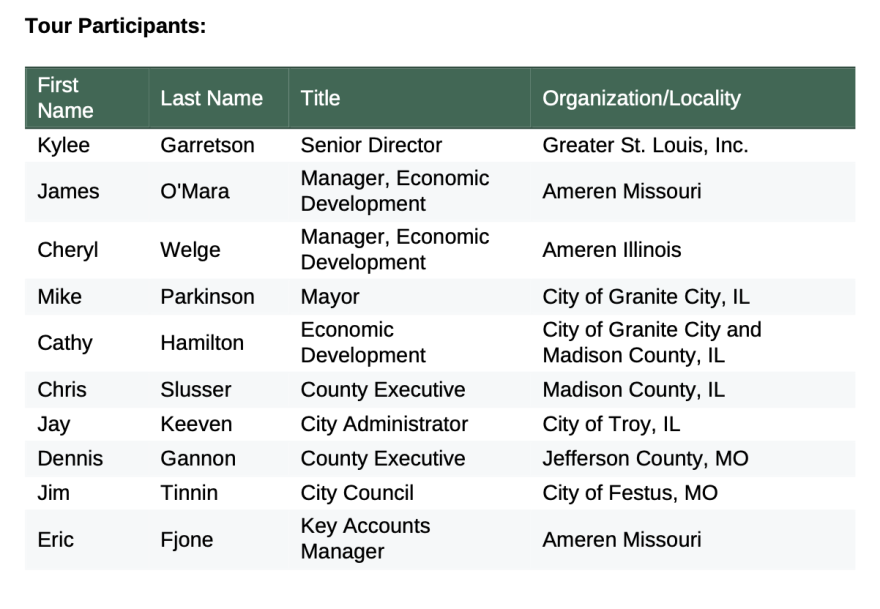
In emails obtained by St. Louis Public Radio, Kylee Garretson, senior business director of business attraction for Greater St. Louis Inc., shared a list of those who would be touring a Google data center in Nebraska.
A trip itinerary shows the officials were asked to sign nondisclosure agreements upon arrival at the Google data center.
The tour included a presentation and Q&A with Google and representatives from Lincoln, a tour of the site and lunch with the Google team. The site tour was not of the actual data floor, which the emails said is “highly confidential and not open to the public.” The group also toured a second location that was actively under construction.
After the trip, Madison County’s Hamilton wrote an email to an official from Papillion, Nebraska, thanking him for his time.
“The St. Louis region has had a bad narrative started on these and it has just grown to moratoriums, etc,” Hamilton wrote. “Your time helped our leadership cut through that and know the Datacenters would be a tremendous benefit to our area.”
Slusser commented on the trip in an article on economic development and data centers in Madison County. He did not return multiple requests from STLPR for comment on the trip.
“I kept seeing the same concerns over and over — noise, water, power, pollution — and I realized if we didn’t truly understand this ourselves, we’d be reacting instead of leading,” Slusser said in a press release about the visit. “So, I wanted to see one in person, not just read about it.”
Joshua Carter
/
Belleville News-Democrat
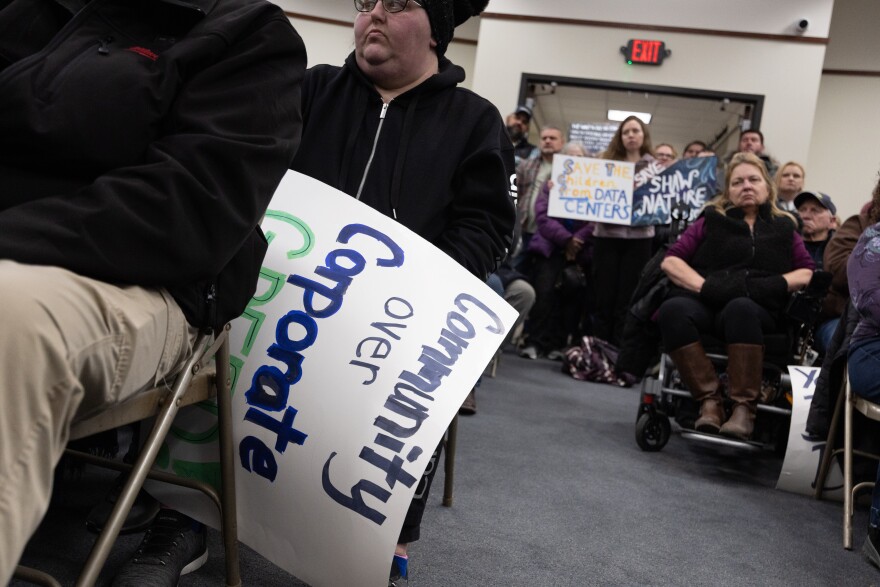
A Franklin County resident holds a sign reading “community over corporate greed” during a zoning commission meeting about a proposed data center near Shaw Nature Reserve last month.
While Greater St. Louis Inc. did not confirm how many trips and how many public officials or different municipalities took part in the trips, the organization’s communications lead, Tony Wyche, confirmed the agency has organized visits to data centers in the region.
“As part of our ongoing efforts to educate and inform regional stakeholders about economic development projects, we have helped organize group visits to data centers and other facilities,” Wyche said in an email.
Ameren also confirmed its participation in the trips.
The utility company stands to make money from data centers moving into its territories. In its November earnings call, Ameren Missouri CEO Marty Lyons said data center developers have already paid the company $38 million in nonrefundable payments to cover transmission upgrades and signal their commitment to their proposed projects. Lyons said construction agreements with data center developers total 3GW of power, and Ameren has said it needs to build new power plants to meet demand for data centers.
“We remain closely engaged with potential data center customers and are building a robust pipeline of large load opportunities that extend into the next decade,” Lyons said.
Greater St. Louis Inc. has been active in pushing for data centers throughout the St. Louis region, Wyche said.
“These projects are critical technology infrastructure, and for our bi-state region to grow and create more and better jobs, they need to be part of our development pipeline,” Wyche wrote in the email. “As there has been much public discussion about data centers, we want to make sure the decisions made about their development are based on real, firsthand information.”
In August, Greater St. Louis Inc. representatives attended meetings in St. Charles to push a hyperscale data center proposal. Maggie Kost, the organization’s chief business attractions officer, said she was there representing the community and hailed the project as a generator of millions in tax dollars.
“Data centers are a critical part of our economic development strategy,” Kost said at the August meeting. “We know that the jobs of the future are going to be dependent on this type of infrastructure that’s out there.”
Kate Grumke
/
St. Louis Public Radio
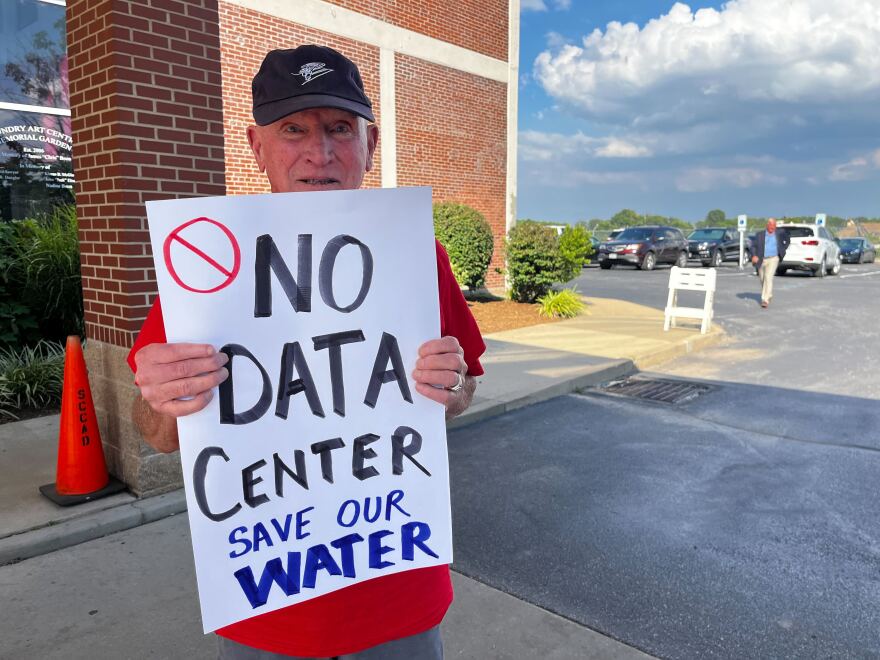
Charles Cross, pictured last August, lives near the site of a proposed data center in St. Charles and does not want to see it built.
The project was ultimately put on ice after public pushback, though the developer said it would come back with a revised proposal. STLPR later uncovered documents linking the planned data center in St. Charles to Google.
Data center proposals are popping up around the St. Louis region, including two in Festus, Missouri, and Troy, Illinois, whose officials participated in the December trip.
Troy’s Keeven attended the December trip and said it was informational, but he is still not sure where he lands on data center projects.
“I would say I walked away with a little better understanding but still a lot more questions,” Keeven said. “Because, again, it’s so new, and it’s something that I have never dealt with, our city has never dealt with — matter of fact — Madison County itself has never dealt with. So we’re trying to learn as we go.”
In Festus, city and county officials faced public backlash after CRG, ClayCo’s data center development wing, brought a proposal that officials said could cost up to $6 billion to develop.
In Troy, the St. Louis Business Journal reported that Cloverleaf Infrastructure, a data center developer, wants to build three data centers in the Metro East. The Troy site may cost more than $1 billion. Keeven said the city has not yet received a formal proposal.
Tinnin, Gannon and Parkinson did not immediately respond to requests for comment.