
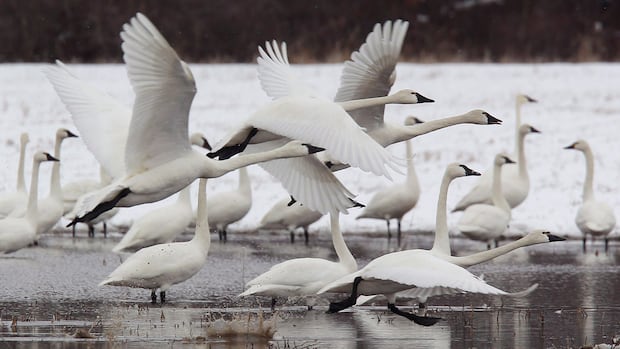
Manitobans could soon be permitted to hunt tundra swans and mourning doves, as biologists say the populations of both species are large enough to support a hunt.
Environment and Climate Change Canada suggested hunting seasons for tundra swans and mourning doves across the Prairies in proposed amendments to Canadian migratory bird regulations.
The proposals are made every two years, said Frank Baldwin, a Winnipeg-based wildlife biologist with the Canadian Wildlife Service, a branch of Environment and Climate Change Canada.
“One of our mandates is to evaluate and provide sustainable hunting opportunities for Canadians, and so the assessment that we’ve completed for these two species … is sort of the culmination of that effort,” he told Radio-Canada.
“We’re looking to obtain some public feedback on the biological rationale that we’ve put forward to consider hunting seasons for the two of them in Manitoba,” in addition to Alberta and Saskatchewan, he said.
Anyone wishing to provide feedback on the proposed hunting seasons can email the national wildlife service by Feb 15.
Manitoba Natural Resources Minister Ian Bushie said he looks forward to working with the federal government on the issue as the engagement process continues.
“Our focus is on ensuring that best practices are followed to promote sustainable hunting practices and protect the habitat for future Manitobans,” he said in a written statement to CBC News.
If passed, a tundra swan hunting season could begin in Manitoba as soon as 2028, with 400 permits issued to hunters in the province each year, the proposed amendments say.
Baldwin said those permits would be repatriated from the United States, where it is legal to hunt tundra swans in some areas. The U.S. collaborates with Canada to manage the tundra swan population because the birds cross their shared border, he said.
“We would be removing that number of tags from the U.S. state draw systems, [so] that would result in … no additional harvest in the population.”
But some have raised concerns that tundra swan hunters might accidentally target trumpeter swans, a sensitive species that can’t be hunted anywhere in North America.
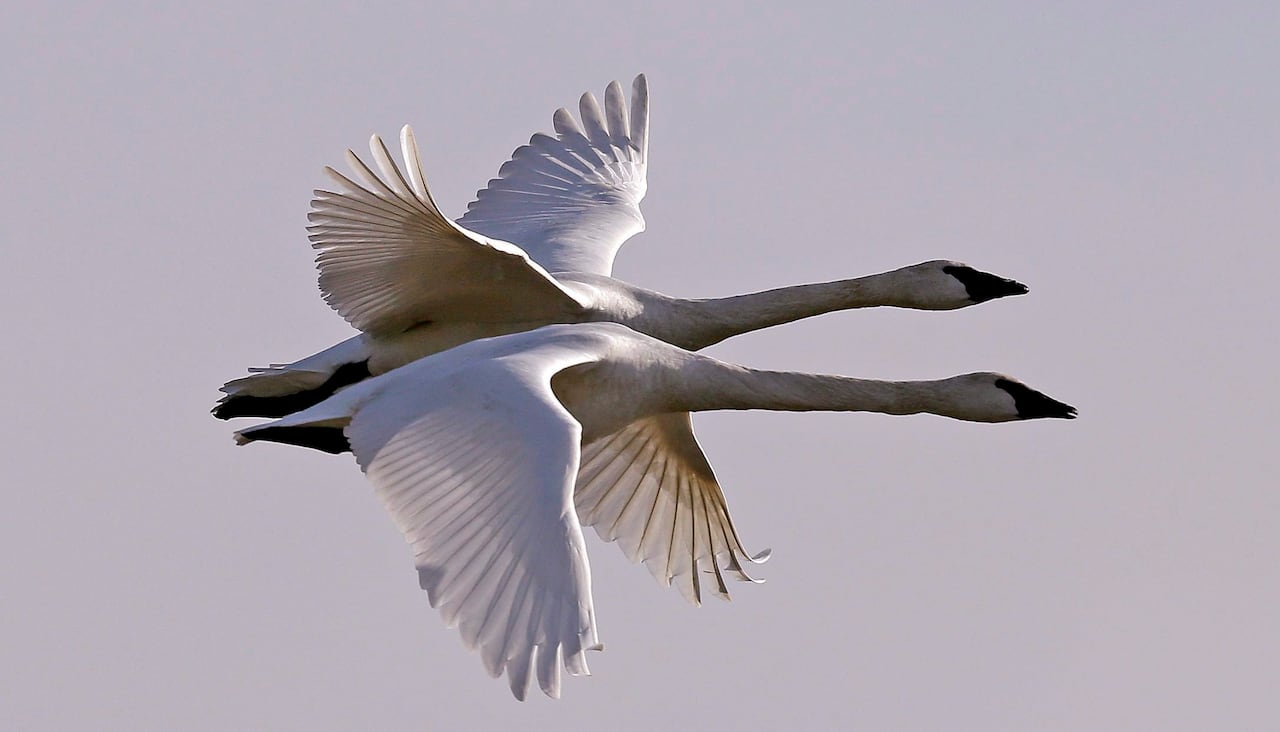 A pair of trumpeter swans fly over their winter grounds in Conway, Wash., in 2017. (Elaine Thompson/The Associated Press)
David Duncan, a hunter and retired biologist in Alberta, previously told CBC News in Calgary that a tundra swan hunt could lead to mistaken killings of trumpeter swans, because the two birds look similar and their habitats often overlap.
Baldwin said research estimates say that for every 400 swan hunting permits that could be issued in Manitoba, around three trumpeter swans would to be killed accidentally.
“We think that that low level of incidental take would have no impact on their continued expansion,” he said.
But at the end of the day, hunters would be responsible for telling the two birds apart, he said.
“What we’re proposing is potentially a tundra swan season,” he said. “It’s not a generic swan season, so the onus is on the hunter to properly differentiate them.”
Mourning dove hunt ‘relatively low’ risk
There is also “relatively low” risk that a mourning dove hunting season would impact similar-looking birds, Environment Canada said in its proposed amendments.
“The only wild species which could reasonably be confused with mourning doves by hunters is the Eurasian collared dove,” which is much larger than mourning doves and “quite uncommon” in Manitoba, the report says.
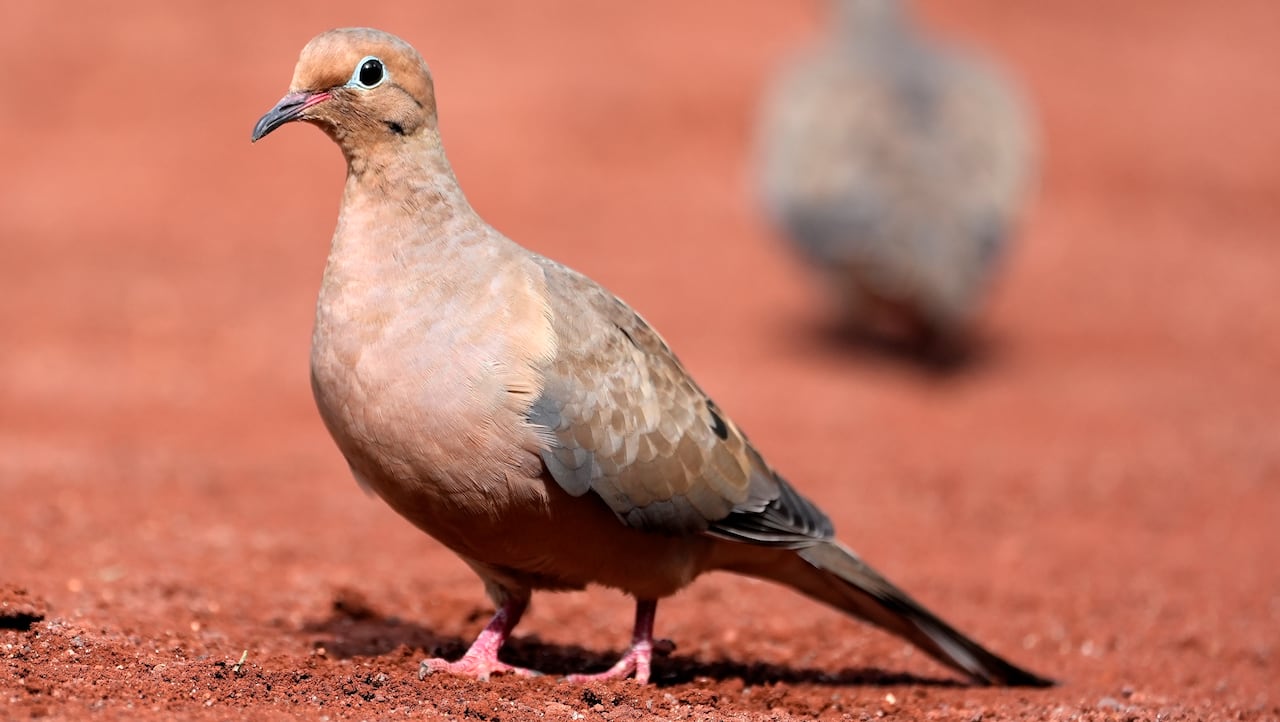 A pair of mourning doves appear at a baseball game in Boston in 2024. (Michael Dwyer/The Associated Press)
The mourning dove has one of the largest populations of game birds in Canada and North America, and they’re hunted in Quebec, Ontario and British Columbia, Baldwin said.
Over 2.3 million mourning doves were recorded in Manitoba last fall, he said.
Baldwin says hunters are important to sustaining migratory bird populations, as his department uses a lot of their monitoring data to inform its decisions.
“We use that to estimate population size, and we also use hunters to control populations which are overabundant.”
A mourning dove hunting season would be a new opportunity for hunters in Manitoba, and minimal equipment is needed to hunt the birds, Baldwin said.
Mark Seamans, a biologist with the U.S. Fish and Wildlife Service and an authority on mourning doves, says the birds are hunted in 40 of 50 American states.
Based on the data he has seen, Seamans believes the Canadian dove population is just as healthy, but the hunting rate in Canada is much lower than in the United States, so he has no concerns about the impact of dove hunting in Canada on the species’ population.
The federal government is proposing a daily limit of 15 mourning doves and a possession limit of 45 doves in the three Prairie provinces.
The harvest of mourning doves in Manitoba is expected to be 3,000 birds per year, representing 0.3 per cent of the breeding population in the province and 0.16 per cent of the estimated population present during the fall migration, the federal government said.
“They fly fast [and] are hard to shoot, so it is a challenge to actually shoot them,” Seamans said. “I think hunters like that challenge. They’re also quite good to eat.”