
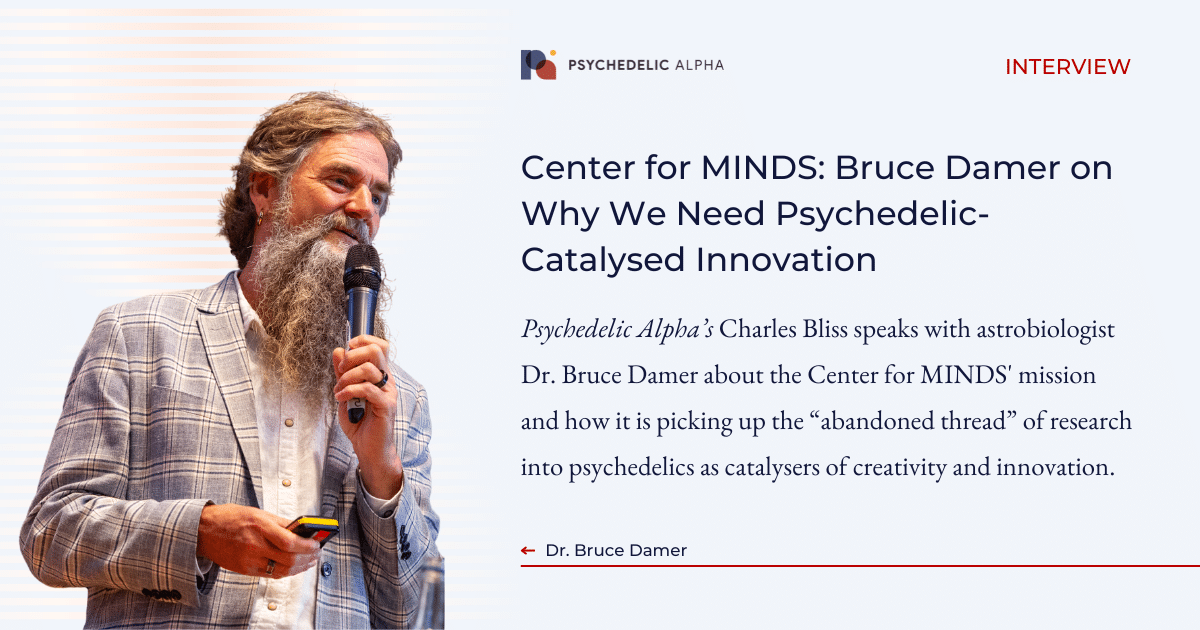
Two months after his ESPD talk, he met investor Ford Smith and non-profit chair Sylvia Rzepniewski in Austin, Texas. Both were very interested in Damer’s work and how it had been expedited by the psychedelic experience. In 2023, they incubated the Center for MINDS as a non-profit out of their venture fund, and publicly launched it at the Texas Eclipse Festival in April 2024.
“We modelled MINDS roughly on MAPS,” Damer said. “We’re both multidisciplinary, we’re both into investigation—but rather than medical applications, we decided to focus on novel discoveries and other transformative solutions for the world arising through psychedelic-catalysed insight and other practices.”
“We posed the question: is it possible to artfully combine these practices to help scientists, engineers, designers and leaders really crack hard problems and come up with beautiful solutions?”
“Technically-oriented people often reach points where they just can’t get any further,” Damer told Psychedelic Alpha. “For me, in the chemistry of the origin of life, it was what happens to trillions of polymers within billions of protocells cycling in a hot spring pool… where do they go next? For someone working, say, in mitigating the effects of climate change, a mind-bending problem might be: ‘How should we build now to account for sea level rise in fifty years?’”
Damer offered a view of how psychedelics might work, at least for him: “Perhaps they soften my mental blocks or quiet my nervous mind and just let everything flow more freely.”
He advised that solutions did not come on a first trip or even after several journeys.
“It may take several sessions. For me, it was 25 sittings involving personal work with ayahuasca before I felt clear enough to bring in the science. But then there came an opening, and a remarkable return, after I had set the intention that I wanted to work on this origin of life problem.”
“Perhaps through psychedelics and other consciousness practices you open up to what Dean Simonton calls a ‘free association storm’. Simonton is a great thinker and writer who researches how genius works. His books are wonderful—they’re not psychedelics—but they form one of the pillars of what we’re doing at MINDS.”
Damer is not alone in crediting psychedelics with seminal discoveries. Francis Crick reportedly used LSD when working on double helix structure of DNA (or perhaps later when gene expression was being tackled). Computer scientist Douglas Engelbart, inventor of the computer mouse and graphical interface in the 1960s, attributed some of his creative powers to psychedelic experiences.
“There’s a long history of this—we’ve all heard about Steve Jobs’s use of LSD being primarily important in his life,” Damer said. “Bill Atkinson credited acid for helping him in creating HyperCard, a game-changing piece of software that presaged the World Wide Web.”
“The mathematician Ralph Abraham, another exemplar, has argued that psychedelics were instrumental in the emergence of chaos theory,” Damer added. “The principles of chaos mathematics and dynamical systems, among their many other uses, are invaluable to the computer models used to study climate change, so it is no exaggeration to say that this field of science is extremely important to our future.”
Damer noted that, in recent years, there has been renewed interest and research in three primary psychedelic paradigms: Indigenous and cultural use; personal growth and expression; and therapeutic medical applications. For Damer, the Center for MINDS will focus on re-opening a “fourth path” of using psychedelics to enhance human cognition and creative problem solving.
The idea was first floated in the mid-1950s by psychiatrist Humphry Osmond, writer Aldous Huxley and neuropsychologist John Smythies with a proposed study titled ‘Outsight’. Together they sought to investigate the effects of mescaline and LSD on the intelligentsia of the day, with participants including Carl Jung, Albert Einstein, A. J. Ayer and Graham Greene. But funding for the project never materialised and the effort was abandoned.
But in 1966, a pilot study titled ‘Psychedelic Agents in Creative Problem-Solving’ led by Willis W. Harman was published just as LSD was criminalised. It found that 66% of the 24 study participants reported enhanced creative problem solving under the influence of LSD or mescaline in a structured and supportive environment. But as the early stages of the War on Drugs took hold, this line of enquiry was discarded.
The Center for MINDS seeks to pick up this “abandoned thread of psychedelics as creative catalysts,” in Damer’s words, and connect people who use mindfulness practices and psychedelics to solve complex problems.
“Of course, psychedelic tools were never completely abandoned by artists and other creative people,” Damer said. “But with professionals it was carried out completely out of sight—under the table, if you will.”
The Center for MINDS will fund research including clinical studies, retreat practice groups and testing protocols, eventually publishing empirical findings to ground mentorship and training programmes.
“As a research organisation, we can also offer micro grants to allow, say, a therapeutic psychedelic practitioner to do some data collection that they just don’t have time to do, to hire an assistant or employ tools,” Damer said. “We know that after a psychedelic-assisted therapeutic session, many people experience an ‘afterglow’ effect which can carry heightened mental capacities. By following up with these patients, we could find out how the practice benefitted or didn’t benefit their working lives.”