
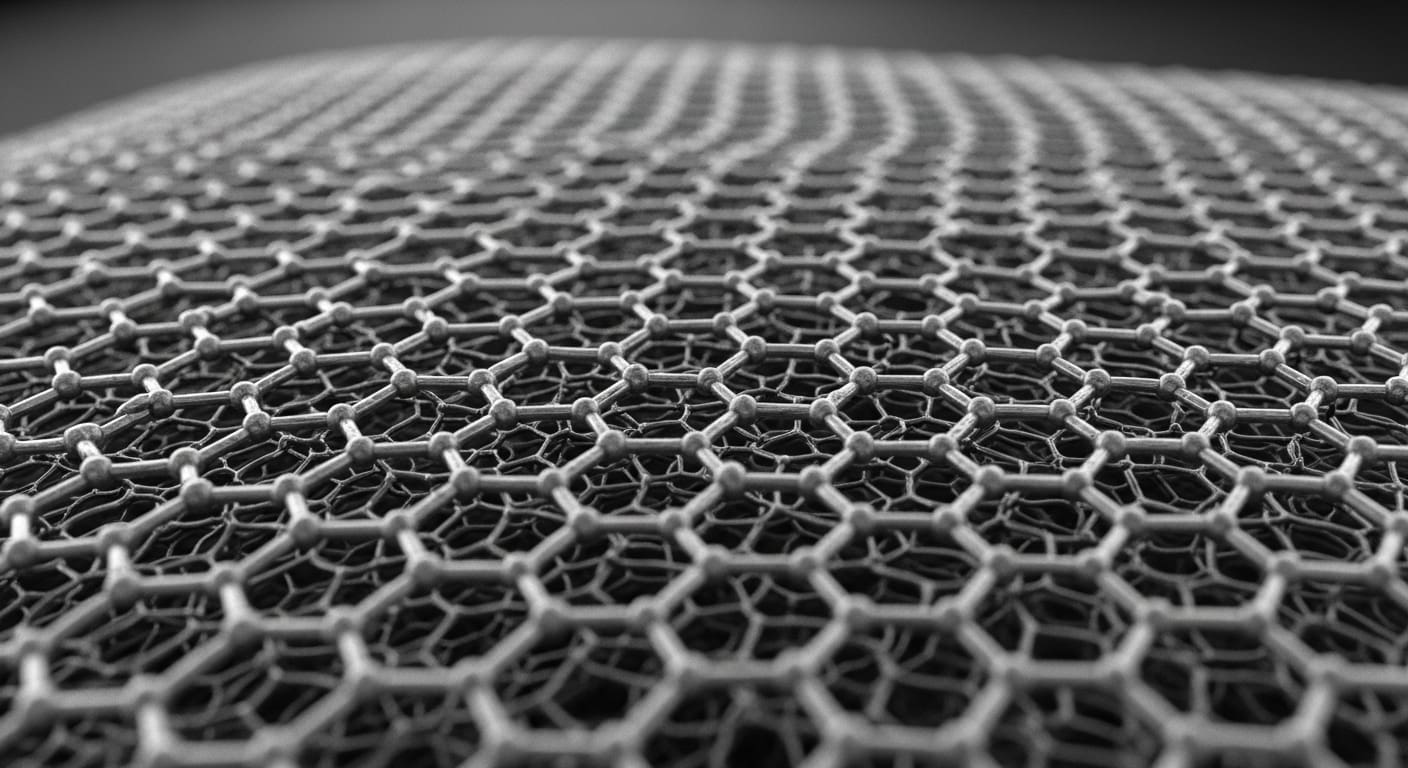
Researchers are increasingly focused on manipulating bilayer graphene through combined strain and twist to engineer its electronic properties. Federico Escudero, Dong Wang, and Pierre A. Pantaleón, alongside Shengjun Yuan et al. from IMDEA Nanoscience and Wuhan University, present a comprehensive method for modelling commensurate supercells under arbitrary strain and twist conditions. Their work significantly advances the field by demonstrating how strain, beyond simply twisting the layers, provides a powerful mechanism to control band narrowing and topological phases in bilayer graphene. This detailed analysis of strain’s influence, considering both magnitude and direction, establishes twisted and strained bilayer graphene as a highly tunable platform for realising novel flat-band and topological phenomena.
Tuning bilayer graphene’s electronic behaviour via twist and strain configurations offers exciting possibilities for novel devices
Researchers have uncovered a method to finely tune the electronic properties of bilayer graphene through the combined application of twist and strain. This work details a global approach for constructing accurate representations of bilayer graphene structures subjected to arbitrary twist and strain configurations.
By employing both atomistic tight-binding and strain-extended continuum models, the study identifies specific configurations that minimise bandwidth beyond the so-called ‘magic angle’, a critical parameter for achieving correlated and topological phases. Results demonstrate a pronounced dependence of band narrowing and topology on the type, magnitude, direction, and degree of lattice relaxation induced by the applied strain.
Notably, shear strain consistently produces a more significant distortion of the graphene layers compared to uniaxial strain. Investigations incorporating electron-electron interactions, modelled using a self-consistent Hartree potential, reveal that strain broadens the initial electronic bands while simultaneously reducing electrostatic renormalization effects.
Furthermore, strain induces topological transitions as narrow and remote electronic bands hybridize, establishing twisted and strained bilayer graphene as a versatile platform for manipulating flat-band and topological phenomena. The research begins by addressing the challenge of creating commensurate supercells, repeating structural units, for any combination of twist and strain.
A key finding is that the introduction of a small biaxial strain consistently enables the identification of commensurate configurations for specific twist and strain values. Using these precisely defined structures, researchers then calculated the electronic band structure and density of states with a full atomistic tight-binding model.
Analysis reveals that while strain generally increases bandwidth at the conventional magic angle, alternative twist angles can be found where bandwidth is minimised, effectively shifting the optimal conditions for flat bands. The emergence of these narrow bands is critically dependent on the direction of applied strain, with shear strain exhibiting a stronger influence on both the geometry and electronic characteristics of the twisted bilayer graphene system. The gap between narrow and remote bands, a consequence of lattice relaxation, is primarily determined by the strain-dependent bandwidth of the narrow bands themselves.
Commensurate supercell construction and electronic structure analysis of twisted bilayer graphene reveal intriguing correlated phenomena
A global method for constructing commensurate supercells underpinned the study of twisted and strained bilayer graphene. Researchers initially developed an algorithm to identify commensurate structures for arbitrary combinations of twist and strain, addressing the challenge of incommensurate lattices typically arising from these conditions.
This involved introducing a small biaxial strain to facilitate the discovery of specific twist and strain values yielding commensurate configurations. Subsequently, these commensurate structures were subjected to detailed analysis using both atomistic tight-binding and strain-extended continuum models.
The tight-binding calculations were performed on the commensurate supercells to determine electronic band structures and densities of states. Investigations focused on identifying configurations that minimized bandwidth beyond the magic angle, thereby promoting the emergence of flat bands crucial for correlated and topological phases.
Results demonstrated a pronounced dependence of band narrowing and topology on the type, magnitude, direction, and degree of lattice relaxation associated with the applied strain. Shear strain consistently induced a greater distortion compared to uniaxial strain, indicating its stronger influence on the system’s geometry.
To account for electron-electron interactions, a self-consistent Hartree potential was incorporated into the calculations. This revealed that strain broadened the bare electronic bands while simultaneously reducing electrostatic renormalization effects. Furthermore, the study observed strain-induced topological transitions resulting from hybridization between narrow and remote bands, confirming twisted and strained bilayer graphene as a highly tunable platform for exploring flat-band and topological phenomena. This comprehensive analysis, utilizing atomistic models, provides a detailed understanding of the interplay between twist, strain, and electronic properties in this material system.
Strain-dependent electronic and topological properties in twisted bilayer graphene are actively being explored
Researchers developed a global method for constructing commensurate supercells for bilayer graphene with arbitrary twist and strain. Investigations utilising atomistic tight-binding and strain-extended continuum models revealed that specific configurations minimise bandwidth beyond the magic angle, demonstrating a strong dependence of band narrowing and topology on strain type, magnitude, direction and lattice relaxation.
Shear strain consistently produced a stronger distortion compared to uniaxial strain, influencing the electronic properties of the system. The inclusion of electron-electron interactions, modelled through a self-consistent Hartree potential, showed that strain broadens the bare bands while simultaneously reducing electrostatic renormalisation.
This interplay between strain and electronic interactions is crucial for understanding the behaviour of the material. Strain also induced topological transitions as the narrow and remote bands hybridised, establishing twisted and strained bilayer graphene as a tunable platform for flat-band and topological phenomena.
Analysis of commensurate structures revealed that a small biaxial strain could consistently induce commensurate solutions for various twist and strain values. Atomistic tight-binding calculations demonstrated that while strain generally increases bandwidth at the conventional magic angle, alternative twist angles can minimise bandwidth, effectively shifting the magic angle with applied strain.
The emergence of narrow bands was found to be critically dependent on the direction of the applied strain. Furthermore, the gap between narrow and remote bands, resulting from lattice relaxation, was determined primarily by the strain-dependent bandwidth of the narrow bands. Comparisons between atomistic results and the strain-extended continuum model showed excellent agreement with appropriate parameter choices, highlighting the importance of the strain-induced gauge potential in accurately capturing the electronic behaviour of twisted and strained bilayer graphene.
Strain-induced band manipulation and topological transitions in twisted bilayer graphene offer new routes to control its electronic properties
Researchers have developed a comprehensive methodology for constructing commensurate supercells in twisted bilayer graphene subject to arbitrary strain. Employing both atomistic tight-binding and continuum models, they investigated how strain influences the electronic band structure, revealing a pronounced dependence of band narrowing and topology on the type, magnitude, and direction of applied strain.
Specifically, shear strain was found to induce a greater distortion than uniaxial strain, impacting the bandwidth and topological properties of the material. The inclusion of electron-electron interactions, modelled using a Hartree potential, demonstrated that strain broadens the initial electronic bands while simultaneously reducing electrostatic renormalization effects.
Furthermore, the study highlighted how strain facilitates topological transitions by hybridizing narrow and remote bands, thereby establishing twisted and strained bilayer graphene as a versatile platform for manipulating flat-band and topological phenomena. The models used, tight-binding and continuum, yielded results in strong agreement, validating the approach.
Acknowledging limitations, the authors note that the analysis focuses on commensurate structures, simplifying the complexity of real-world systems which may exhibit incommensurate behaviour. Future research directions include exploring the effects of varying stacking orders and investigating the impact of more complex strain profiles. These findings establish a clear path toward tailoring the electronic and topological properties of bilayer graphene through the combined application of twist and strain, potentially enabling the design of novel electronic devices and materials.