
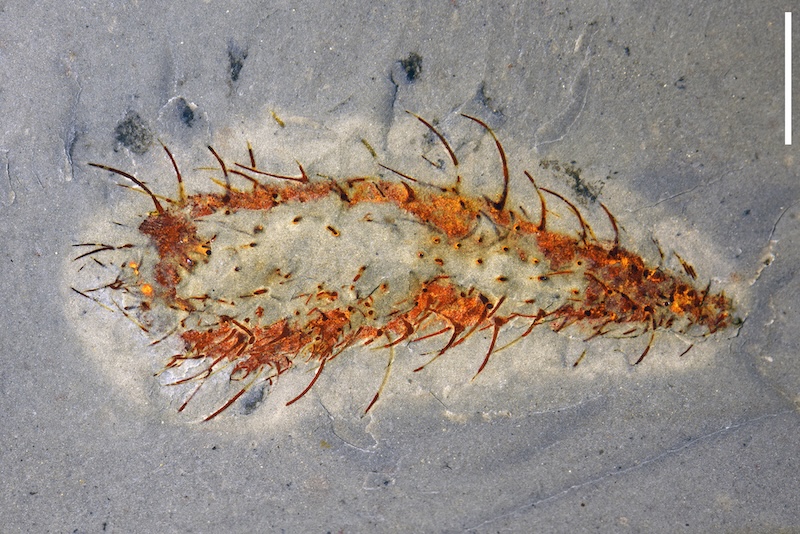
 This remarkable cactus-like organism from the Huayuan Biota is called Allonnia. It’s one of the organisms that survived a major mass extinction 513 million years ago. The red coloring is from iron oxide deposits. The top right scale bar is 5 millimeters long. Image via Han Zeng/ Chinese Academy of Sciences. Used with permission.
EarthSky’s 2026 lunar calendar shows the moon phase for every day of the year. Get yours today!
The Sinsk Event was a major mass extinction 513 million years ago that greatly reduced the marine life of the Cambrian Explosion.
Scientists in China discovered rare soft-bodied fossils from 512 million years ago showing some animals survived by living in deep-water habitats.
These fossils reveal that marine ecosystems changed after the extinction and that deep oceans might have acted as refuges from harsh conditions.
A video from the Chinese Academy of Sciences about the 512-million-year-old Huayuan Biota fossils that survived a major mass extinction.
These marine animals survived a mass extinction 513 million years ago
There have been several major mass extinctions during the history of life on Earth. One such extinction was the Sinsk Event. It occurred 513 million years ago. Recently, in late January 2026, researchers in China published a paper about fossilized marine organisms that survived that catastrophic event. Their study revealed that global marine communities changed following this mass extinction. Moreover, these organisms were able to survive because their deep-water habitat provided a refuge from sudden drastic environmental changes.
For a long time, scientists did not have much information about what happened after the Sinsk Event because of a sparse fossil record. However, five years ago, Chinese researchers made a significant discovery in Huayuan County, in the Hunan Province of China. At this site, they found exquisitely preserved soft-bodied fossils dated to 512 million years ago, about a million years after the Sinsk Event.
The scientists published their study of these fossils in the peer-reviewed journal Nature on January 28, 2026.
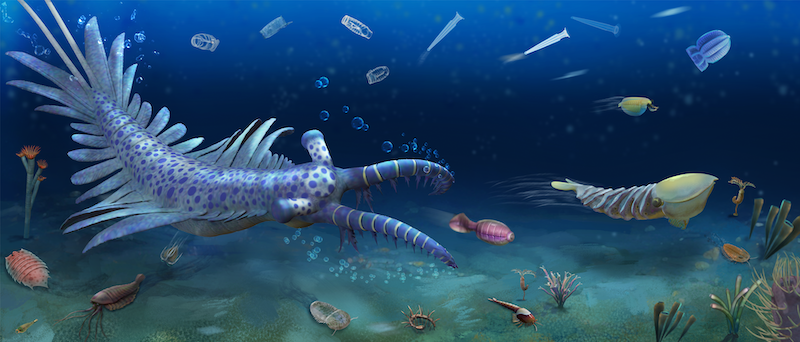 Artist’s depiction of the Huayuan Biota. Image via Yang Dinghua & Scientific Visualization Team at ScienceNet.cn/ Chinese Academy of Sciences.
The Sinsk Event was a major mass extinction
Before the Sinsk Event, there was a very important milestone in the history of life on Earth, called the Cambrian Explosion. About 540 million years ago, the first complex organisms arose, representing most animal phyla (major animal groups). Prior to that, life on Earth was mostly microbial.
The Sinsk Event interrupted the Cambrian Explosion 513 million years ago. As a result, the diversity of marine animals dropped drastically. Over time, 50 million years later, that diversity rebounded in what’s known as the Great Ordovician Biodiversification Event.
So, what caused the Sinsk Event? Scientists think there were several environmental incidents. For instance, there were major shifts in Earth’s tectonic plates that may have disturbed shallow marine habitats. In addition, large-scale volcanic activity spewed considerable amounts of greenhouse gases into the atmosphere, causing rapid climate change. Together, these stressors created very low levels of oxygen in the ocean, which killed many sea creatures.
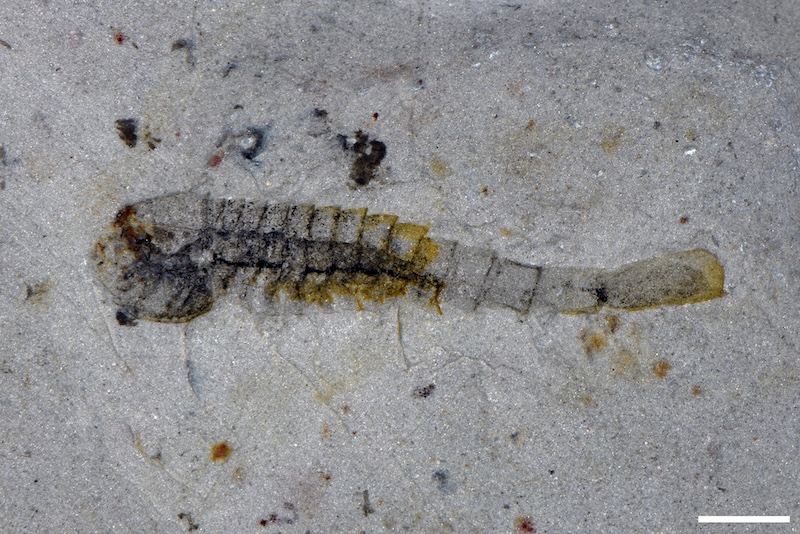 Fuxianhuiid is a newly described arthropod in the Huayuan Biota. Here, the animal’s gut was preserved in this fossil. The bottom right scale bar is 2 millimeters long. Image via Han Zeng/ Chinese Academy of Sciences. Used with permission.
Rare soft-bodied fossils from Hunan Province, China
Scientists did not know much about life after the Sinsk Event because of gaps in the fossil record. That is, until five years ago. That’s when a research team from the Chinese Academy of Sciences discovered a treasure trove of soft-bodied fossils, 512 million years old. They called it the Huayuan Biota, after the location where it was found.
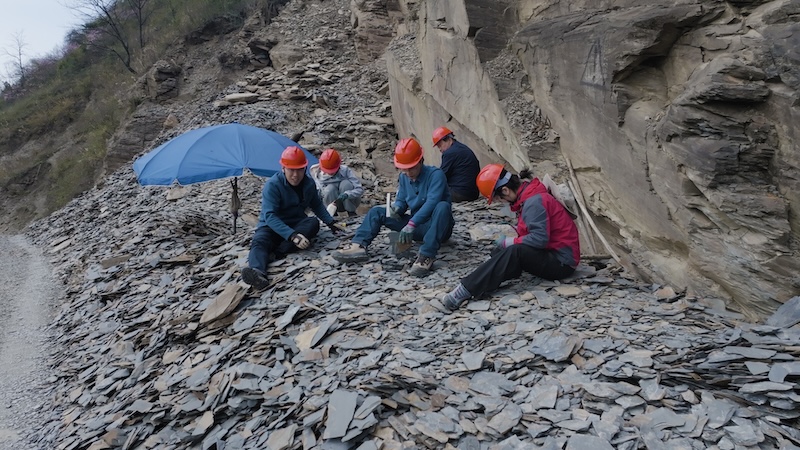 Scientists excavating Huayuan Biota fossils at the quarry in Huayuan County, in the Hunan Province of China. Image via Han Zeng/ Chinese Academy of Sciences. Used with permission.
Most fossils we’re familiar with are preserved hard parts of a body, such as bones, teeth and shells. In contrast, for soft-bodied fossils, organisms are rapidly preserved in low oxygen conditions, such as when buried in fine-grained aquatic sediment. As a result, the organism does not decay, allowing preservation of anatomical structures like soft tissue, muscle, the digestive system, and even the nervous system. Consequently, because of specialized conditions needed to preserve such fragile features, soft-bodied fossils are extremely rare.
Animals of the Huayuan Biota survived a major mass extinction
The scientists collected over 50,000 specimens overall, all from a single quarry. They were able to classify 8,681 specimens, most of them invertebrates. From those, they identified 153 animal species from 16 major groups or phyla. Notably, 91 specimens were new to science.
Interestingly, they noticed that their collection had a diverse mix of predators like arthropods, as well as prey such as sponges and pelagic tunicates (free-floating filter-feeding ocean animals). Not only did they live in deep water, they had a complex food web.
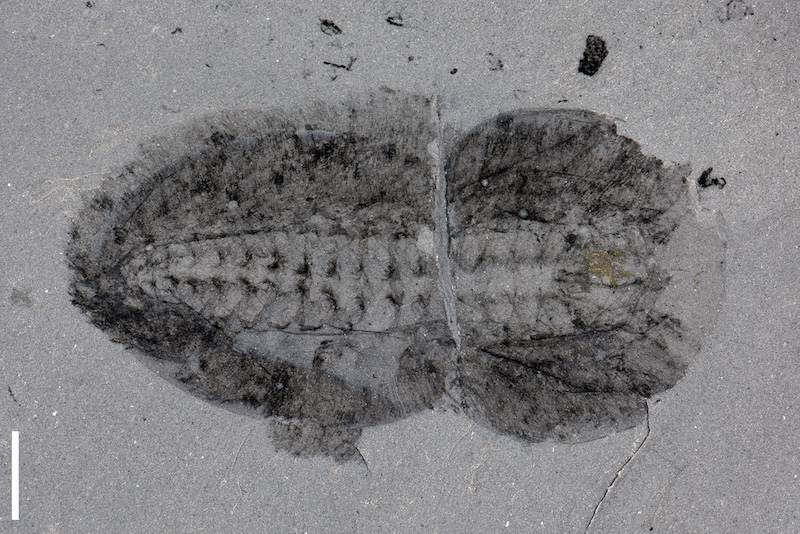 Naraoia, from the Huayuan Biota, is a soft-cuticled arthropod, preserved with its gills. The scale bar in the lower left is 5 millimeters long. Image via Han Zeng/ Chinese Academy of Sciences. Used with permission.
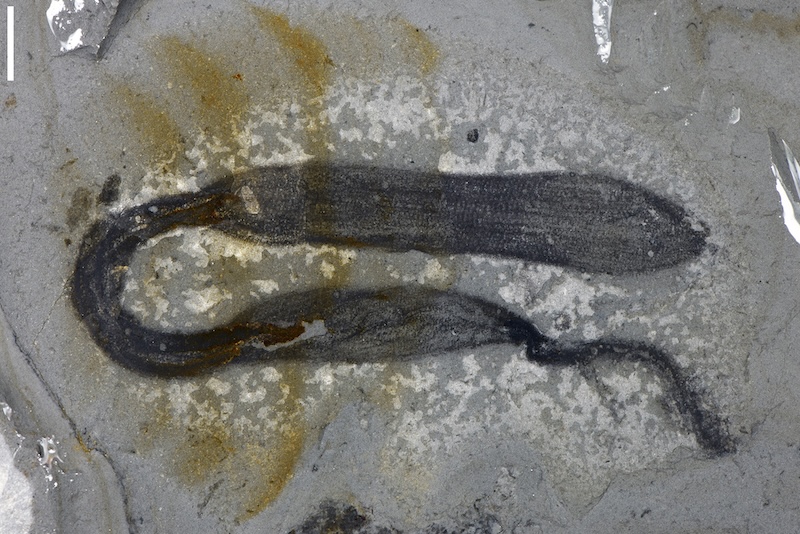 This creature from the Huayuan Biota is Leptomitus, a sponge with preserved organic matter. The scale bar on the upper left is 5 millimeters long. Image via Han Zeng/ Chinese Academy of Sciences. Used with permission.
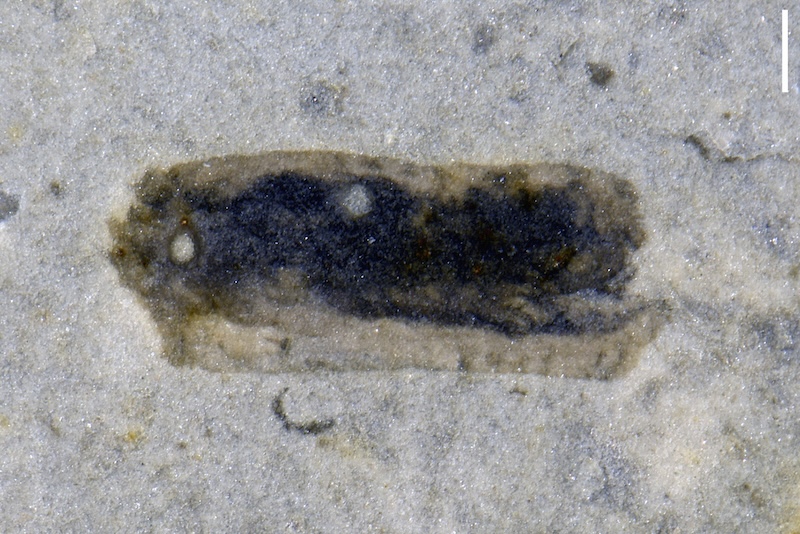 This animal from the Huayuan Biota is a pelagic tunicate. The inner dark coloration is preserved soft tissue. The scale bar at the upper right is 1 millimeter long. Image via Han Zeng/ Chinese Academy of Sciences. Used with permission.
Comparisons to other Cambrian soft-bodied fossils
Additionally, the researchers saw that some animals were similar to a famous collection of Cambrian Explosion soft-bodied fossils from the Burgess Shale, found in the Canadian Rockies of British Columbia. This suggests that some organisms dispersed across the ocean after the Sinsk Event, perhaps carried by ocean currents.
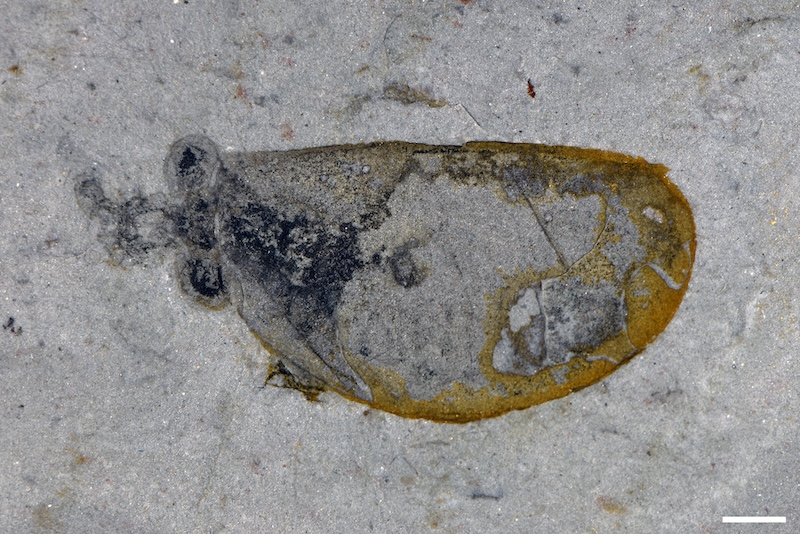 Surusicaris is a carapaced arthropod previously known from the Burgess Shale, that is also present in the Huayuan Biota. Preserved in this fossil are eyes and their optic nerve tissue. The scale bar at the bottom right is 2 millimeters long. Image via Han Zeng/ Chinese Academy of Sciences. Used with permission.
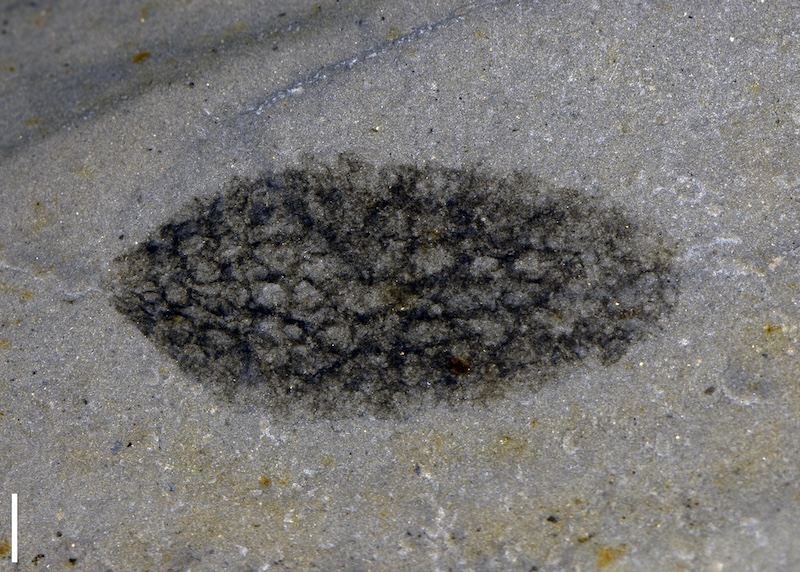 This unidentified pineapple-like fossil from the Huayuan Biota has soft tissue preserved in it. The scale bar at the bottom left is 2 millimeters long. Image via Han Zeng/ Chinese Academy of Sciences. Used with permission.
Also, the team compared other known Cambrian soft-bodied fossils with the Huayuan Biota. They found that marine organism communities before and after the mass extinction were organized differently. In addition, since the Huayuan Biota lived in deep water, perhaps organisms at greater depths in outer continental shelves were able to escape the extreme conditions brought by the Sinsk Event.
Bottom line: Scientists in China discovered pristinely preserved soft-bodied fossils of marine creatures that survived a major extinction event 513 million years ago.
Source: A Cambrian soft-bodied biota after the first Phanerozoic mass extinction
Via Chinese Academy of Sciences
Read more: Our teeth have strange origins in ancient fish
Shireen Gonzaga
View Articles
About the Author:
Shireen Gonzaga is a freelance writer who enjoys writing about natural history. She is also a technical editor at an astronomical observatory where she works on documentation for astronomers.