
What if the key to solving climate change is not just better technology, but better protection of it. Baniql’s green-nickel breakthrough cuts energy use by 80% – but their IP strategy is what is attracting investment.
The climate crisis is not just a source of doom and gloom. It also presents opportunities. In the Paris Agreement, the problem is set out with urgency and clear targets, such as deep cuts in greenhouse gas emissions and a quick transition to low-carbon systems. Those goals serve as a blueprint.
In this Innovating for Impact miniseries, we meet three small and medium-sized enterprises (SMEs) that are following that blueprint. All finalists in the WIPO Global Awards 2025, they demonstrate how innovation and IP strategy can work in lockstep to scale climate solution technologies into sustainable businesses. First up is Baniql, a green-nickel startup that can teach innovators about patent potential, joint-development agreements and more.
Energy-saving and near zero-waste nickel and cobalt extraction
Incorporated in San Jose, California, in 2021 before later expanding its operations to Indonesia, Baniql addresses a key challenge in the energy transition. Nickel and cobalt are vital ingredients in the lithium-ion batteries used to power our smartphones and electric vehicles. Demand is understandably high. So how do we extract enough of these materials for our needs without harming the environment?
Conventional methods, such as high-pressure acid leaching (HPAL) and smelting, are energy-intensive and highly polluting. Baniql’s answer? A novel low-acid, low-energy extraction process.
Willy Halim, Baniql co-founder and CEO, says the company’s technology uses about 80 percent less energy than traditional HPAL, running at up to 70 percent lower temperatures and avoiding HPAL’s extreme pressures. That means its equipment can be modular and much smaller.
“This allows us to deploy compact, scalable units directly at mine sites,” adds Baniql co-founder and COO, Eric Januar. “We don’t need the multibillion-dollar plants that conventional methods demand.”
Baniql
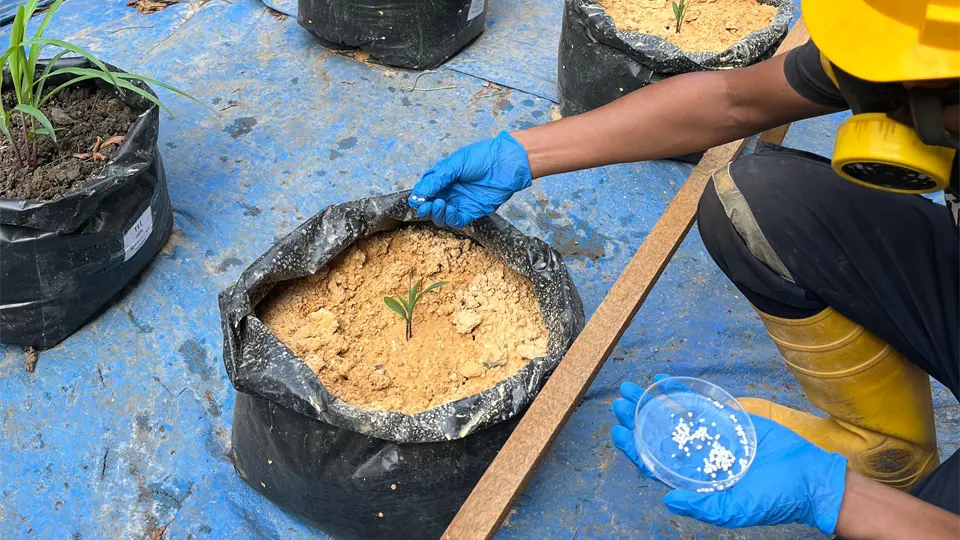
Baniql experiment converting solid by-product into neutral soil/fertilizer instead of toxic waste.
Baniql’s process generates “virtually zero waste”, according to co-founder and director, Seungwan Kim. By contrast, a standard HPAL operation produces roughly 98 percent of waste for every 2 percent of nickel recovered. Residue from Baniql’s process can be safely returned to the soil and even support plant growth on rehabilitated land.
Januar adds that the Baniql method cuts electricity use by about 98 percent and reduces fossil fuel consumption by more than 90 percent, compared with standard techniques. Baniql can also process ore that used to be considered too low-grade to be economical, while dramatically lowering toxic tailings and water contamination. The result, he says, is a cleaner, faster and more cost-effective way to mine these critical battery metals.
Balancing patents and trade secrets for novel nickel extraction process
With such technological potential catering to such high demand, how has Baniql used intellectual property (IP) to shore up its position? Simple. It built its business on it.
The company filed its first key patent application in 2022 for a new extraction process, followed by a second in 2024 for its green and selective chemistry. A third application is underway. These patent applications are to cover its unique chemical formulas, process parameters and modular reactor design.
Baniql began with filings in the United States and plans to use the Patent Cooperation Treaty (PCT) to seek protection in major mining markets, such as Australia, the Philippines, Europe and Indonesia.
Januar says the firm’s “business model and company value are rooted in our IP strategy” and that every patent application and decision about trade secrets is made to support Baniql’s growth. Some core know-how, such as the exact leaching agents and purification steps, remain confidential in-house.
“IP influences every major decision,” Halim says. “We prioritize research and development (R&D) projects with patent potential, and structure partnerships to protect our technology.”
For example, Baniql is not licensing its process yet. Instead, it is running internal pilots to validate the technology and gather performance data. According to Kim, this approach keeps the company in full control of its IP in these early stages, positioning it strongly for future scaling and partnerships.
Januar says the IP strategy has paid off. “Our patents were pivotal in securing a US$1.6 million seed round,” he reports, as investors recognized the technology’s value. Since 2021, Baniql has raised more than US$3 million, including a 2023 climate grant from the Temasek Foundation in Singapore.
Over the next five years, Baniql aims to partner with mining operators worldwide. The startup plans to license its technology, along with engineering support and possible performance-based royalties, to mining companies in Indonesia, the Philippines, Australia, Africa and Latin America.
Lessons for innovators
Much can be learned from the company’s approach to IP and technology. Above all: innovators should treat IP as a foundational investment, not an afterthought. By seeking protection for new technologies early, startups not only can prevent infringement but also bolster their credibility in the eyes of investors.
Baniql has woven IP into its business plan. The SME has sought patents for key parts of its extraction method while keeping certain catalyst formulas secret until licensing, while also tweaking its international filings to priority markets: mineral-rich countries.
Leveraging collaboration, too, has been an important part of Baniql’s business plan. By licensing technology, reaching joint-development agreements and joining patent pools, companies can avoid duplicating work and focus on their core strengths.
“Licensing our technology directly to established mining companies shows how a clear value proposition builds strong partnerships,” says Baniql director, Aristotle Vergara.
Baniql demonstrates that pairing innovation with strategic IP management can lead to real climate impact. Its story blends optimism with urgency – the team knows the clock is ticking. By protecting their ideas early, even small teams can make a big difference.
The company featured in this article was among the finalists of the WIPO Global Awards 2025. Selected from a record 780 applications across 95 countries, the 10 winners exemplify how IP can be used strategically to scale up solutions to some of the world’s greatest challenges.
The 2026 call for entries is open for applications until March 31.
The competition is seeking SMEs, startups and university spinouts that use IP to create value for their business.