
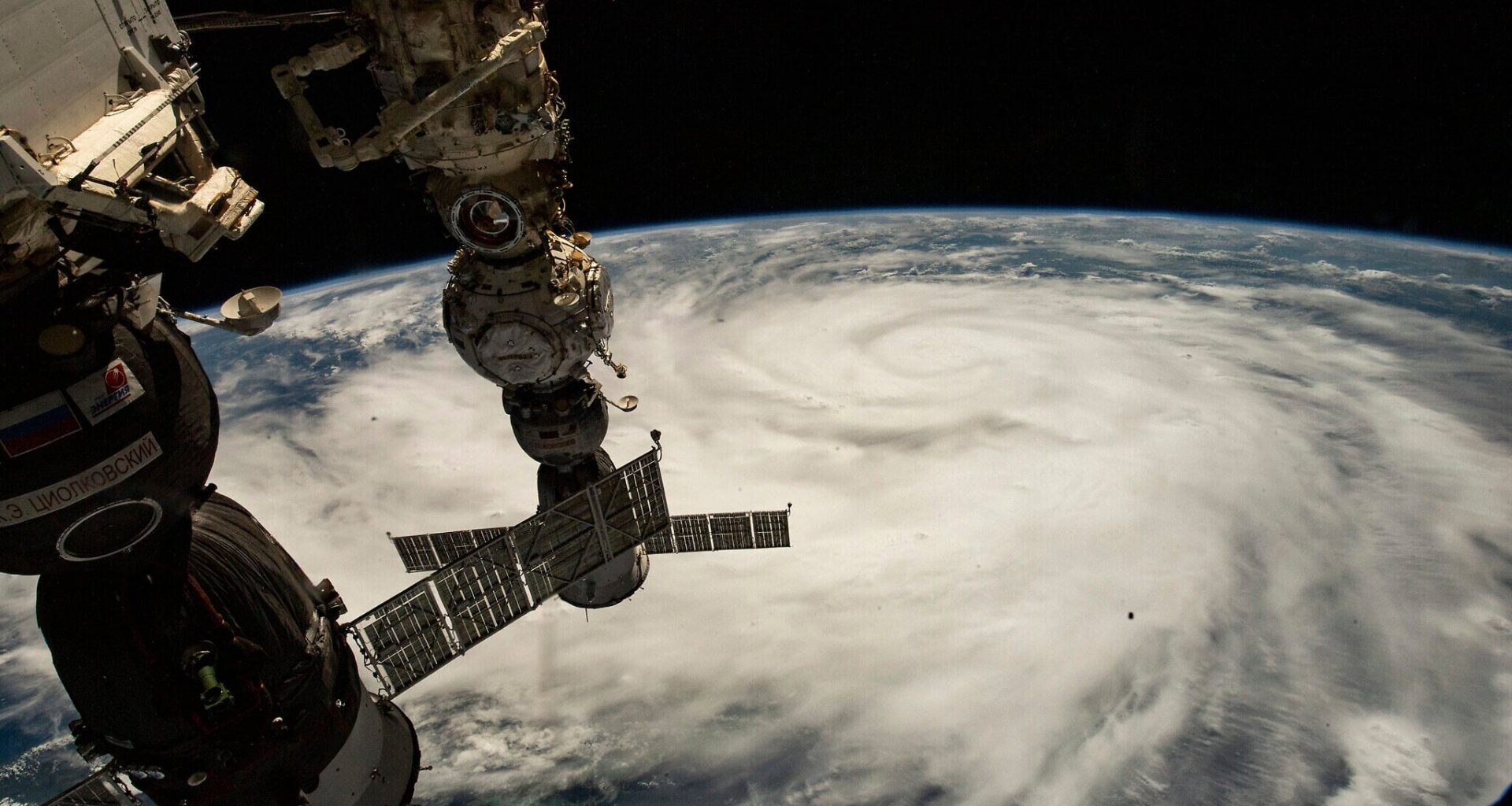
Israeli-founded Tomorrow.io, a weather intelligence platform, said Wednesday that it has secured $175 million in fresh capital to launch the next generation of weather-monitoring satellites into space to forecast where storm clouds are gathering as well as help businesses and countries manage fast-evolving climate threats.
The funding round, led by private equity firms Stonecourt Capital and HarbourVest, gives the company a valuation of over $1 billion. It takes Tomorrow.io’s total funding to more than $500 million.
Billing itself as the SpaceX of weather, Tomorrow.io’s bold endeavor is to tackle the decades-old challenge of getting weather forecasts right as extreme weather events are ranked as the top long-term risk, according to a survey by the World Economic Forum. In 2024, natural disasters wiped $320 billion from the global economy, with weather and climate change-related catastrophes, such as floods, wildfires, hurricanes, and tropical cyclones, responsible for 93% of overall damages.
Formerly known as ClimaCell, Tomorrow.io was founded in 2016 by Israeli Air Force veterans Shimon Elkabetz, Rei Goffer, and Itai Zlotnik. The three founders teamed up to develop weather forecasting intelligence software and observation solutions that go beyond traditional meteorological systems, and rely on a patchwork of ground-based radars and stations.
Speaking to The Times of Israel, Goffer said they soon realized that the availability and quality of existing public data to observe the planet are the main limiting factors for accurate weather forecasting, constraining emergency preparedness and disaster response.
Sign up for the Tech Israel Daily
and never miss Israel’s top tech stories
By signing up, you agree to the terms
“There are roughly 100 hurricanes or tropical cyclones a year globally and we still have a hard time forecasting both their trajectory and intensity,” said Goffer. “If you look at why, in most cases, it was because of a pretty rapid change in the structure of a storm that was missed because of gaps in existing meteorological observation data.”
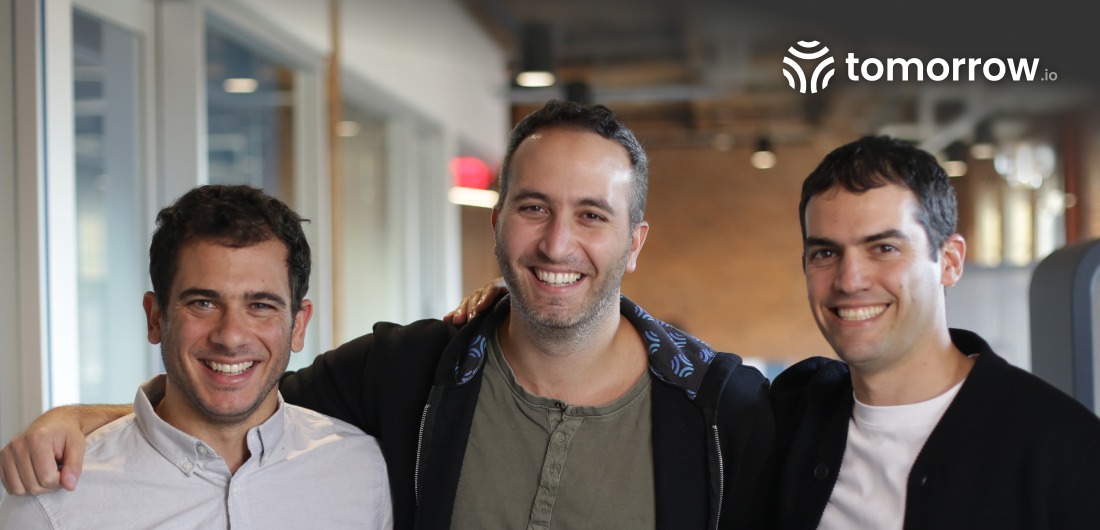
Tomorrow.io co-founders (from left to right): Rei Goffer, Shimon Elkabetz, and Itai Zlotnik. (Courtesy)
“Our goal is to eliminate those gaps and provide governments and organizations with an infinitely better ability to anticipate those rapid changes so that they can take timely decisions about whether or not to evacuate a full district in Thailand because of 600 millimeters of rain in the next 24 hours,” he noted.
The lack of timely and dense data prompted the three founders to develop their own satellite technology to improve observations and measurements of the current state of the atmosphere, especially in underserved regions such as India, the Philippines, and Africa.
“There are great advancements in AI-based weather forecasting models, but they are not useful if they rely on very limited amounts of data, driven by current observation and infrastructure,” said Goffer. “Our strategy has been to have data that have the highest impact on the forecasting models and are the most scarce today.”
The Boston-based firm said in January that it had completed the full deployment of its first commercial weather radar satellite constellation, having launched 13 satellites into space. Its technology, used by NASA and the US Air Force, employs AI to process satellite data for weather forecasting and to provide real-time precipitation data anywhere in the world.
“Our satellite constellation network covers the world every 60 minutes compared to roughly 3 to 5 hours by more traditional government-type meteorological agencies,” said Goffer. “We cover the entire global atmosphere: For any given point on Earth, three out of four times, the most recent scan of that point would come from Tomorrow.io.”
Goffer said that the size of the satellites range from a shoebox to a mini fridge, whereas government satellites are the size of a car or bigger, heavier, and more costly.
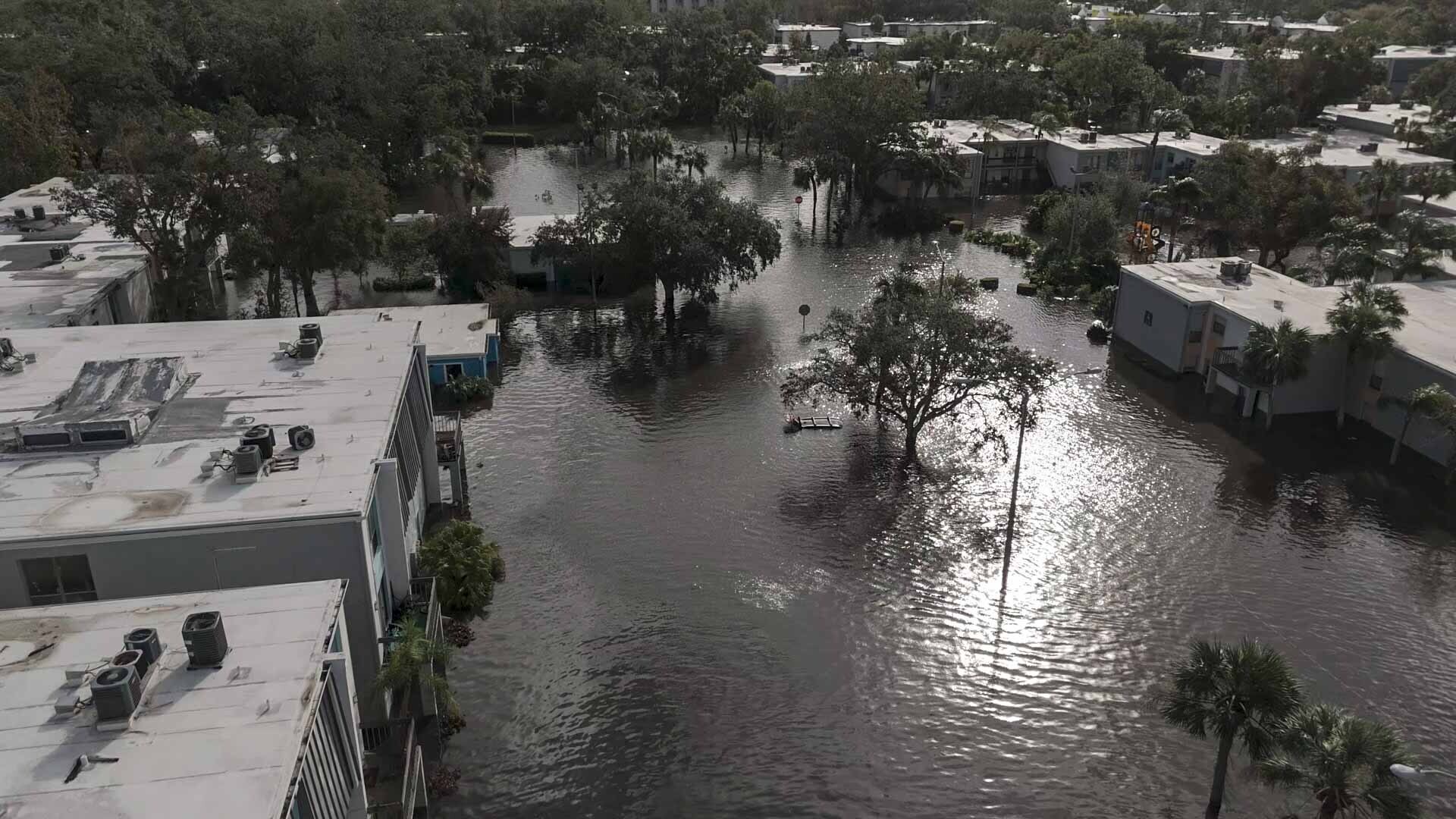
Floodwaters sit in an apartment complex where people are being rescued in the aftermath of Hurricane Milton, Thursday, October 10, 2024, in Clearwater, Florida. (AP Photo/Mike Stewart)
“What [Elon Musk’s] SpaceX did to space exploration, which is moving the center of gravity away from solely government-driven to private industry coming in, taking risks, innovating, and doing things that were considered impossible, such as reusable rockets that drove the launch price down by a factor of 10, we are doing the same thing for weather,” said Goffer. “We don’t want to replace the National Weather Agency, the same way that SpaceX is not replacing NASA.”
“We are here to partner and enable them to do their job infinitely better than they could have if they just kept doing business as usual,” he remarked.
Tomorrow.io’s satellite constellation already provides real-time atmospheric intelligence of the Earth’s surface to more than 250 enterprises and organizations across aviation, logistics, energy, insurance, and the public sector, including Uber, Delta, and JetBlue.
Goffer said that the freshly raised funds will be used to develop and launch DeepSky, a low Earth orbit constellation of satellites equipped with advanced sensors designed to make the atmosphere and oceans continuously observable in real time. The satellite infrastructure is designed to refine atmospheric forecasts by collating vast quantities of data needed to feed AI-native weather intelligence models.
“It is a quantum leap in every dimension, in terms of the size of the satellites, the types and capabilities of sensors, coverage in data-sparse regions, higher quality observations, and faster refresh cycles,” said Goffer. “We are not going to control the weather, but we will have infinitely better ability to predict it, especially those extreme events that are catastrophic.”
You appreciate our journalism

You clearly find our careful reporting valuable, in a time when facts are often distorted and news coverage often lacks context.
Your support is essential to continue our work. We want to continue delivering the professional journalism you value, even as the demands on our newsroom have grown dramatically since October 7.
So today, please consider joining our reader support group, The Times of Israel Community. For as little as $6 a month you’ll become our partners while enjoying The Times of Israel AD-FREE, as well as accessing exclusive content available only to Times of Israel Community members.
Thank you,
David Horovitz, Founding Editor of The Times of Israel