
Chicago-based Adtalem Global Education is again changing its name, this time to Covista, to reflect the for-profit company’s pivot toward health care education.
The company was previously called DeVry Education Group before changing its name to Adtalem in 2017. The company’s last name change followed years of scrutiny and government enforcement directed toward for-profit colleges.
In recent years, however, the company has shed many of its non-health-care-focused offerings, including by selling its well-known DeVry University in 2018.
The newly renamed company now has more than 97,000 students at its five health-care-focused institutions: American University of the Caribbean School of Medicine, Chamberlain University, Ross University School of Medicine, Ross University School of Veterinary Medicine and Walden University.
The new name “really reflects the business we’ve become,” said Steve Beard, chairman and CEO of Covista. “The composition, the mission and the focus of the business has changed radically.”
He said over the last four or five years, the company refocused on health care education to meet a continued need for more health care workers.
The National Center for Health Workforce Analysis has projected national shortages in 2038 of many types of health care workers, including nurses, physical therapists, dental hygienists and physicians, among others. Each month, more than 702,000 health care job vacancies are posted, but there are only 306,000 unemployed health care workers in the U.S., according to Covista.
Covista recently worked with Gallup to survey more than 1,300 health care clinicians and 160 health care executives across the country on the shortages. Of those surveyed, 76% of clinicians and 73% of health care executives said staffing shortages at least somewhat affect their ability to provide quality care.
“There is a not insignificant number of health care leaders and clinicians that believe that the workforce shortages are not just staffing challenges, but that they have resulted in the diminution in the quality of care offered to patients,” Beard said. “We think that’s an important issue to interject into the dialogue about the root causes of workforce shortages as well as the solutions to addressing them.”
Beard said the company plans to offer new programs and expand its geographic reach. Already, Covista’s institutions graduate about 10% of all new nurses in the U.S. each year, according to Covista.
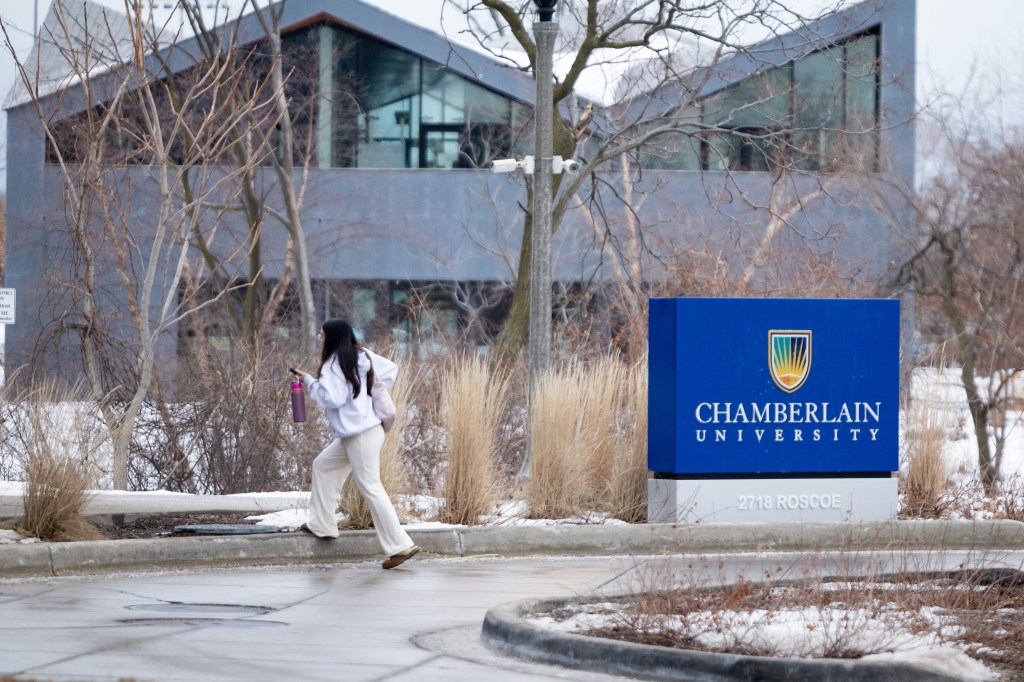
 Marisol Lagunas teaches a first-year pathophysiology class at Chamberlain University, Feb. 4, 2026, in Chicago. Adtalem Global Education is changing its name to Covista, which has five health-care-focused institutions, including Chamberlain University. (Josh Boland/Chicago Tribune)
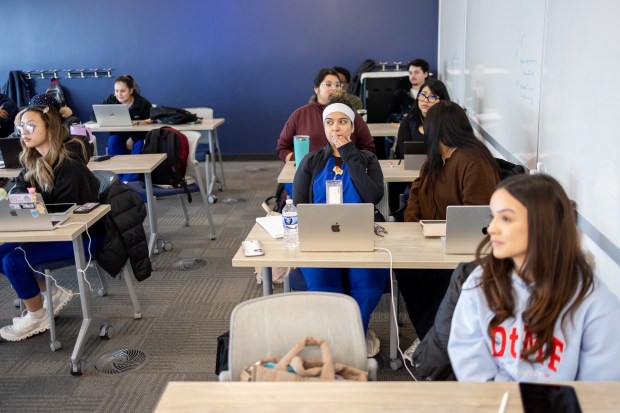 Students listen to Marisol Lagunas teach a first-year pathophysiology class at Chamberlain University, Feb. 4, 2026, in Chicago. (Josh Boland/Chicago Tribune)
The company’s headquarters will remain in the Willis Tower downtown. Covista also has a corporate office in Lisle and has Chamberlain University campuses in Chicago, Addison and Tinley Park. In all, Covista has 31 campuses across the country and internationally.
The company’s stock will start trading under the symbol CVSA on the New York Stock Exchange on Feb. 24.
The company’s last name change in 2017 came just months after DeVry University agreed to pay $100 million to settle a Federal Trade Commission lawsuit alleging it misled prospective students about their post-graduation job and income prospects. The company did not admit to wrongdoing as part of that settlement, and said at the time that the name change to Adtalem had nothing to do with the settlement.
Over the years, for-profit colleges have faced criticism, including during the administration of President Barack Obama, which targeted allegedly inflated job placement claims and predatory lending practices.
During those years, several for-profit college chains shuttered following government sanctions, including California-based Corinthian Colleges in 2015 and ITT Technical Institute in 2016.
Though the first Trump administration was friendlier to for-profit colleges, scrutiny of them has continued.
Earlier this week, Democratic Sen. Dick Durbin introduced legislation that would require all medical schools outside of the U.S. and Canada to meet the same minimum requirements in order to receive federal Title IV student aid money — namely that at least 60% of their enrollment be non-U.S. citizens and that students have at least a 75% pass rate on the U.S. Medical Licensing Examination.
In introducing the measure, Durbin’s office said in a news release that the legislation is needed to keep federal dollars from going to schools that saddle students with large amounts of debt while producing poor outcomes. His office said the median student loan debt is $409,518 at Covista’s American University of the Caribbean School of Medicine and $440,593 at Covista’s Ross University School of Medicine compared with a median debt of $215,000 at U.S. medical schools, citing data from the the Association of American Medical Colleges.
Meanwhile, his office said Caribbean-based medical schools have an average on-time completion rate of 44% compared with 82% to 84% for U.S. medical schools. Foreign-trained American graduates had a residency match rate of 67.8%, compared with 93.5% for graduates of U.S. allopathic medical schools and 92.6% for graduates of U.S. osteopathic medical schools in 2024, according to Durbin’s office.
“Medical schools in the Caribbean should not be able to rake in millions of dollars in U.S. federal student aid while skirting the same requirements that U.S.-based medical schools are bound to,” Durbin said in a news release.
When asked about the legislation, a Covista spokesperson said in a statement: “We’re focused on opening pathways to careers in health care and our graduates go on to serve where they’re needed most. We’re proud to graduate 24,000 health care professionals annually, more than any other U.S. institution, including twice as many MDs as any MD-granting school in the country. (Fifity-five percent) of our medical graduates are training in primary care shortage areas, and our medical students achieve a 95% first-time residency attainment rate.”
According to Covista’s recent survey, about 85% of health care executives said it makes no difference in hiring decisions whether a person’s degree comes from a for-profit or non-profit institution.
“We believe our programs compare favorably and oftentimes competitively to the outcomes you find at other institutions,” Beard said. He also said that traditional higher education institutions have “had their fair share of missteps.”
“I think you have some institutions that have made missteps and you have others that have not, and I don’t think the propensity to do so is driven by the tax status of either entity,” Beard said.
The Associated Press contributed to this story.