
 Credit: Isar Aerospace
German rocket builder Isar Aerospace has announced plans to expand its testing facilities at the Esrange Space Center in Sweden. The announcement comes as the company prepares for the second flight of its Spectrum rocket, currently expected no earlier than 19 March.
Isar Aerospace was founded in 2018 and is developing a 28-metre-tall rocket designed to deliver up to 1,000 kilograms to low Earth orbit. The company is conducting the rocket’s initial flights from Andøya Spaceport in Norway and has also secured a slot at the new multi-user commercial launch facility being developed by CNES at the Guiana Space Centre. To date, the company has raised over €400 million, excluding the €150 million secured through a convertible bond from Miami-based Eldridge Industries.
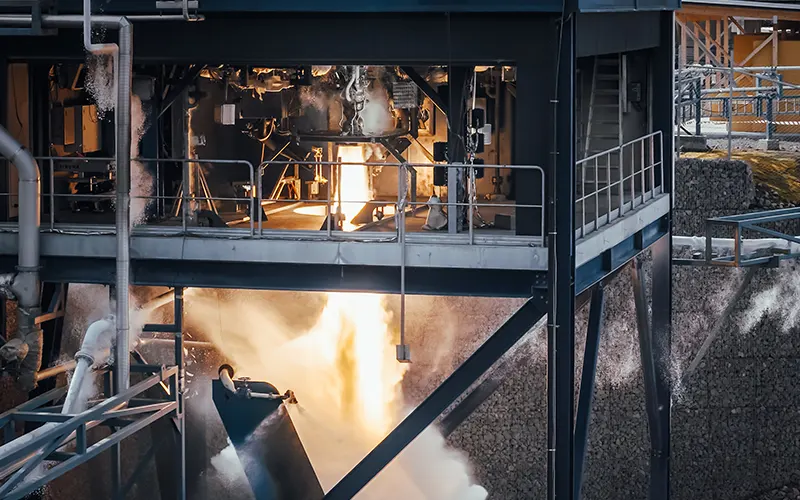
On 4 February, Isar Aerospace announced plans to expand its testing facilities at Esrange Space Center, located in northern Sweden near Kiruna. According to a press release, the new “purpose-built acceptance test facility” will enable the company to test more than 30 of its Aquila rocket engines per month. It will also allow for fully integrated stage acceptance testing.
“With our second test facility at Esrange, we are unlocking new capabilities and accelerating our progress. The expanded site will allow us to test and qualify more engines and stages than ever before, supporting our ambition to make space access truly scalable.”
Isar Aerospace declined to comment on the construction timeline for the new facility, including when work would begin or be completed. The company did confirm, however, that the new facility would operate alongside its existing testing infrastructure at Esrange.
Managed by SSC Space, the Esrange Space Center currently has two vertical test stands, known as VTS-1 and VTS-2. The first is utilized by Rocket Factory Augsburg to test its Helix engines, which power both the first and second stages of the company’s RFA ONE rocket. VTS-2 is assigned to Isar Aerospace for testing the company’s Aquila rocket engines, which the company has utilized since 2019.
In addition to its testing facilities, the space center has hosted suborbital rocket launches since the 1960s. In January 2023, SSC Space inaugurated a new orbital launch facility. While the new facility has yet to host a launch, US-based launch provider Firefly Aerospace and South Korean launch provider Perigee Aerospace have both signed agreements to launch their respective rockets from the facility.
Onward and Upward
Isar Aerospace launched an inaugural flight of its Spectrum rocket in March 2025, with the flight ultimately ending with the rocket crashing into the Norwegian Sea less than a minute after lifting off.
In December 2025, the company announced it had successfully completed hot-fire tests of both rocket stages for its second flight and was preparing to move forward with a launch in late January 2026. However, during preparations for the launch on 21 January, the company encountered a “pressurization valve issue,” forcing it to push the flight to March.
According to Isar Aerospace CEO Daniel Metzler, the company’s goal for its second flight is to “demonstrate real progress.”
“Our goal with this mission is to demonstrate real progress, and to achieve that, we will once again push our systems to their limits,” said Metzler. “We are ready to proceed within the next available launch window.”
In addition to preparing for the rocket’s second flight, Isar Aerospace announced on 16 January that the rockets for flights three to seven were already in production. To support the ramp-up of its production capacity, the company is opening a new 40,000-square-metre manufacturing facility near Munich. According to the company’s 4 February update, the facility is “nearing completion, with interior fit-out works underway.” Once complete, the facility will have the capacity to produce more than 30 Spectrum rockets per year.
Keep European Spaceflight Independent
Your donation will help European Spaceflight to continue digging into the stories others miss. Every euro keeps our reporting alive.