
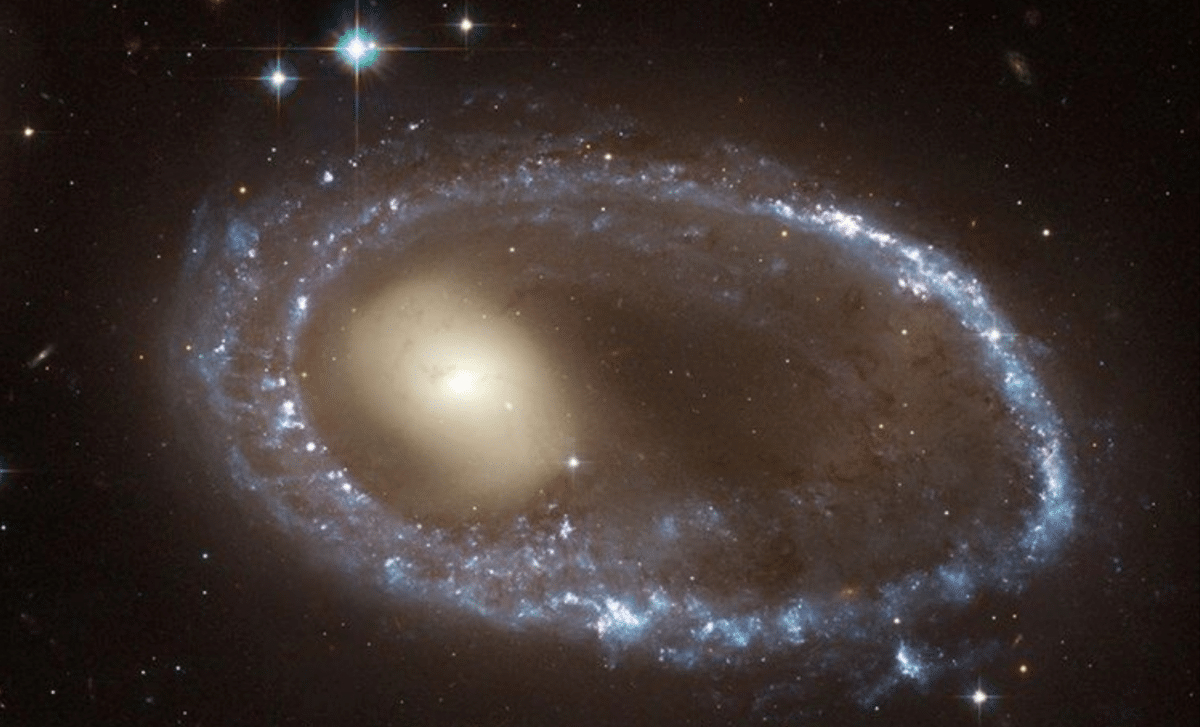
An international team of astronomers, led by Weichen Wang of the University of Milan, Italy, discovered a massive and unusually quiescent galaxy, aptly named the “Red Potato.” Observed with the advanced capabilities of the James Webb Space Telescope (JWST), this galaxy is located in a gas-rich region of the universe, within a cosmic web node at a redshift of approximately 3.25. The study has unveiled intriguing features about the Red Potato, including its surprising lack of active star formation, despite being situated in an environment abundant with cool gas that typically promotes galaxy growth.
Discovery of a Massive, Quiescent Galaxy
The Red Potato, or MQN01 J004131.9-493704, is a massive galaxy with a stellar mass of 110 billion solar masses. Its half-light radius spans about 3,260 light years, which makes it a formidable cosmic entity. However, despite its massive size, it shows very low levels of star formation, which is atypical for a galaxy of its scale. The galaxy’s star formation rate (SFR) is recorded at just 4.0 solar masses per year, a rate that is at least one order of magnitude lower than the expected star-forming main sequence (SFMS) for galaxies in such a region. As noted by the researchers,
“In this work, we present the discovery of a massive quiescent galaxy in a gas-rich environment of a cosmic web node or protocluster at z ∼ 3.2, identified and spectroscopically confirmed from a JWST program.”
This paradox, being massive yet quiescent, has prompted scientists to probe the factors preventing this galaxy from forming stars as efficiently as others in similar environments.
The galaxy’s lack of active star formation despite being located in a gas-rich environment suggests a different kind of evolutionary path. Normally, galaxies located in such regions, known as protoclusters or cosmic web nodes, host substantial amounts of cool and molecular gas, which serves as fuel for star formation. However, the Red Potato defies these expectations, offering a unique glimpse into the complex processes that govern galaxy evolution in the early universe.
Lack of Molecular Gas: An Unexpected Finding
One of the most significant and surprising findings of this study, published on January 28 on the arXiv pre-print, serveris the Red Potato’s apparent scarcity of molecular gas. Using JWST’s sophisticated Near Infrared Camera (NIRCam) and Near Infrared Spectrograph (NIRSpec), the team was able to determine that the galaxy’s molecular gas mass is less than 7 billion solar masses. This represents a small molecular gas fraction of less than 0.06, which is notably low for such a massive galaxy. Furthermore, the team found no detectable carbon monoxide (CO) or sodium D-lines, both of which are typically present in galaxies that are rich in molecular and neutral gas. The absence of these key indicators suggests that the galaxy has either exhausted its gas supply or is unable to efficiently accrete new gas into its system.
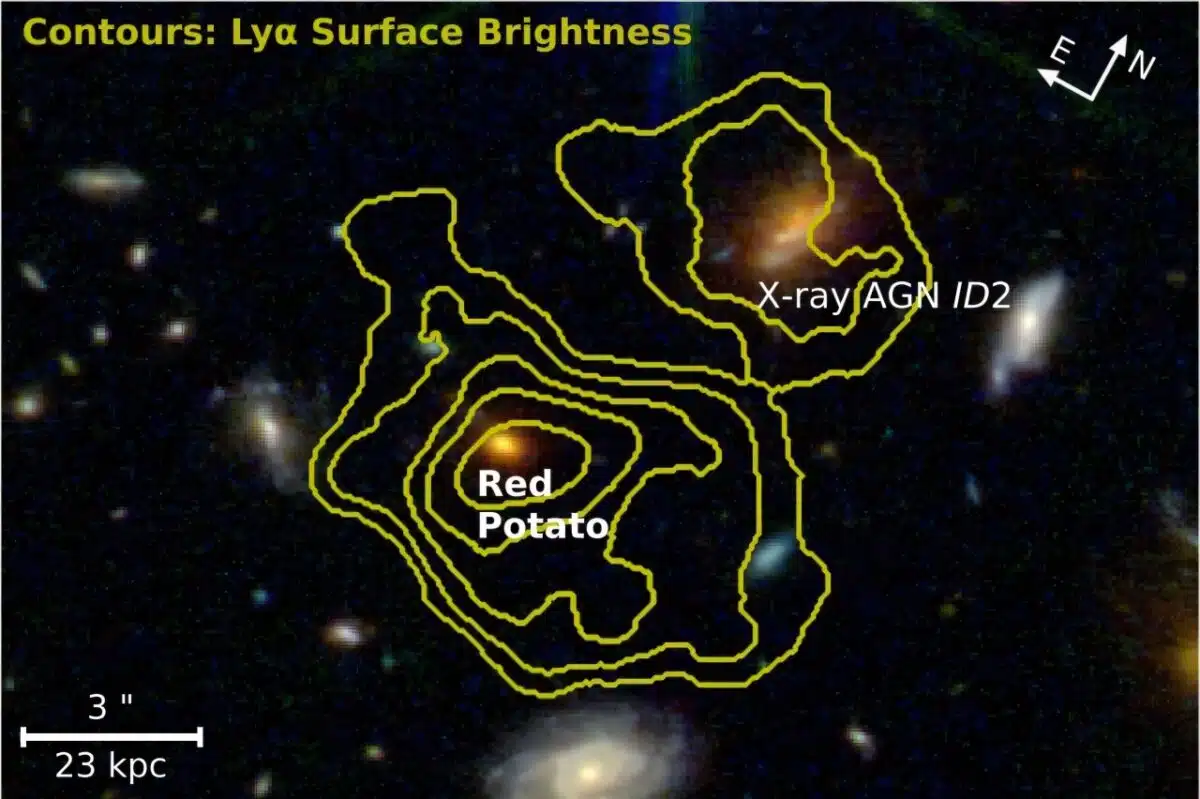 Galaxy MQN01 J004131.9-493704 “Red Potato” at z=3.25 and its surrounding cool Lyα-emitting gas reservoir. Credit: arXiv (2026). DOI: 10.48550/arxiv.2601.20473
This lack of gas may be one of the reasons why the Red Potato has a star formation rate that is so much lower than its peers. The researchers suspect that external factors may be inhibiting the galaxy’s ability to accrete gas from the surrounding cosmic environment, preventing it from feeding the ongoing formation of stars.
The Role of X-ray Jets in Regulating Gas Accretion
Another important aspect of the study is the discovery of an X-ray jet that seems to be emanating from a neighboring active galactic nucleus (AGN). The presence of this jet is not just an intriguing feature in itself; it may also play a crucial role in regulating the gas environment surrounding the Red Potato. The X-ray jet is thought to contribute to turbulence in the circumgalactic medium (CGM) of the galaxy, a crucial region of gas surrounding the galaxy where material is often accreted.
The interaction between the AGN’s X-ray jet and the CGM likely disturbs the natural flow of gas into the galaxy, reducing its ability to accumulate the fuel necessary for star formation. This phenomenon is a form of feedback, where the energy and material expelled by the AGN prevent the surrounding gas from entering the galaxy, thus inhibiting its growth. The elevated gas velocity dispersion, observed through the galaxy’s Lyα and Hα line profiles, is a key signature of this turbulent gas environment.
A Rare and Fascinating Case in Galaxy Evolution
The discovery of the Red Potato provides valuable insights into the complexities of galaxy formation and evolution in the early universe. Located at a redshift of approximately 3.25, this galaxy is part of a critical era in cosmic history when galaxies were forming and evolving rapidly. However, the Red Potato challenges some long-standing assumptions about how galaxies grow. Despite being in a region rich with gas, it has somehow become quiescent, possibly due to external factors such as feedback from an AGN. This case raises important questions about the balance of forces that determine a galaxy’s growth, from gas accretion to feedback mechanisms.
The study, which was made possible through the advanced capabilities of the JWST, is a crucial step in understanding the interplay of gas, stars, and feedback processes in the formation of massive galaxies. As astronomers continue to observe and analyze similar objects, they will be able to refine their models of how galaxies evolve, particularly in the early universe when conditions were very different from today.