
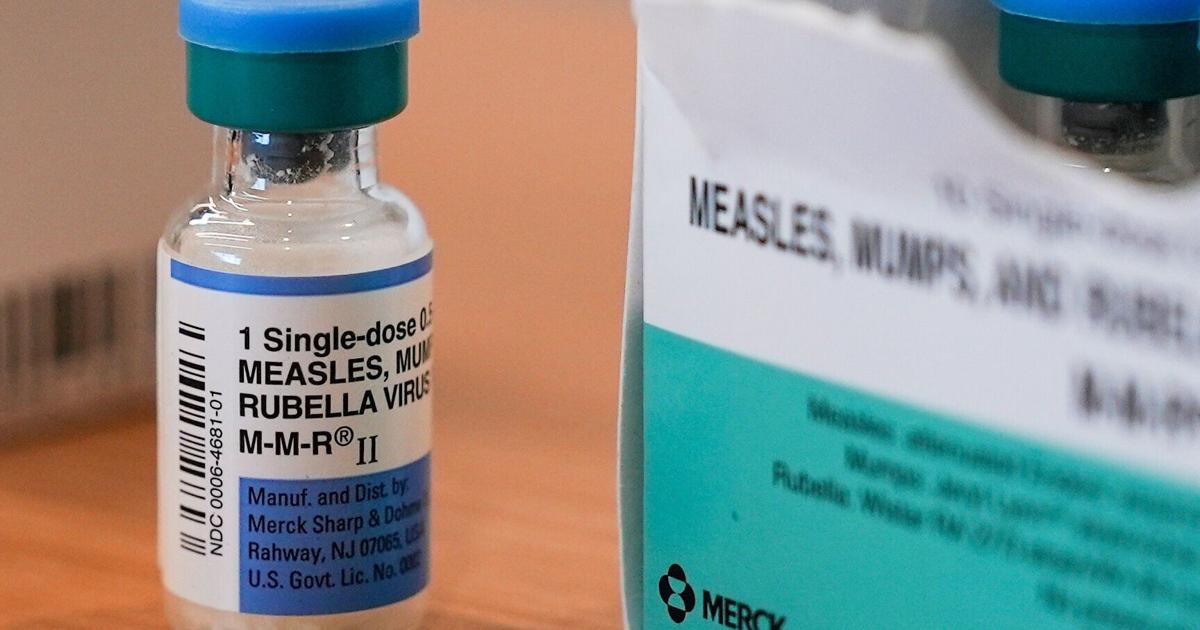
Health officials confirmed a second measles case in Wisconsin earlier this week — this time in Madison — and one local expert says there’s a reason to be concerned but clear ways to stay safe and healthy.
The Cap Times spoke with Dr. Joseph McBride, an infectious disease specialist at UW Health, after public health officials reported a University of Wisconsin-Madison student contracted measles, likely through international travel, and potentially exposed people on campus.
That report on Monday followed the Jan. 26 news of a case of measles in Waukesha County.
“These two new cases that we’ve had in the state do not seem to be linked with one another, and that’s good because that shows that there’s not necessarily an outbreak,” McBride said. “However, it’s also bad, because that shows that there’s a lot of measles that’s out there, and these cases will continue to increase.”
What is measles?
Measles is an incredibly contagious respiratory virus that is spread through airborne particles, McBride explained.
That means if someone has measles and coughs, sneezes, sings or even breathes, those germs can be spread to others.
What makes measles particularly dangerous is that the various particles can stay in the air for up to two hours after leaving the body of the person infected. So even if you weren’t in direct contact with someone who has measles, you could still catch it by entering a room they were previously in, McBride explained.
Symptoms
Measles has a standard incubation period of 7-21 days. Most people will start to become symptomatic somewhere around Day 10 to 14.
Initial symptoms of measles are somewhat generic and can include things like a cough, fever and runny nose.
“People feel like they’ve got a cold,” McBride said.
Symptoms will show up before the standard measles rash will appear, and unfortunately that means someone could be transmitting the virus to others before they realize it’s measles.
The head-to-toe rash is the telltale sign of measles.
“An old rule of thumb that you’ll read in old medical journals is that if you see a kid with a bad rash, and you smile at them, and they smile back, it’s probably not measles, because measles makes people feel awful,” McBride said.
The viral infection is far more dangerous than a standard cold and about one-quarter of people who get measles end up hospitalized.
“Then there’s a lot of other secondary problems that happen with measles, too. One is that there can be secondary bacterial infections that set up in the lungs, around the skin, and that could be really devastating to people,” McBride said.
Measles also can affect people’s heart, nerves and their brain and can result in long-term conditions.
Who is protected?
The good news is that most people are vaccinated against the virus as part of standard childhood injections for measles, mumps and rubella, or MMR. This includes about 95% of UW-Madison on-campus students, according to university officials, and about 95% of school-age children in Dane County.
If you have received the MMR vaccine as a child — typically required to attend public school without a waiver — you have about a 97% protection against catching measles and if you do catch it, your symptoms will be less severe.
If you have had a confirmed case of measles before, you are also considered immune because of the viruses’ antibodies. People who were born before 1957 are also considered immune because this was before the vaccine was developed in 1963 and measles was far more common.
How to stay safe and healthy
The easiest way to stay protected is to make sure you have received the MMR vaccine, McBride said. If you don’t have the documentation of the vaccine or a confirmed previous case, doctors can test your blood for antibodies.
“There are some people, of course, who can’t get the measles, mumps and rubella vaccine, or the MMR, based on maybe their immune system or different medication that they’re on,” McBride said. “These people are at risk, and it can be really challenging for people to know what their protection level is in these situations.”
The MMR vaccine is a live vaccine. This means developers have minimized the risk of the vaccine to a level that will create antibodies without causing a severe case of the infection itself.
In this case, by a healthy person receiving the vaccine, they can help avoid transmitting the infection to an immunocompromised person who isn’t able to get the vaccine.
McBride said these new Wisconsin cases serve as a wake-up call for doctors to make more of a point to advocate for vaccinations with patients.
Last year, the U.S. Centers for Disease Control and Prevention confirmed 2,267 cases of measles, the most since 1991. Last month alone, the CDC confirmed 588 cases.

Health and Human Services Secretary Robert F. Kennedy Jr. arrives for the “Take Back Your Health” Tour event at the Tennessee state Capitol on Wednesday.
GEORGE WALKER IV / AP PHOTO
South Carolina saw the largest outbreak in recent history, confirming more than 800 cases since October.
“These handfuls of cases that we’re seeing across the country is a sign and a constant reminder that it is out there and we need to protect ourselves,” McBride said. “It’s also a sign that we as a medical community have gotten complacent about our vaccines and how much we need to really act and reassure and demonstrate the importance of this to our public.”
That job has become extra challenging with the shifting federal stance on the safety and efficacy of vaccines, McBride said, referring to Health and Human Services Secretary Robert F. Kennedy Jr.’s history of questioning vaccines and falsely linking them to autism.
“It’s quite clear that the federal government has made vaccines not a priority on current public health interventions,” McBride said. “I think we have to do as much as we can to really describe the benefits of these things to people. The best way to do that is by having conversations face to face and saying ‘Hey, as your physician, as your nurse, my only interest is keeping you out of the hospital and keeping you healthy,’ and that takes time and energy and patience and substituting maybe external recommendations with face to face interaction.”
Vaccination resources
The Madison Metropolitan School District, in partnership with Public Health Madison & Dane County and local health care providers, will host a free measles, mumps and rubella vaccination clinic Saturday, Feb. 7. The clinic will run from 10 a.m. to 2 p.m. at Holtzman Learning Center, 333 Holtzman Road. The free vaccination clinic is open to people ages 5 and older. To help ensure adequate staffing and vaccine availability, families are encouraged to make appointments through PHMDC’s website.
Residents can find out more about vaccine availability by contacting Public Health Madison & Dane County or by calling their primary care doctor.