
Most of my Israeli friends are unaware of the political storm their president is currently causing in Australia. They are understandably preoccupied with other things: cleaning bomb shelters ahead of a possible war with Iran, for instance. Australia is very, very far away. And yet in Australia, the fact that Israeli President Isaac Herzog is due next week for an official visit has certainly not gone unnoticed.
Greens senator David Shoebridge opined:
“It’s hard to express just how disgraceful the government’s invitation of Israel’s president Herzog is. They know it will inflame community divisions… We’ve seen the photo of President Herzog signing bombs that were sent into Gaza. He’s accused by a UN commission of inquiry of inciting genocide.”
Labor veteran MP Ed Husic similarly said:
“I find it hard to reconcile the images I’ve seen of him signing bombs that were then dropped on Palestinian homes… I am concerned that a figure like that doesn’t necessarily advance social cohesion.”
These statements are useful for several reasons. They are representative of the standard position of the Australian left; from parliament to protests in the streets of major cities, the furore over Herzog’s visit is difficult to overstate. They also encapsulate many of the misleading and defamatory claims levelled against Israel. Together, they form a case study in the double standards, selective outrage, and fundamental misreading of reality that characterize the anti-Israel movement. And they are easily debunked.
The first claim that can be dismissed is the pretence that opposition to Herzog’s visit is driven by concern for “community division” or “social cohesion.” This language serves mainly to cloak a political position in the guise of civic responsibility. It is worth asking where this concern for cohesion was when, for nearly two years, tens of thousands of protesters shut down central Sydney and Melbourne on a weekly basis, many calling for intifada and wearing terrorist insignia. Discomfort with Herzog’s visit is not about community harmony. It maps almost perfectly onto attitudes toward Israel, and critics should drop their concerned posturing and admit it.
Equally apparent is the double standard applied to Herzog. Since October 2023, Australia has hosted several senior foreign leaders. In 2024, Chinese Premier Li Qiang visited Canberra, representing a repressive autocracy that systematically suppresses minorities and detains millions of Muslims in “re-education” camps. That same year, Chinese Foreign Minister Wang Yi was welcomed. In late 2025, Indonesian President Prabowo Subianto—leader of a country where homosexuality is illegal and mandatory hijab laws are widespread—was also warmly received.
In none of these cases did Shoebridge feel compelled to denounce the visits in the Senate. This is not a peripheral observation, nor is it mere “whataboutism.” The selective application of moral outrage is central to how Israel is discussed and must be acknowledged if the debate is to be honest.
The near-obsessive focus on a photograph of Herzog signing an artillery shell further illustrates a deeper problem. The West, and the Anglosphere in particular, has so lost touch with the realities of war that it judges Israel’s wartime behavior by peacetime sensibilities. Herzog’s autographed shell is presented as evidence of a supposedly sick society infatuated with violence, when in fact it reflects a longstanding wartime practice. Allied leaders signed weaponry during World War II; American politicians did so during the Vietnam War; and more recently, President Volodymyr Zelensky signed artillery used in the Ukraine-Russia conflict.
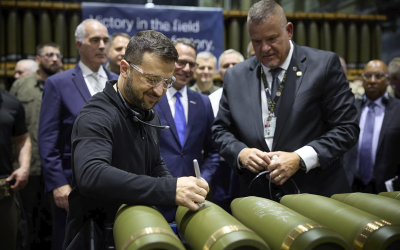
2024, Volodymyr Zelensky signs a bomb, Image courtesy of Press Service of the President of Ukraine
From the comfort of Australia, this tradition may appear crude or lacking in grace. That reaction is understandable. But it is not evidence of moral depravity. Australians should be cautious about judging the morale-boosting gestures of a democracy that has had to mobilize hundreds of thousands of reservists to fight what it understands to be an existential war.
Critics should be similarly cautious when invoking a UN commission of inquiry that claims Herzog demonstrated “intent” to kill Gazan civilians. I will not engage here with the commission’s conclusion that Israel has committed genocide, nor with what that conclusion suggests about the credibility of international institutions. (Those interested should read the rebuttal to this report by the non-profit UN Watch) What matters is how Herzog’s words are presented.
The quote most often cited was delivered at a press conference one week after October 7—one week after massacres, sexual violence, and the public parading and beating of hostages through Gaza’s streets:
“It’s an entire nation out there that is responsible. It is not true, this rhetoric about civilians who were not aware and not involved. It is absolutely not true.”
What critics routinely omit are Herzog’s other statements at the same press conference, in which he explicitly affirmed the protection of civilians and adherence to the laws of war:
“The IDF uses all means at its disposal in order to reduce the harm to the population… locating the enemy separately from the civilian population, evacuating civilians from combat zones, warning civilians, and monitoring the humanitarian situation.”
When challenged by a journalist, Herzog clarified further:
“No, I didn’t say that. I want to make it clear. I was asked about separating civilians from Hamas… If you have a missile in your goddamn kitchen and you want to shoot it at me, am I allowed to defend myself?”
Whether this selective quotation reflects cynical bad faith or an ingrained reflex to interpret anything Israel-related in the worst possible light is open to debate. Either way, it degrades public discourse and should be roundly repudiated.
In the immediate aftermath of the Bondi terror attack, many Australians were quick to post that they “stand with the Jewish community.” President Herzog, the figurehead of the Jewish state, is due to arrive next week to do precisely that. The fact that, in a matter of weeks, a solidarity visit could be reframed as an endorsement of genocide speaks volumes about the sinister effectiveness of the anti-Israel narrative. For Australian Jews still reeling from the attack, it is a sobering reminder of how quickly expressions of solidarity can evaporate.
My professional background is as a musician: I spent years playing with the Israel Philharmonic, and I currently perform with the Israeli Opera as a violinist. This experience has given me deep familiarity with Israel’s musical landscape and close connections throughout the cultural community. Alongside my work as a musician, I maintain a long-standing passion for writing. On my Substack, While Rome Burns, I publish essays and vignettes about daily Israeli life, with a focus on music and culture.